


Vehicle emergency lights are specialized signaling devices mounted on vehicles to warn other road users, protect workers, and satisfy provincial safety regulations. LED warning lights now dominate the market because they draw less current, last longer, and produce more visible output than halogen alternatives. Canadian professionals and DIY installers face a layered compliance picture: federal motor vehicle safety standards set the floor, while each province adds its own color, class, and mounting rules on top. Getting this right protects you from fines, liability, and the far worse outcome of an accident caused by inadequate warning.
What are the main types of vehicle emergency lights?
Emergency warning lights fall into four core categories, and choosing the wrong type for your application is one of the most common and costly mistakes in fleet upfitting.
Light bars mount on the roof or cab and provide 360-degree coverage. Full-size bars suit fire apparatus, police, and tow trucks that need maximum visibility from all directions. Compact mini bars work well on utility trucks, pilot cars, and snow removal equipment where profile matters.
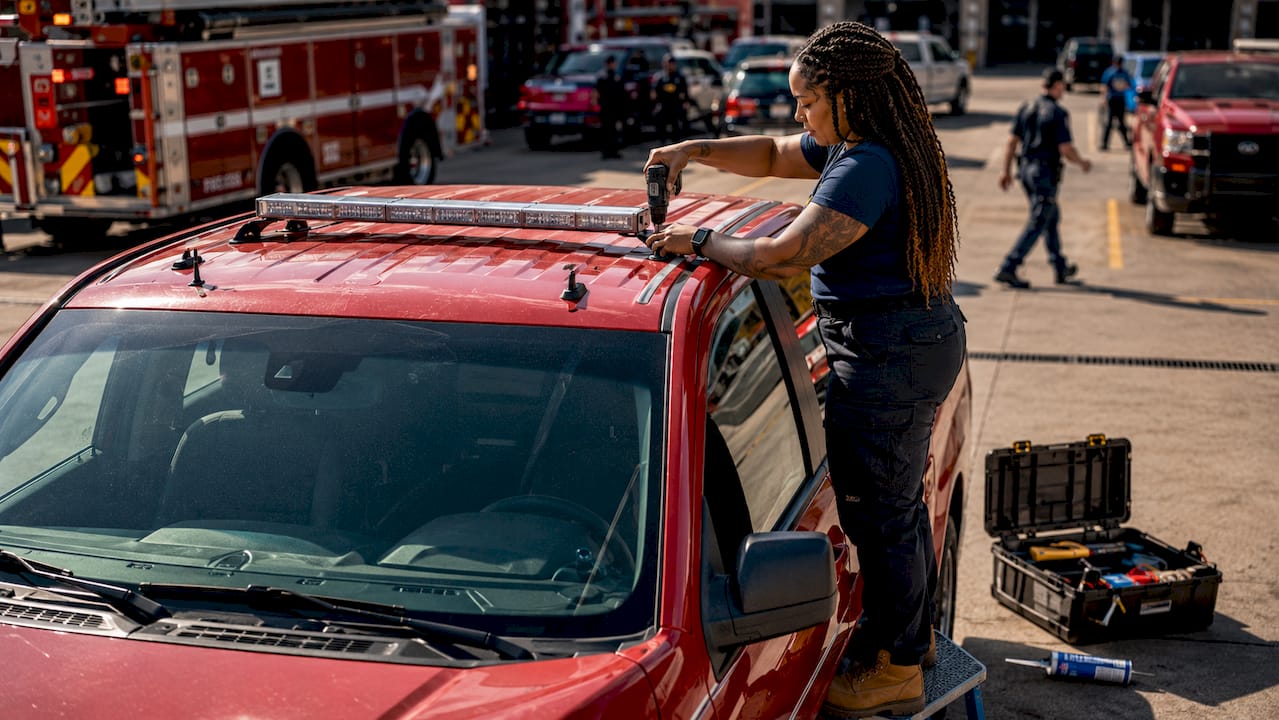
Beacons are single-point rotating or LED strobe units. They are the standard choice for construction equipment, forklifts, and slow-moving service vehicles. An amber LED beacon is the most widely accepted option across Canadian provinces for non-emergency caution use.
Surface mount and hideaway lights install flush into grilles, bumpers, or body panels. These are popular on tow trucks and roadside assistance vehicles where a low-profile warning system is needed without a permanent roof fixture.
Scene lights use wide-beam LED technology with IP68/IP69K ingress ratings for water and dust protection. Their aluminum housings and vibration resistance make them reliable in rough terrain and harsh weather, which is exactly what Canadian winters demand.
| Light type | Best application | Typical color |
|---|---|---|
| Full-size light bar | Fire, police, tow trucks | Red, blue, amber |
| Mini light bar | Utility, pilot cars, snow removal | Amber |
| Beacon | Construction, slow-moving equipment | Amber |
| Surface mount / hideaway | Roadside assistance, grille warning | Amber, white |
| Scene light | Work area illumination | White |
LED technology has replaced halogen across nearly every category. LEDs produce more lumens per watt, run cooler, and carry service lives measured in tens of thousands of hours versus a few hundred for halogen bulbs. For a detailed LED vs. halogen comparison, the performance gap is significant enough that halogen is rarely the right choice for a new build.
Flash patterns also matter for compliance and communication. Quad-flash, split-flash, and wig-wag patterns each carry different urgency signals. Many controllers let you store multiple patterns and switch between them, which is useful when a vehicle serves more than one role.
What are the legal and regulatory standards for emergency lighting in Canada?
Canadian compliance for vehicle emergency lighting is not a single national standard. It is a patchwork of provincial rules layered on top of SAE International’s technical benchmarks.
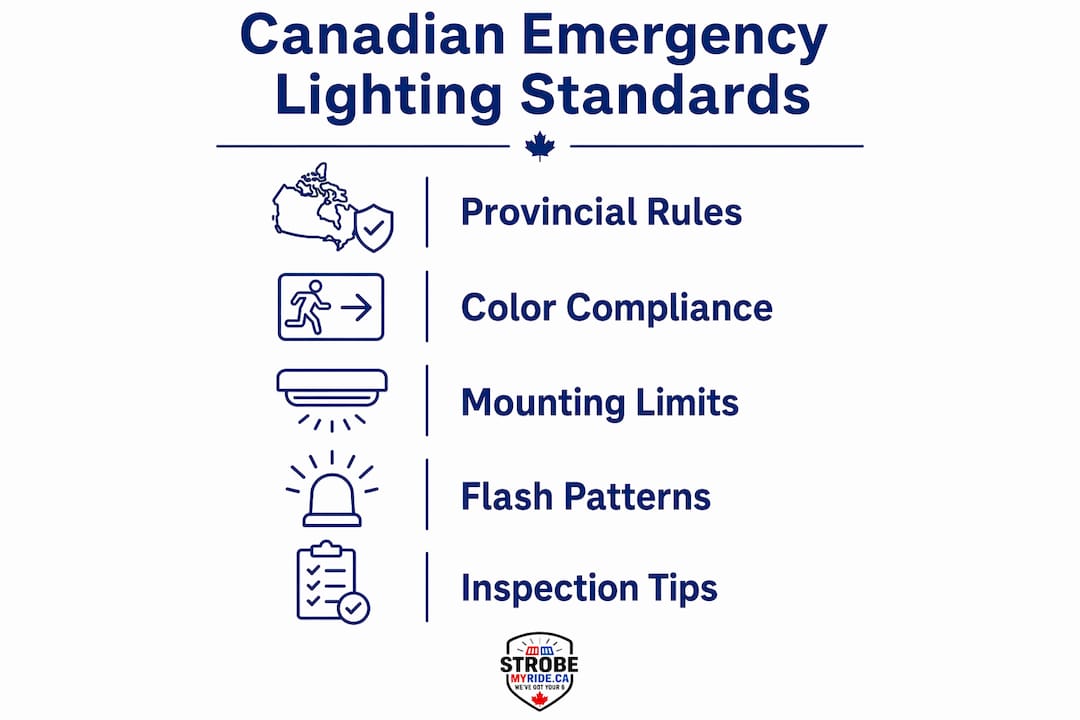
SAE J-Series standards define the performance parameters that matter most: minimum output intensity, beam spread, and color purity. SAE J845 specifically governs 360-degree warning devices and sets the minimum candela output required for a light to qualify as a legal warning device. Meeting SAE J845 is not optional for most professional applications. It is the baseline that provincial enforcement officers check.
Color rules vary sharply by province, and this is where most compliance failures happen.
- Amber is accepted across virtually all Canadian provinces for service fleets, construction, tow trucks, and slow-moving vehicles.
- Blue is restricted to law enforcement in most provinces. Saskatchewan and Alberta permit blue for certain non-police uses, but verification with the provincial authority is required before installation.
- Green is permitted in Quebec and some other provinces for volunteer firefighters and incident commanders.
- Red is generally reserved for fire apparatus and ambulances.
Unauthorized use of red, blue, or green lighting can result in vehicle stops, fines, and civil liability. The risk is not theoretical. Officers actively look for non-compliant lighting on commercial vehicles during roadside inspections.
Quebec permits amber and green lights for specific roles. Saskatchewan and Alberta permit amber and blue under defined conditions. Provincial color rules differ enough that a lighting setup legal in one province may draw a fine in the next.
| Province | Amber | Blue | Green | Red |
|---|---|---|---|---|
| Ontario | Yes | Police only | Volunteer fire | Fire/EMS |
| Quebec | Yes | Police only | Yes (incident command) | Fire/EMS |
| Alberta | Yes | Limited non-police | No | Fire/EMS |
| Saskatchewan | Yes | Limited non-police | No | Fire/EMS |
| British Columbia | Yes | Police only | Volunteer fire | Fire/EMS |
Mounting location and flash rate also fall under provincial jurisdiction. Most provinces prohibit forward-facing red or blue lights on non-emergency vehicles regardless of intensity. Always confirm current rules with your provincial transport authority before purchasing.
Pro Tip: If your vehicle crosses provincial borders regularly, build your lighting system around amber. It is the one color that travels cleanly across Canada without triggering compliance issues.
How to properly install vehicle emergency lights for safety and durability
Installation quality determines whether your lighting system works reliably for years or fails at the worst possible moment. The electrical side is where most problems start.
Electrical installation best practices
- Disconnect the negative battery terminal before touching any wiring. This eliminates the risk of shorts during installation.
- Use a fuse and relay rated for 10–15 amps on any system drawing over 36 watts. Direct battery wiring without fusing is a fire risk, not a shortcut.
- Ground to bare metal, not to existing ground points that may already carry load. A dedicated ground run to the chassis is the correct approach.
- Use OEM upfitter switches when your vehicle has them. These factory-designed power control points reduce the risk of overloading the vehicle’s electrical system with aftermarket loads.
- Run wiring through grommeted holes in firewalls and body panels. Bare wire edges against metal will chafe through insulation over time.
Mechanical mounting
The ABS backer plate method is the best drill-free option for grille-mounted lights. It sandwiches the light between the grille mesh using ABS plastic plates secured with stainless steel bolts. The light is secure, the grille is undamaged, and the whole assembly removes cleanly for lease returns or vehicle resale.
For permanent roof or cab mounts, use stainless steel hardware and apply a butyl sealant around any penetration point. Water intrusion through mounting holes is a leading cause of corrosion damage inside cab roofs.
Pro Tip: Pre-program all light heads on a test bench before the vehicle goes into service. Synchronizing flash patterns in a controlled environment prevents erratic or conflicting signals after installation, and it saves significant diagnostic time later.
Weatherproofing is not optional in Canada. Apply dielectric grease to every electrical connector before seating it. Use heat-shrink tubing with adhesive lining on all splices. These two steps address the primary failure modes for emergency lighting in cold, wet, and salt-heavy environments.
How to maintain and troubleshoot vehicle emergency lighting systems
A lighting system that fails during an actual emergency or roadside operation is worse than no system at all. Scheduled maintenance prevents most failures before they happen.
Routine maintenance tasks
- Clean lens covers monthly with a non-abrasive cloth. Road grime and salt film reduce effective output significantly, especially on forward-facing warning lights.
- Inspect all connectors quarterly for signs of corrosion, green oxidation, or loose seating. Connectors are the most common failure point in any vehicle electrical system.
- Verify flash patterns after any wiring work or controller replacement. Patterns can reset to factory defaults when power is interrupted.
- Check mounting hardware for loosening caused by vibration. Stainless steel fasteners resist corrosion, but they still need periodic torque checks on high-vibration vehicles.
Common failure points and troubleshooting
Intermittent flashing is almost always a connection problem. Start at the controller output terminals, then work toward the light heads. A loose ground is the single most common cause. Moisture and corrosion cause the majority of electrical failures in vehicle emergency lighting over time, particularly in Canadian climates where road salt accelerates galvanic corrosion.
Total failure after a wet season usually points to water ingress at a connector or a corroded ground path. Pull each connector, clean with electrical contact cleaner, apply fresh dielectric grease, and reseat firmly. If the system still fails, test continuity from the fuse block to each light head individually.
Wiring fatigue shows up as intermittent failure that correlates with vehicle movement or vibration. Flex points near doors, hoods, and body seams are where insulation cracks first. Inspect these areas visually and replace any wire showing cracked or brittle insulation.
Pro Tip: Before winter, apply a corrosion inhibitor spray to all exposed connectors and mounting hardware. Canadian road salt is aggressive, and a five-minute seasonal treatment prevents hours of troubleshooting in february.
Seasonal checks matter more in Canada than in most markets. Spring inspections should focus on salt damage from the winter. Fall inspections should confirm all seals and weatherproofing are intact before freeze-thaw cycles begin.
Key Takeaways
Compliant, durable vehicle emergency lighting requires matching light type and color to your specific use case, meeting SAE J-Series standards, and protecting every electrical connection against moisture and corrosion.
| Point | Details |
|---|---|
| Color compliance is provincial | Amber travels across all Canadian provinces; blue, green, and red require province-specific verification. |
| SAE J845 sets the performance floor | Any 360-degree warning device must meet minimum candela output to qualify as a legal warning device. |
| Pre-program before installation | Synchronize flash patterns on a test bench to prevent signal conflicts after the vehicle enters service. |
| Fuse and relay every circuit | Systems over 36 watts need a properly rated fuse and relay to prevent electrical fires. |
| Moisture is the primary failure mode | Dielectric grease and heat-shrink tubing on every connection extend system life significantly in Canadian conditions. |
What I’ve learned after years of watching installs go wrong
The most expensive mistake I see repeatedly is buying lights based on looks and price, then discovering post-installation that the color or flash pattern is not legal for the vehicle class or province. Specification has to come before selection. That means knowing your province’s rules, your vehicle classification, and your use case before you open a product page.
The second pattern I see is underestimating the electrical side. A light that costs $80 can cause $800 in damage if it is wired without proper fusing. The relay and fuse are not optional accessories. They are the difference between a system that works for five years and one that starts a fire in the first month.
DIY installation is absolutely viable for most surface mount and grille applications. The professional emergency lights that Canadian fleets rely on are designed with straightforward wiring in mind. What separates a good DIY install from a bad one is preparation: read the wiring diagram, pre-program the controller, and weatherproof every connection before the vehicle leaves the shop.
The technology side is genuinely improving. Controllers are getting smarter, with programmable scene modes and CAN bus integration on newer fleet vehicles. But the fundamentals do not change. Correct color, correct output, correct installation, and consistent maintenance. Those four things determine whether your lighting system does its job when it matters.
— Kerry
Professional-grade emergency lighting, built for Canadian conditions
Strobemyride supplies LED warning lights, light bars, beacons, and controllers designed specifically for Canadian fleets, emergency services, and DIY upfitters. Every product is selected for compliance with SAE standards and durability in harsh Canadian environments, from coastal salt air to prairie cold snaps.
The catalog covers everything from compact amber LED mini light bars for service trucks to full-size light bars, high-output LED search lights, and plug-and-play controllers. Expert support is available to help you match the right product to your vehicle class and provincial requirements. Fast Canadian shipping means your build does not sit waiting. Browse the full range at Strobemyride and get your vehicle upfitted correctly the first time.
FAQ
What color emergency lights are legal across all Canadian provinces?
Amber is the one color accepted for non-emergency warning use across virtually all Canadian provinces. Red, blue, and green carry strict restrictions that vary by province and vehicle class.
What is SAE J845 and why does it matter?
SAE J845 is the SAE International standard governing 360-degree warning devices. It sets minimum output intensity and beam spread requirements that a light must meet to qualify as a legal warning device in professional applications.
Do I need a relay for LED emergency lights?
Any system drawing over 36 watts requires a fuse and relay rated for 10–15 amps. Wiring directly to the battery without fusing creates a fire risk and can damage the vehicle’s electrical system.
Can I install emergency lights without drilling?
The ABS backer plate method allows drill-free grille mounting using ABS plastic plates and stainless steel bolts. This approach is secure, removable, and leaves the vehicle undamaged for resale or lease return.
How often should I inspect my vehicle’s emergency lighting system?
Inspect connectors and mounting hardware quarterly, and perform a full seasonal check before winter and after spring thaw. Canadian road salt accelerates corrosion, making regular inspection more critical than in milder climates.
Recommended
- Emergency Vehicle Lighting: A Complete Guide to Safety and Compliance | Strobe My Ride – Strobe My Ride
- Fleet Lighting Compliance Guide for Canada | Strobe My Ride – Strobe My Ride
- Emergency Lighting News & Guides | Strobe My Ride Canada
- Emergency Warning Lights for Tow Trucks & Roadside Service Vehicles in Canada | Strobe My Ride – Strobe My Ride


