
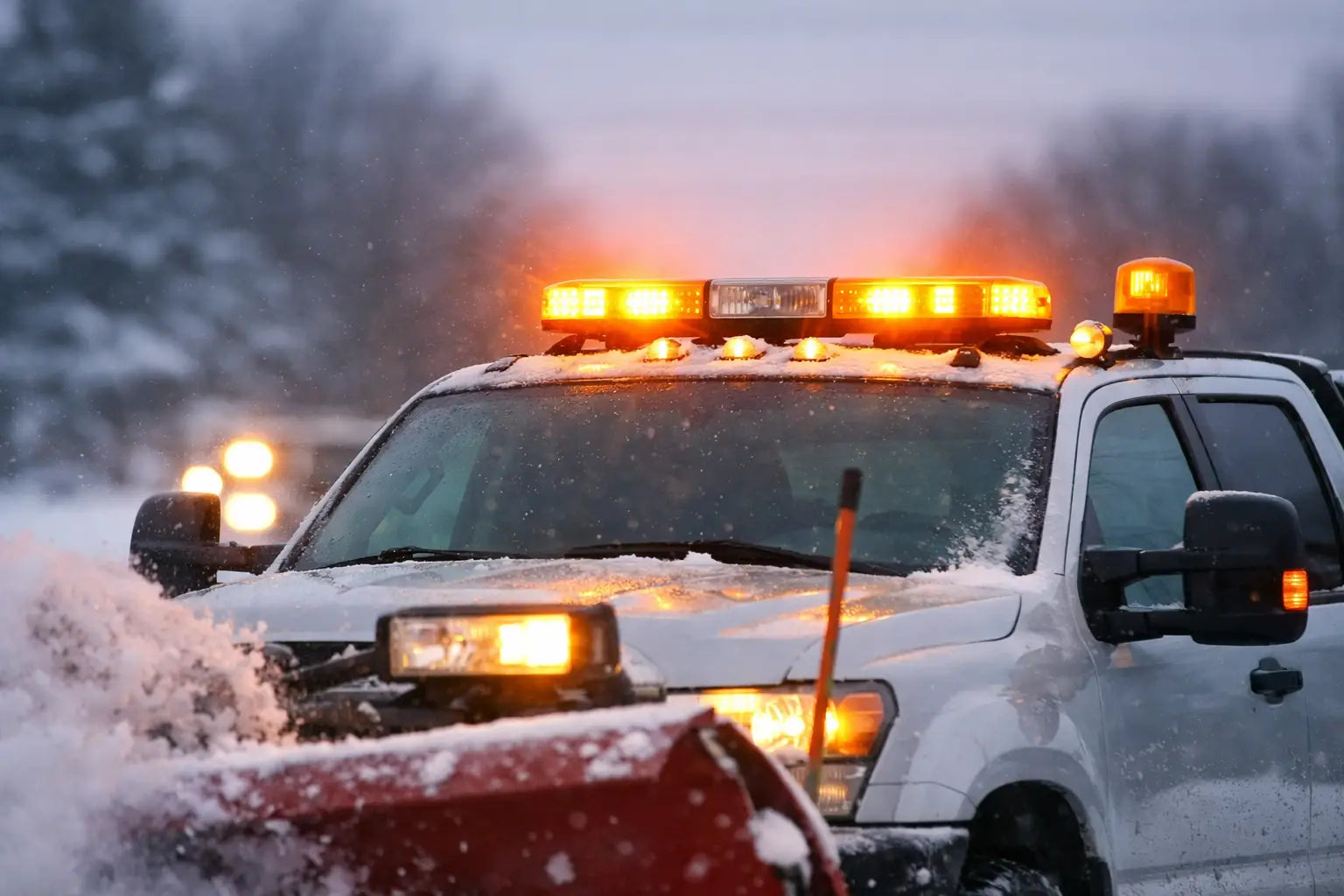
At 4:30 a.m., with snow blowing sideways and a wing kicking up a white cloud beside the truck, nobody cares how cheap your warning lights were. They care whether oncoming traffic saw you in time. That is why choosing the best snow plow warning lights is not about looks, and it is not about grabbing the first beacon you find online. It is about visibility, durability, legal compliance, and keeping operators safe when conditions are at their worst.
Snow plow trucks work in the exact conditions that expose weak lighting fast. Salt gets into connectors. Ice builds on housings. Vibration shakes apart bargain mounts. Whiteout glare can wash out lights that look bright in a warehouse but disappear on a live roadside. If you are buying for a municipal fleet, a contractor, or a single plow truck that has to earn through every storm, you need gear built for real work.
What makes the best snow plow warning lights?
Brightness matters, but brightness alone is not the full story. A good snow plow warning setup has to stay visible through snowfall, road spray, and the reflection coming off the blade and the snowpack. That usually means combining more than one style of light rather than relying on a single beacon to do everything.
SAE class rating is one of the first things to check. For active snow and roadside duty, Class 1 output is usually the right place to start because it is built for higher-intensity warning applications. If you are buying for municipal or commercial fleet use, this is not the place to save a few dollars on off-brand lights with vague specs and no real compliance backing.
Flash pattern also matters more than many buyers think. In clear weather, aggressive multi-pattern flashes can help grab attention. In heavy snow, though, some patterns create too much visual clutter or bounce excessive glare off nearby surfaces. A clean, decisive warning pattern often performs better than a chaotic one.
Then there is build quality. Polycarbonate lenses, sealed electronics, solid mounting hardware, proper weatherproof connectors, and proven cold-weather reliability are what separate professional gear from novelty lighting. If a light cannot survive a Canadian winter on a plow route, it is not a deal. It is downtime.
The main light types for plow trucks
The best setup depends on the truck, blade configuration, route type, and whether the vehicle spends more time plowing open roads, parking lots, urban streets, or highway shoulders. There is no single perfect light for every application.
Rotating or LED beacons
A beacon is the classic starting point. For many plow operators, a permanent or magnetic beacon mounted high on the roof gives 360-degree warning coverage with a simple install. On smaller trucks or seasonal units, that can be enough for basic visibility.
The trade-off is coverage versus blockage. Roof beacons mounted behind a light rack, salt spreader controls, or other equipment can lose visibility from certain angles. Snow buildup can also reduce output if the lens shape holds slush. A beacon works best when it is mounted high, clean, and unobstructed.
Mini light bars and full-size light bars
For serious plow work, mini bars and full-size light bars are often the stronger choice. They offer a broader warning signature, more LED heads, better off-axis visibility, and often improved day and night performance compared with a single beacon.
A mini bar suits many contractor pickups and 1-ton plow trucks well. A full-size bar makes more sense on larger municipal units, highway service trucks, and trucks that operate in higher-speed environments where earlier detection matters. Bigger is not always better, though. If the bar is too tall, mounted poorly, or blocked by equipment, you can lose some of the advantage.
Surface mounts and hideaways
Surface mount LEDs are one of the smartest additions to a plow truck because they fill in blind angles that a roof light cannot cover well. Mounted at the grille, rear, headache rack, or body corners, they help the truck stay visible when the plow blade, spreader, or box body blocks part of the main warning light.
Hideaways can work too, but they depend heavily on headlight and taillight housing design. Some modern housings do not play nicely with generic hideaway installs, and output can vary. For fleets that want repeatable results and easier servicing, surface mounts are often the safer call.
Traffic advisors and rear warning
Rear visibility is where a lot of plow setups come up short. That is a problem because plow trucks spend plenty of time backing, turning, salting, and operating partly in-lane. A rear traffic advisor or strong rear-facing warning package can make a major difference, especially on shoulder work, lot work, and urban routes.
If your truck regularly stops or crawls in traffic, rear warning should be treated as essential, not optional.
Best snow plow warning lights by use case
If you run half-ton or 3-quarter-ton contractor pickups, a roof-mounted mini bar paired with grille or rear surface mounts is usually the sweet spot. It gives strong all-around warning without overbuilding the truck or eating the budget.
If you manage municipal plow trucks, heavier spec equipment makes more sense. Full-size light bars, dedicated rear warning, and additional perimeter lighting help maintain visibility around larger bodies, wider plow setups, and more complex work zones. These trucks are out for long shifts and repeated storms, so service life matters as much as output.
If the vehicle works highways or higher-speed regional roads, prioritise long-range visibility and rear warning performance. Drivers need to identify the truck early, not when they are already on top of it. That usually points to Class 1 bars with strong rear modules and supplemental warning at eye level for approaching traffic.
For parking lot and private site work, the setup can be slightly more compact, but do not cheap out just because speeds are lower. Tight spaces, reversing, pedestrian traffic, and poor weather still create risk. A clean roof light plus rear and side warning is money well spent.
Mounting matters more than buyers think
A premium light mounted in the wrong spot can perform worse than a decent light mounted properly. Height helps. Clear line of sight helps more. The goal is to keep warning output visible above the snow plume, around the plow assembly, and past anything else bolted onto the truck.
Front warning can be affected by the plow blade itself, especially when raised. That is why many operators use supplemental grille or windshield-level lighting to maintain forward visibility. On the rear, spreaders, tailgates, and box bodies can block low-mounted lights. Higher rear placement often improves performance.
Wiring also matters. Sloppy installs cause failures, corrosion, and intermittent operation right when the truck needs to be dependable. Proper connectors, fused circuits, loom protection, and switch placement all pay off over a full season.
How to avoid buying the wrong lights
The fastest way to waste money is buying based on price alone. Cheap imported lights often advertise huge flash counts and inflated brightness claims, but the real test is whether they survive cold starts, vibration, salt, and back-to-back storms. Many do not.
Another common mistake is underbuilding the warning package. One beacon on a busy plow truck may technically give some warning, but it may not give enough warning in dense snowfall, urban traffic, or angled roadside work. A better approach is to build a system - roof warning for 360 coverage, targeted front and rear modules for blocked angles, and patterns that stay readable in bad weather.
Buyers also get tripped up by ignoring compliance and application fit. Not every flashy aftermarket light belongs on a work truck. Professional buyers should be looking for real specs, real ratings, and products meant for fleet use. That is where a specialist supplier has an edge. Strobe My Ride focuses on professional-grade lighting built for roadside and municipal duty, not Amazon junk dressed up with big claims.
What Canadian buyers should prioritise
For EN-CA fleets and contractors, winter performance is only part of the equation. You also want Canadian stock, predictable shipping, and support from people who understand the job. Waiting on cross-border orders during snow season is a great way to sideline a truck when it should be making money or clearing roads.
Warranty matters too, but so does the kind of company standing behind it. A no-BS warranty is worth more than a long warranty from a seller who disappears when there is a problem. When your truck is down, you need answers fast.
If you are buying for multiple units, standardising your warning setup can also save time in the shop. Common mounts, common controllers, and repeatable wiring layouts make maintenance easier and keep parts inventory simpler.
The best snow plow warning lights are the ones that stay visible when the weather turns ugly, keep working after a month of salt and vibration, and fit the way the truck actually operates. Start with the job, not the catalogue. Build around real coverage, real durability, and real compliance. When the next storm hits before dawn, that is what keeps your crew seen and your trucks moving.