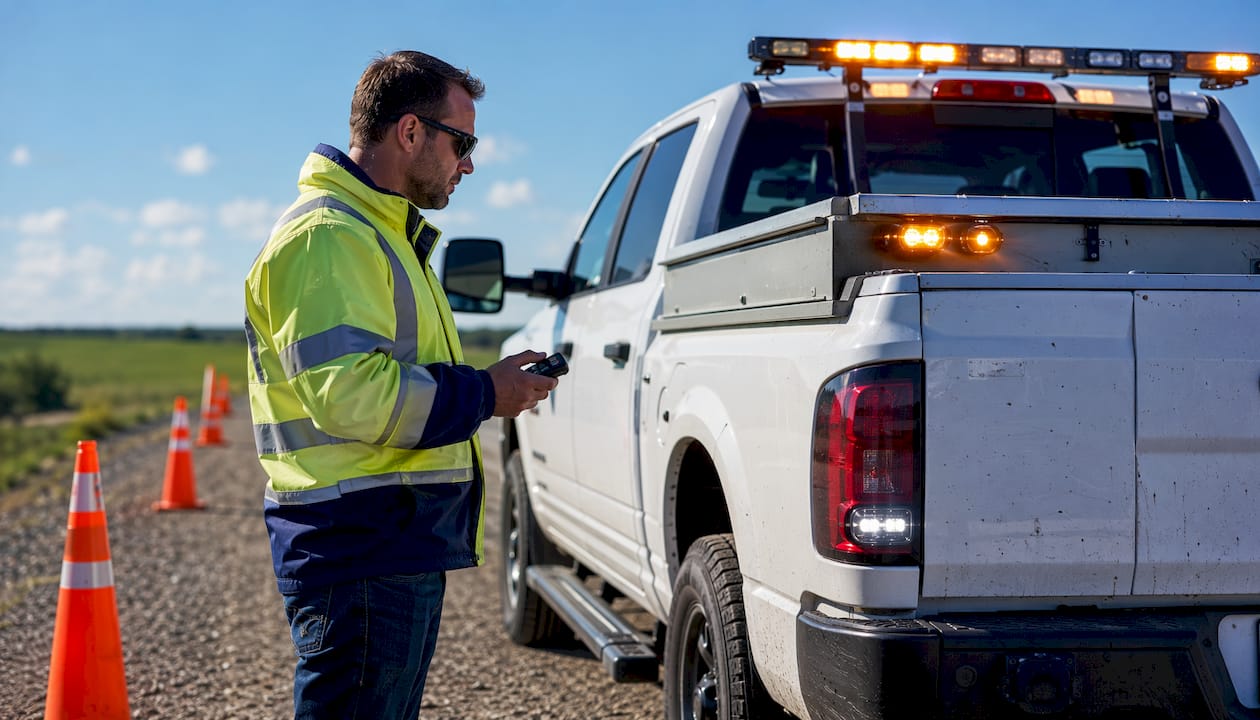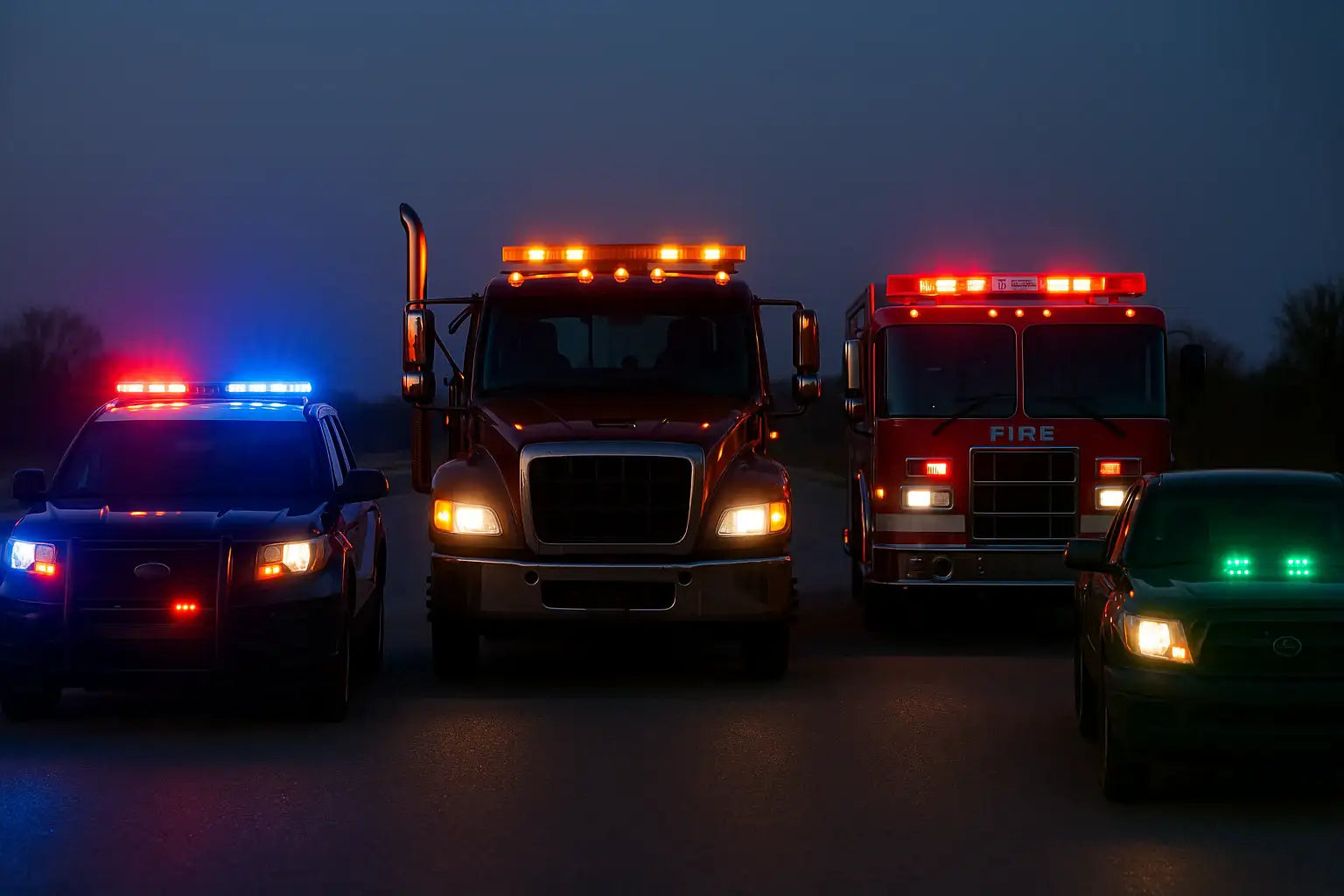


For Canadian commercial and emergency fleets, the Signal Arrow Rapid Deploy foldable LED directional arrow from Strobe My Ride is the recommended starting point: it deploys without tools, operates from an in-cab controller, and meets the auto-dimming and weather-resistance expectations set out in provincial traffic control manuals. For vehicle-mounted directional warning, the Patrol Arrow traffic directional warning bar complements it for tow trucks, roadside units, and pilot cars.
- Provincial manuals including OTM Book 7 and the BC Ministry’s 2020 Traffic Management Manual require flashing arrow boards (FABs) to meet minimum element counts, panel sizes, and flash rates aligned with MUTCD §6L.06 — and to be documented in a Traffic Control Plan (TCP) for each project.
- Nighttime auto-dimming of at least half the daytime brightness is a minimum requirement across multiple provincial manuals, and in-cab remote control is explicitly called out as expected for vehicle-mounted boards.
Table of Contents
- What does a portable traffic arrow actually do for your fleet?
- Which arrow board type does Canadian guidance require?
- Fleet checklist: what specs to verify before you buy
- How to deploy a portable arrow safely on Canadian roads
- Costs, lead times, and what maintenance actually looks like
- Why Strobe My Ride’s arrow solutions fit Canadian fleet requirements
- Key takeaways
- Strobe My Ride makes fleet procurement straightforward
- Primary sources and further reading
What does a portable traffic arrow actually do for your fleet?
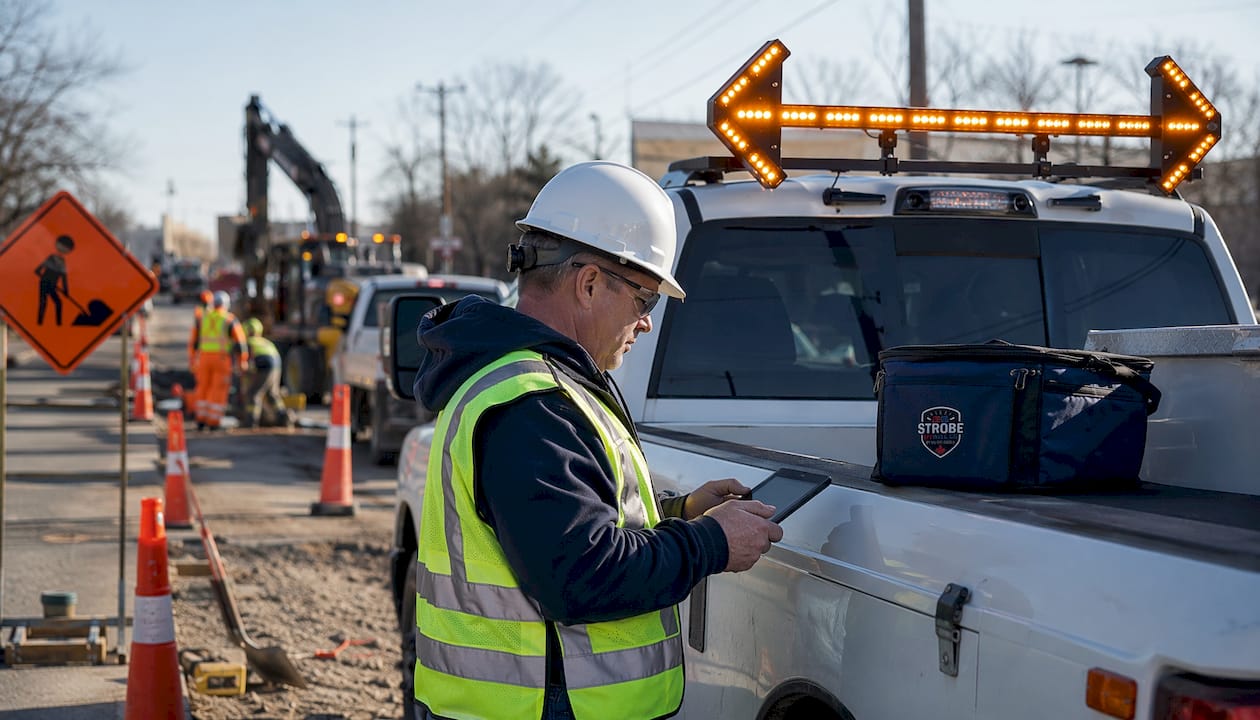
A flashing arrow board (FAB) is an array of amber LED elements capable of two primary display modes: arrow mode, which shows a directional arrow to guide drivers out of a closing lane, and caution mode, which displays a horizontal bar as a general warning. The distinction matters operationally. Provincial manuals explicitly prohibit using arrow mode on two-lane, two-way roads because a directional arrow on a two-lane road can divert oncoming traffic into a head-on conflict.
Common fleet use-cases for a portable traffic arrow include:
- Lane tapers and closures on multi-lane arterials and highways, where the board sits within the closed lane at the end of the merging taper
- Mobile operations such as line-painting, pothole patching, and utility work, where the board travels with the crew vehicle
- Buffer and pilot vehicle duties, where the board mounts on a truck or attenuator vehicle ahead of the work zone
- Emergency and roadside response, including tow trucks and incident-response units requiring fast, visible traffic direction
For high-speed, high-volume roads, a buffer vehicle with an arrow board and often a truck-mounted attenuator (TMA) is mandatory for mobile operations under PEI’s 2025 temporary workplace traffic control manual — a requirement echoed across other provincial guidance. Lower-speed roads may accept a well-marked vehicle, but the arrow board remains best practice.
Which arrow board type does Canadian guidance require?
The Type A/B/C classification used in MUTCD §6L.06 and adopted by Canadian provincial manuals is the primary selection tool for procurement officers:
- Type A: Low-speed urban streets (≤50 km/h)
- Type B: Intermediate-speed facilities and maintenance or mobile operations on high-speed roadways
- Type C: High-speed, high-volume highways (≥90 km/h)
- Type D (BC-specific): Vehicle-authorised boards including arrow sticks with a minimum of 16 lamps
For most Canadian commercial fleet work on arterials and provincial highways, Type B is the minimum. Freeway and high-speed corridor work requires Type C. The BC Ministry’s manual also notes that for mobile operations on high-speed roads, truck-mounted arrow-shaped boards of at least 150 cm × 75 cm may substitute for a Type C panel.
Concrete provincial dimension examples from Newfoundland and Labrador guidance specify arrow head height and lamp count dimensions for highways with higher speed limits, along with recommended legibility distances. Flash rate must comply with provincial standards, including appropriate flash rates and element “on time” requirements for flashing mode.
Pro Tip: Provincial guidance treats a board with two or more lamps out in the bar, or any lamp out in the arrow head, as ineffective and requiring replacement before the next shift. Build that threshold into your pre-shift inspection checklist.
Fleet checklist: what specs to verify before you buy
Start with the classification and panel area, then work through the operational and mechanical details.
- Panel type and certified illuminated area: confirm Type A, B, or C classification and that the panel dimensions meet the minimum for your road class (e.g., 150 cm × 75 cm for Type C mobile operations).
- Element and lamp count: commercial product lines commonly offer 13/26, 15/30, and 25/50-light configurations. Match the count to your type requirement and verify each lamp’s LED count.
- Flash rate and mode range: the board must support 25–40 flashes per minute and offer arrow, caution, and sequential modes from the controller.
- Auto-dimming: a minimum 50% reduction from full brilliance for night operations is required by multiple provincial manuals. Confirm the dimming is automatic or easily operator-controlled from the cab.
- In-cab controller: vehicle-mounted boards must have remote controls. Wireless controllers that plug into a 12 V outlet reduce installation time and cost.
- IP rating: weather resistance is non-negotiable for year-round Canadian use. Request the IP rating and confirm it covers rain, snow, and road spray.
- Operating temperature: verify rated performance at −40 °C if the board will be used in northern or prairie conditions.
- Mounting and tilt options: check whether manual swivel, power tilt, or actuator-controlled frames are available and compatible with your vehicle type (pick-up, utility truck, TMA).
- Folding/rapid-deploy feature: foldable boards reduce travel height and speed up deployment for mobile operations.
- Documentation package: request a TCP-compatible spec sheet, dimming test data, flash-rate test results, and warranty and service terms before issuing a purchase order.
| Spec | Minimum requirement | Notes |
|---|---|---|
| Flash rate | 25–40 flashes/min | Per MUTCD and provincial manuals |
| Night dimming | ≥50% from full brilliance | Automatic preferred |
| Arrow head height (Type C, ≥90 km/h) | 600–760 mm | Newfoundland and Labrador guidance example |
| Minimum lamp count (≥90 km/h) | 14 amber lamps, standard diameter | Provincial guidance example |
| Minimum mounting height (trailer/static) | around 2 m from roadway | BC Ministry manual |
| Vehicle-mounted minimum height | about 1 m from roadway | BC Ministry manual |
| Operating temperature | Rated to −40 °C | Canadian climate requirement |
For guidance on how Canadian lighting standards apply to vehicle-mounted equipment, Strobe My Ride’s standards overview is a useful reference alongside the provincial manuals.
How to deploy a portable arrow safely on Canadian roads
The arrow board is part of a system. Deploying it correctly means following the TCP and coordinating with every other device in the work zone.
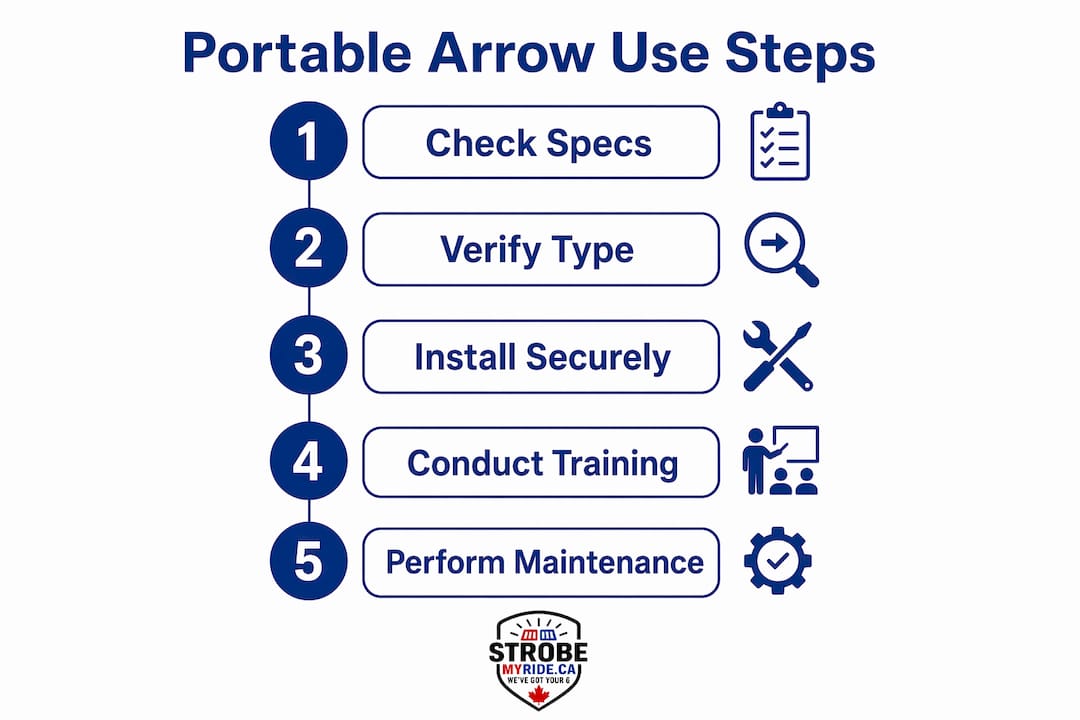
- Review the TCP before mobilising. Confirm the board type, placement location, and display mode specified for the project. The TCP governs, not the operator’s preference.
- Position the vehicle. For a stationary lane closure, place the board either on the shoulder at the beginning of the merging taper, or within the closed lane at the end of the taper. For mobile operations, maintain enough separation from the work crew to give approaching drivers adequate reaction distance.
- Delineate the board. Provincial manuals require the FAB to be surrounded by channelizing drums or tubes at all times. Correct construction site signage, combined with the arrow board, is what creates the full channelising effect drivers need to respond safely.
- Select the correct display mode. Arrow mode is for stationary or moving lane closures on multi-lane roads only. Use caution mode for roadside work on or near the shoulder, or for temporarily closing one lane on a two-lane, two-way road. Never use arrow mode on a two-lane road.
- Cover or remove the board when inactive. When the FAB is not actively directing traffic, cover or disable it to prevent driver confusion. Leaving an arrow illuminated when no lane closure is active is a documented safety hazard in provincial guidance.
- Close out correctly. Remove the board from the roadway when the operation ends. Do not leave it on the shoulder in caution mode without a proper shoulder closure taper.
For lane taper deployments specifically, the portable LED arrow lights guide on the Strobe My Ride site provides additional placement detail.
Operator certification matters. In Ontario, O.Reg. 213/91 §67 requires the worker who sets up or operates roadway measures to be certified as competent. Other provinces have equivalent expectations. Equipment compliance and operator competency are separate requirements — a certified board operated by an untrained worker is still a liability.
Pro Tip: Run day/night transition drills with new operators before the first live deployment. The most common field errors are selecting arrow mode on a two-lane road and leaving the board illuminated during a break. Both are cited in provincial guidance as hazardous.
Costs, lead times, and what maintenance actually looks like
Procurement costs for a vehicle-mounted LED arrow board system typically include:
- Unit price: varies by lamp count, panel size, and controller type; foldable rapid-deploy units and vehicle-mounted bars occupy different price tiers
- Mounting hardware: manual swivel, power tilt, or actuator frame, depending on vehicle type
- Shipping to Canada: confirm whether the supplier ships from Canadian stock or cross-border, as customs clearance adds lead time
- Installation labour: allow for wiring the controller and securing the mount, particularly for power-tilt actuator systems
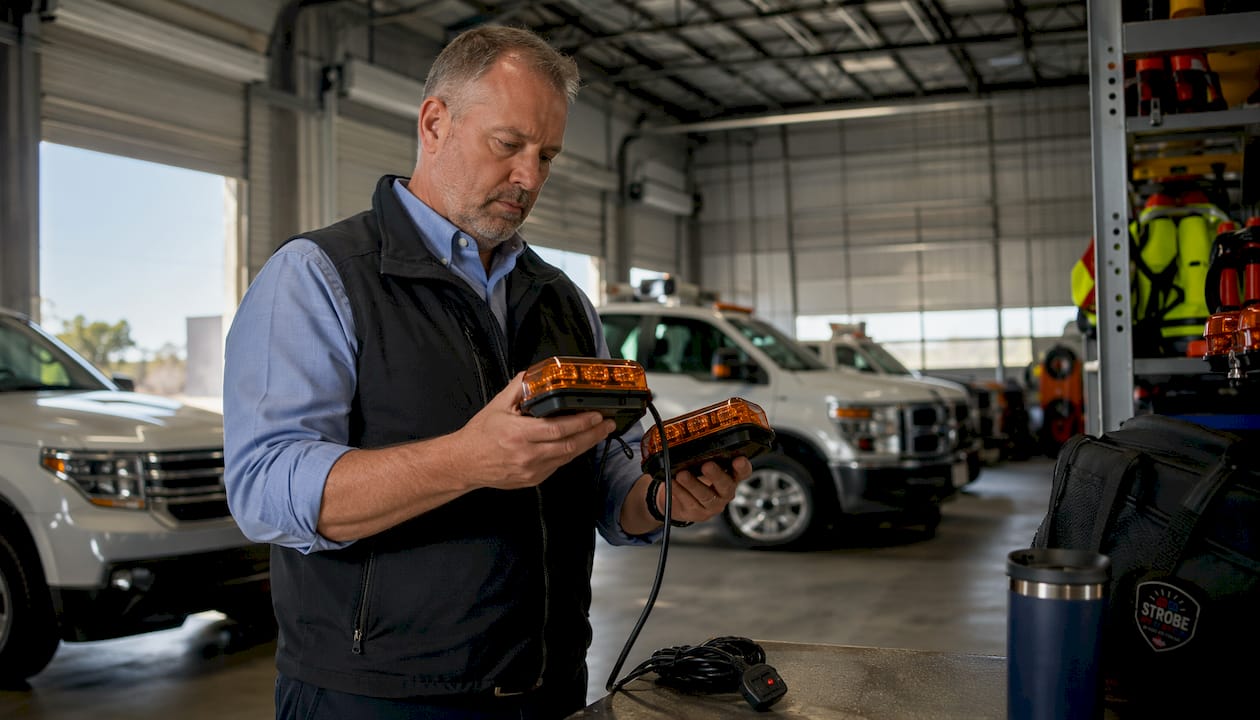
Lead times vary by model and season. Fleet operators ordering ahead of a construction season should confirm stock availability and request spare lamp modules and a replacement controller at the time of initial purchase. Sourcing spares after a field failure mid-project is costly and time-consuming.
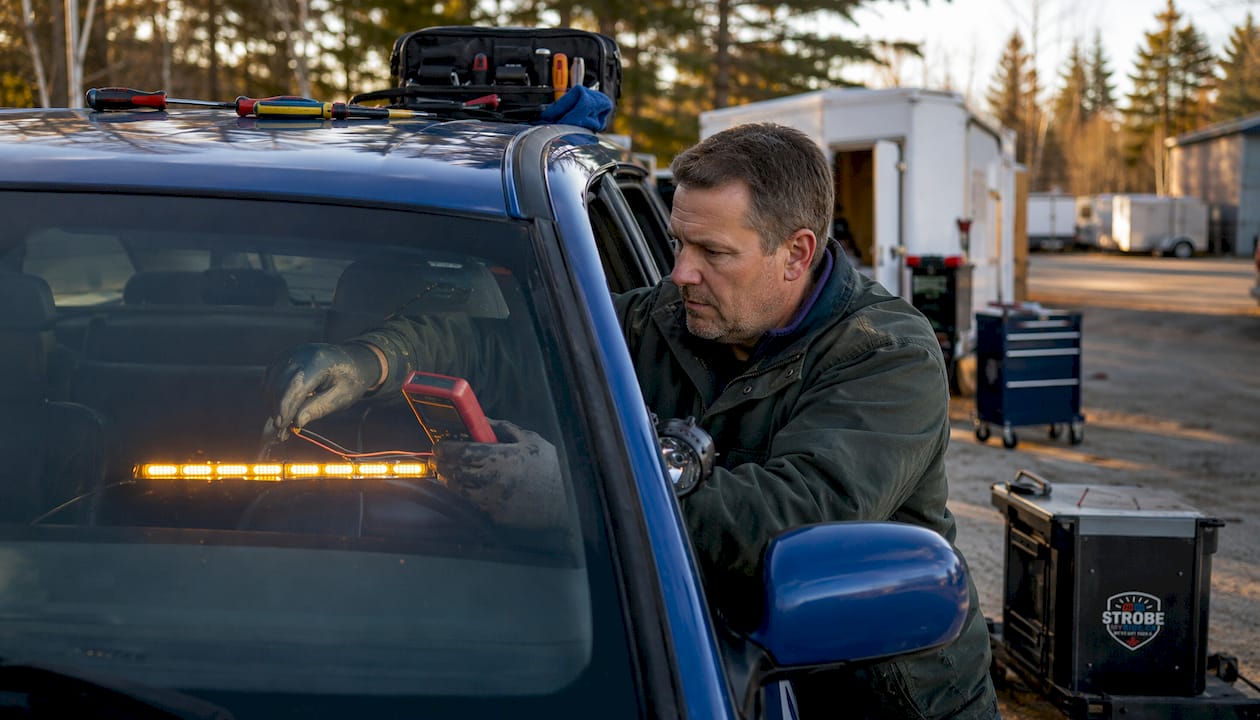
Daily pre-shift checks should cover lamp function across all display modes, controller connectivity, mounting security, and IP-rated seal condition. Battery-backed or solar-powered units need a charge-level check before each shift. Keep a maintenance log; it supports both TCP compliance documentation and warranty claims.
Why Strobe My Ride’s arrow solutions fit Canadian fleet requirements
Strobe My Ride offers two product categories that address the checklist above directly.
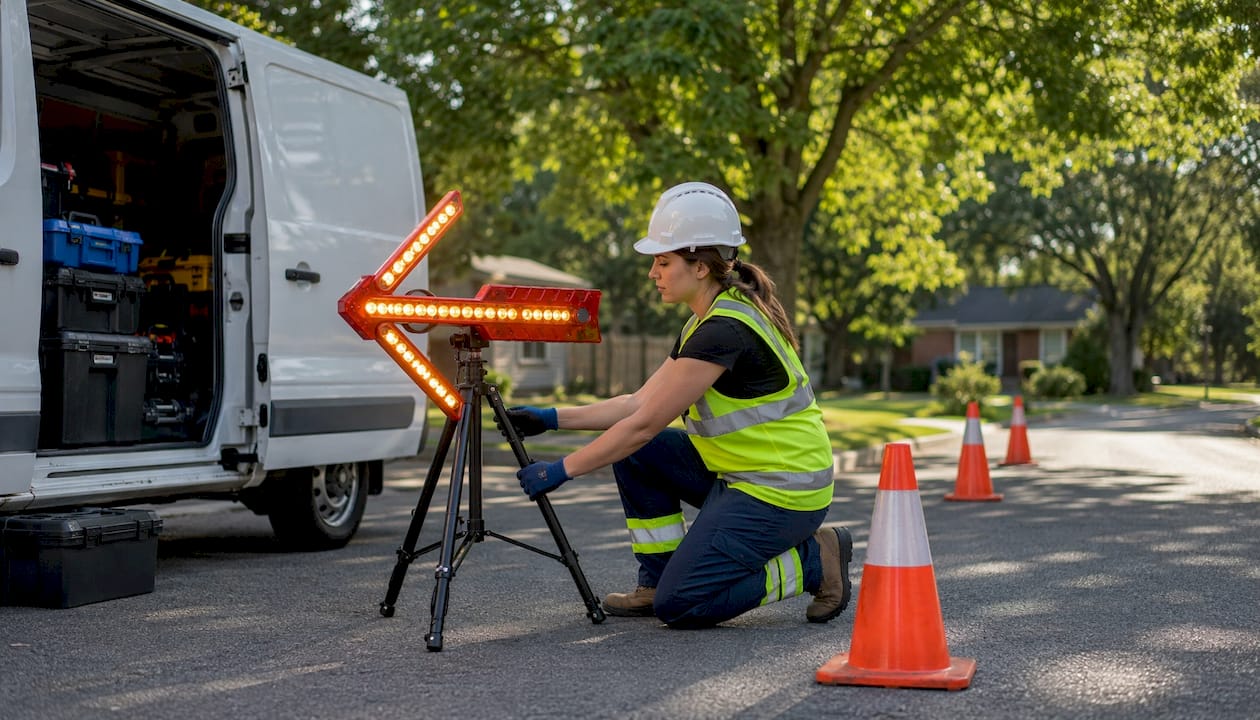
The Signal Arrow Rapid Deploy is a foldable LED directional arrow designed for fast roadside deployment without tools. It suits tow operators, roadside assistance crews, and any fleet that needs a portable traffic arrow on short notice. The foldable design keeps travel height low and deployment time short.
The Patrol Arrow traffic directional warning bar is a vehicle-mounted LED traffic direction arrow suited to tow trucks, pilot cars, and emergency response vehicles. It provides the in-cab-controlled, multi-mode directional warning that provincial manuals expect for vehicle-mounted operations.
| Product | Form factor | Primary use | Key features |
|---|---|---|---|
| Signal Arrow Rapid Deploy | Foldable, portable | Roadside, taper, incident response | Rapid deploy, LED flare array, directional modes |
| Patrol Arrow | Vehicle-mounted bar | Tow truck, pilot car, fleet vehicle | In-cab control, multi-mode, amber LED bar |
Both products are available through Strobe My Ride with Canadian shipping and warranty support. When preparing a TCP package, request the product spec sheet from Strobe My Ride to confirm that the lamp count, panel dimensions, and dimming specifications align with the type classification required for your project’s road class.
Browse the full Patrol series collection or go directly to the Signal Arrow Rapid Deploy product page to review specifications and place an order.
Key takeaways
A compliant portable traffic arrow for Canadian fleets requires the correct Type classification, auto-dimming to at least 50% at night, a flash rate of 25–40 flashes per minute, and documentation in a project-level TCP before it is legally effective on a provincial road.
| Point | Details |
|---|---|
| Match Type to road class | Use Type B minimum for arterials; Type C for freeways and highways ≥90 km/h. |
| Dimming and flash rate are mandatory | Provincial manuals require ≥50% night dimming and a flash rate of 25–40 flashes/min. |
| TCP documentation is required | No federal product registry exists; every project needs a TCP for provincial district review. |
| Operator certification applies | Ontario O.Reg. 213/91 §67 requires certified competency; other provinces have equivalent rules. |
| Strobe My Ride for Canadian fleets | The Signal Arrow Rapid Deploy and Patrol Arrow meet fleet deployment needs with Canadian shipping and warranty support. |
Strobe My Ride makes fleet procurement straightforward
When your fleet needs a portable traffic arrow that ships fast, arrives with a TCP-ready spec sheet, and is backed by in-country technical support, Strobe My Ride is the direct route. The Signal Arrow Rapid Deploy and Patrol Arrow are stocked for Canadian operators, not drop-shipped from overseas with a three-week wait.
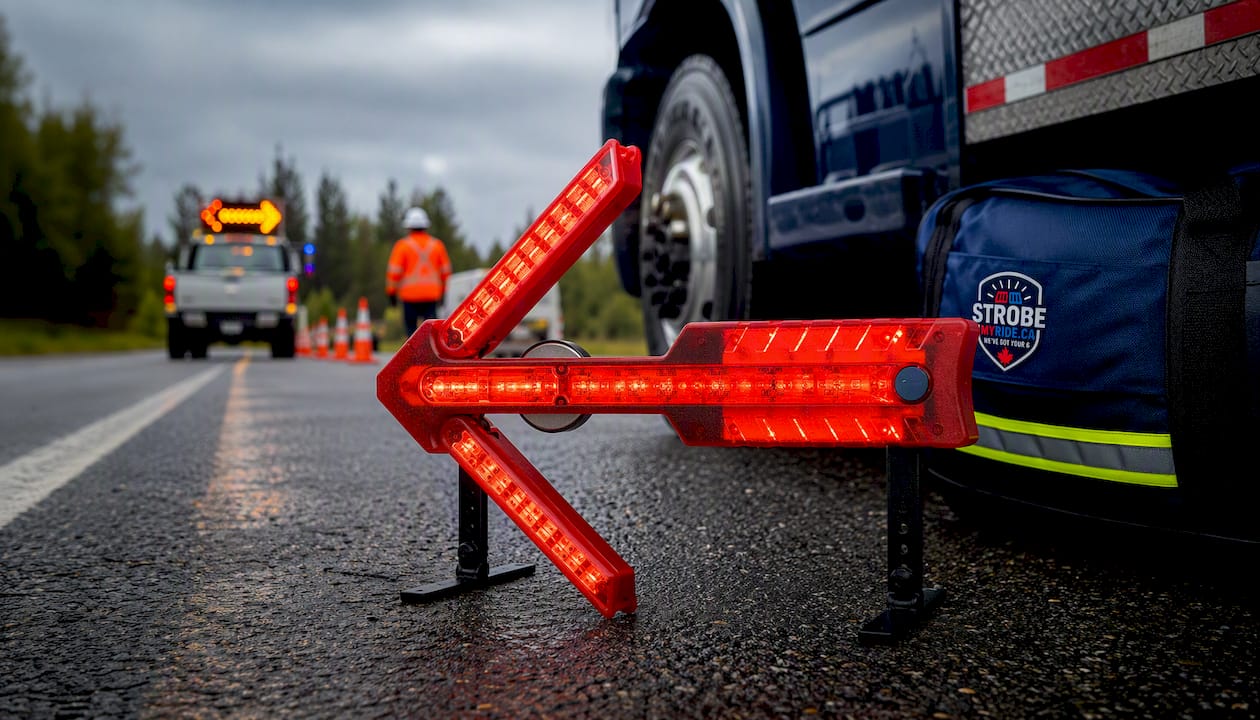
Strobe My Ride provides product documentation formatted for TCP and TMP submissions, so your procurement team is not starting from scratch when it comes time for MTO or provincial district review. Spare lamp modules, replacement controllers, and mounting hardware are available alongside the primary units, which means you can order your full kit in one transaction. Canadian warranty coverage and technical support are included — no third-party service arrangements required.
Order the Signal Arrow Rapid Deploy directly, browse the Patrol series for vehicle-mounted options, or contact Strobe My Ride to request a technical specification packet for your next TCP submission.
Primary sources and further reading
These are the authoritative references a procurement officer or safety manager should have on file when preparing a TCP or tender for portable traffic arrow equipment in Canada.
- Ontario Traffic Manual, Book 7 (OTM Book 7): The technical benchmark for MTO district TCP review in Ontario; defines TC-12 flashing arrow board sign requirements and placement rules.
- BC Ministry of Transportation — 2020 Traffic Management Manual for Work on Roadways, Part B: Section 4.6 covers FAB specifications, Type A/B/C/D classifications, setup, and operation in detail.
- Temporary Workplace Traffic Control Manual — Prince Edward Island (2025): Current Atlantic guidance on buffer vehicle requirements, TMA use, and cover/disable practices for arrow boards.
- Traffic Control Manual — Newfoundland and Labrador (2018): Provides concrete dimension examples (arrow head height 600–760 mm, 14-lamp minimum) and the prohibition on arrow mode for two-lane roads.
Recommended
- Portable LED arrow lights for lane tapers: 2026 guide | Strobe My Ride – Strobe My Ride
- Patrol Arrow – Traffic Directional Warning Bar Canada | Strobe My Ride – Strobe My Ride
- Traffic advisor guide for Ontario roadside professionals | Strobe My Ride – Strobe My Ride
- SMR LINE TRAFFIC ADVISORS / ARROWS Canada | Strobe My Ride – Strobe My Ride