


Yes, blue flashing lamps are legal on Alberta tow trucks, but only under a Registrar’s exemption and only when paired with amber lamps. The two colours must operate in tandem, never blue alone. Both are authorised solely while the truck is stopped and actively assisting another vehicle on the highway. Mandatory equipment includes roof mounting, SAE-compliant lamps, an in-cab control, and an indicator the driver can see.
TL;DR:
- Blue flashing lamps are only legal on Alberta tow trucks when operated in tandem with amber lamps under a Registrar’s exemption, not alone.
- Lamps must be roof-mounted, SAE-compliant, activated only when the truck is stopped and helping a vehicle, with a visible in-cab control and indicator.
- The exemption is conditional, requires full compliance with installation and operational rules, and is valid only if every condition is met.
- Inspectors check lamp function, wiring, and documentation, with non-compliance risking immediate removal of the lighting setup until corrected.
- Fleet managers should keep primary regulatory documents and exemption paperwork accessible to demonstrate compliance during roadside inspections.
Quick compliance checklist for on-shift crews and fleet managers
Before a driver leaves the yard, run through this list. Failing any item means the truck is not legally ready for a call.
- Amber lamps installed and visible from all directions, meeting the base requirement under the Vehicle Equipment Regulation.
- Blue lamps, if fitted, operate only in tandem with amber — never as a standalone signal.
- Roof-mounted lamp assembly with an unobstructed 360-degree view.
- SAE-compliant hardware confirmed at the SKU level, not assumed from marketing copy.
- In-cab control switch and a driver-visible indicator lamp that lights up when the system is active.
- Lamps activated only while stopped and assisting another vehicle, never while underway.
- Working lights used only when stopped, never while the truck is moving on a highway.
- Documentation on board: exemption copy, upfit invoices, maintenance log.
Pro Tip: Keep a laminated copy of the exemption terms clipped inside the cab. Peace officers doing a roadside check will ask for it, and having it on hand turns a five-minute stop into a thirty-second one.
What the Vehicle Equipment Regulation and Registrar’s exemption require
Section 31 of the Vehicle Equipment Regulation (AR 122/2009) sets the baseline: a tow truck must carry one or more amber warning lamps visible from every direction. Those amber lamps may only be switched on while the truck is attaching or drawing another vehicle, or while a crew member is helping a person repair, start, or move a stopped vehicle. Outside those two situations, the amber system stays off.
Blue lamps sit on top of that baseline, not beside it. Alberta’s Registrar’s exemption for blue flashing lamps allows tow trucks and support vehicles to add blue flashing lamps to the amber system, provided the two operate together, the assembly is roof-mounted, the lamps meet SAE standards, and the system runs from an in-cab control with a driver-visible indicator.
Registrar’s exemptions are issued as conditional permissions under section 114 of the VER. They do not amend the base regulation, and every listed condition must be met for the exemption to remain valid.
That framing matters for fleet managers. An exemption is not a blanket rewrite of provincial lighting law. It is a narrow carve-out tied to a documented pilot and its extension through 2028, and it only protects operators who follow every condition to the letter.
Installation details: roof mounting, SAE conformity, cab controls and indicators
The exemption’s fitment rules aren’t suggestions. They’re the difference between a compliant rig and a truck that fails its next inspection.
- Roof mounting: both the VER and the exemption expect flashing lamps positioned on the roof so they’re visible from all directions, not tucked behind cargo or angled toward one side.
- SAE conformity: lamps must meet SAE standards, and that compliance has to be verified per SKU. Catalogue photos don’t prove certification. Ask the supplier for the specific standard the unit meets.
- In-cab control and driver-visible indicator: the driver needs a physical switch inside the cab and a light or icon confirming the system is live. Regulators built this in specifically to cut down on accidental activation while a truck is moving.
- Working lights: deck and cargo illumination is fine while stopped, but those lights must go dark once the truck is back on the highway.
Procurement teams sourcing a roof-mounted assembly can review fitment details on Strobe My Ride’s tow truck light bar catalogue before ordering.
Driver procedures and company policies to prevent misuse
Equipment compliance only holds up if the person behind the wheel uses it correctly. Build these steps into daily operations:
- Activate amber and blue together, and only once the truck has stopped to assist a vehicle already on the roadway.
- Never use blue lamps alone for general visibility or as a substitute for hazard flashers; the exemption expressly forbids solo blue operation.
- Run a pre-shift lamp check: confirm the cab indicator lights up, inspect lenses for cracks or fogging, and test the flash pattern before the first call.
- Log every activation where possible, so incident review has a paper trail if a complaint or inspection follows.
- Retain records on board: exemption copy, upfit invoice, and the most recent inspection receipt.
Pro Tip: Tie the pre-shift lamp check to the same clipboard drivers already use for brake and tire checks. Bundling it into an existing habit gets far higher compliance than adding a separate form nobody reads.
Some operators mistakenly treat blue lamps as a general-purpose add-on for extra visibility on the shoulder. That’s the single most common way fleets lose their exemption standing, since tandem operation is a hard condition, not a preference.
What inspectors will look for and the consequences of non-compliance
Inspection days are not the time to discover a lamp circuit fault. Alberta’s commercial vehicle maintenance standards require lamps, reflectors, and lamp circuits to function safely, and inspectors typically check:
- Amber and blue lamp function, including flash pattern and lens condition.
- Lamp circuit integrity and correct wiring to the in-cab control.
- Indicator lamp operation, confirming the driver can see when the system is active.
- Headlamp alignment and general reflector condition as part of the same pass.
A failed inspection can mean an order to remove non-compliant equipment, a delay in returning the truck to service, or administrative penalties depending on the severity of the finding. Being inspection-ready mostly comes down to documentation: keep the exemption paperwork accessible and be ready to demonstrate the in-cab control and indicator on request.
Strobe My Ride’s expertise on compliant tow truck lighting
A supplier with experience in LED warning lights for Canadian tow and roadside operators often receives fitment questions like those in this guide from fleet customers. Certifications, permitted colours, and SAE compliance vary by individual SKU and by jurisdiction, so always confirm the specific product record before ordering, and never assume one lightbar’s certification applies to another model in the same line.
Three catalogue options worth reviewing for tow truck applications:
- Patrol Bar Quad 60 w/ STT, a full-size lightbar suited to roof-mounted installations.
- Patrol Bar Quad 47 w/ STT, an alternative full-size SKU for fleets comparing configurations.
- Fleet SM Stealth surface mount, a smoked-lens option for a lower-profile fitment.
Reach out to Strobe My Ride’s technical support team with your specific SKU questions before purchase. They can confirm what each product record actually states about compliance and fitment for your application.
Where to buy and next steps with Strobe My Ride
This supplier stocks SAE-rated emergency lighting for Canadian tow and roadside fleets, with technical support available to walk through fitment questions before you commit to a purchase. Rather than guessing which configuration matches your operation, bring your specifics to the conversation.
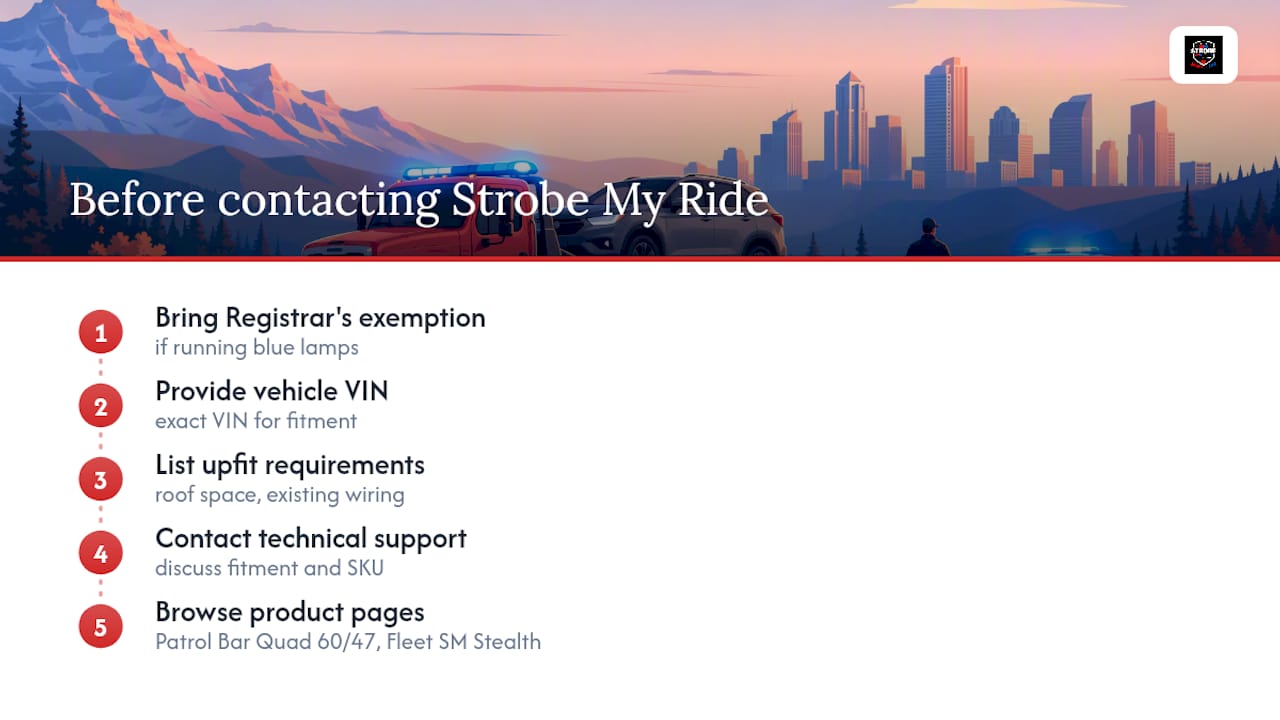
Before contacting sales or support, gather three things: your copy of the Registrar’s exemption (if you’re running blue lamps), your vehicle’s VIN, and a clear list of your upfit requirements, including roof space and existing wiring. That gives the technical team what they need to point you toward the right SKU rather than a generic recommendation.
Browse the Patrol Bar Quad 60, Patrol Bar Quad 47, and Fleet SM Stealth surface mount product pages for full SKU details, and check the amber and blue tow truck lighting overview for additional context on Alberta and Saskatchewan fitment considerations. Fleets sourcing related service work can also connect with AAA Frictions for vehicle parts and service support alongside a lighting upfit.
Official documents and primary sources to keep on file
Every fleet manager running blue lamps should have these documents saved, not just bookmarked:
- The Registrar’s exemption PDF for the exact installation and use conditions.
- The Vehicle Equipment Regulation for the base amber lamp requirement under section 31.
- The commercial vehicle maintenance standards regulation for inspection checklist language.
- The peace officer bulletin on blue and amber lights for how enforcement understands the tandem-operation rule.
Each one carries the legal basis for a piece of this guide. If an inspector or a dispatcher ever questions a fitment decision, the primary document settles it faster than any summary.


