


Blue lights are not generally legal in Canada. They are reserved for authorized emergency vehicles and a small number of designated exemptions, and the rules change from one province to the next. Ontario controls blue, red, and green lamps under O. Reg. 484/07, while Alberta permits blue lamps on tow trucks only through a specific registrar’s exemption. Before you buy or install anything, confirm your province’s current regulation.
TL;DR:
- Alberta’s blue lamp exemption allows tow trucks and support vehicles to use blue flashing lamps only when stopped and actively aiding another vehicle, with specific operational requirements.
- Ontario permits blue lamps solely on certain authorized vehicle types listed in regulation O. Reg. 484/07, and volunteer medical responders must carry specific identification when using green lights.
- Most provinces restrict blue and red lamps to emergency services or authorized officers, frequently tying them to SAE or VER equipment standards, with narrow, time-limited exemptions.
- Operating blue lights without proper authorization risks fines, vehicle inspection failures, and being mistaken for an emergency vehicle, especially if used while moving or outside permitted categories.
- Recent signs show Alberta might extend its blue-light exemption, but provinces maintain separate rules, making consistent legal compliance essential for fleets operating across borders.
Blue light laws Canada: a province-by-province snapshot
Every province treats blue as a restricted colour, but the exemptions and enforcement details vary enough that a rule confirmed in one jurisdiction can be meaningless in the next. Here is the general pattern as it stands across the country:
- Alberta: Tow trucks and certain highway maintenance and support vehicles may use blue flashing lamps under a time-limited registrar’s exemption, but only paired with amber lamps and only while stopped.
- Ontario: O. Reg. 484/07 lists specific authorized vehicle types for red, blue, and green lamps; volunteer medical responders get separate green-light permissions tied to identification requirements.
- Nova Scotia: Many commercial and non-emergency vehicles are limited to yellow or amber warning lamps, with red and blue reserved for authorized emergency vehicles and designated peace officers, per the Vehicle Warning Lights Regulations.
- Other provinces and territories: Most follow the same underlying logic — blue and red lamps are tied to police, fire, ambulance, or a narrow list of designated officers, with amber remaining the default colour for general warning and roadside work.
The common thread across nearly every jurisdiction is that blue signals emergency authority to other drivers, so provinces guard it closely. Several also lean on SAE or VER (Vehicle Equipment Regulation) references when they define what counts as a compliant lamp, which means legality and equipment standards are two separate boxes to check, not one. A handful of provinces have also run pilot programs or time-limited exemptions rather than permanent legislative changes, which is exactly what happened in Alberta, and that distinction matters if you are trying to plan lighting purchases years in advance.
What does Alberta’s blue light exemption actually permit?
Alberta’s registrar issued a time-limited exemption covering tow trucks, support vehicles, and certain highway maintenance vehicles, allowing them to run blue flashing lamps in addition to their standard amber lighting. The exemption is narrow by design, and every condition attached to it matters if you want to stay on the right side of it.
Under the registrar’s exemption, blue lamps must be operated in tandem with amber lamps at all times. They can only be activated while the vehicle is stopped and actively assisting another vehicle, never while driving. Amber must remain visible from all directions, and the lamps require a control switch inside the cab along with an indicator the driver can see. The equipment itself must meet applicable SAE or VER standards.
For tow operators, that translates into a simple operational habit: engage blue lamps only once you’re stopped on scene, never in transit, and confirm your specific unit’s wiring includes the required cab indicator before it goes on the road.
What does Ontario’s O. Reg. 484/07 cover?
O. Reg. 484/07 sets out exactly which vehicle types in Ontario may carry flashing red, blue, or green lamps, and the list is specific rather than general. It names certain Ministry vehicles along with aviation and forest-fire management vehicles among the authorized categories, according to the CanLII consolidation of the regulation.
Volunteer medical responders occupy a distinct category under the same regulation. They may use intermittent green lights, but only while carrying identification issued by their volunteer medical response organization, and they must surrender that identification for inspection on demand.
Key takeaways for anyone reading this regulation before an upfit:
- Private and commercial vehicles outside the listed categories generally cannot carry blue lamps under Ontario law.
- Volunteer responders using green lights must have their organizational ID on them at all times while those lights are active.
- Installing blue lighting on a vehicle that doesn’t fall into an authorized category creates real enforcement exposure, not just a technicality.
How do other provinces and territories handle blue lights?
Nova Scotia’s Vehicle Warning Lights Regulations require many non-emergency commercial vehicles to run yellow or amber lamps only, keeping red and blue reserved for authorized emergency vehicles and designated peace officers. That pattern repeats, with local variation, across most of the country.
A few themes hold up province to province:
- Colours outside amber are almost always tied to a specific authority: police, fire, ambulance, or a named designated officer category.
- Many provincial rules point back to SAE or VER equipment standards rather than inventing their own technical specifications.
- Exemptions tend to be narrow, time-limited, and specific to vehicle type, not blanket permissions for an entire industry.
If your fleet operates in a province not covered here, the fastest path to a real answer is the provincial e-laws or statutes database and the relevant ministry of transportation page, since blog posts and forum threads routinely repeat outdated or partial rules.
How to comply: a checklist before installing blue lamps
Confirming legality before you order equipment saves money and avoids a vehicle that fails inspection or draws enforcement attention on its first shift. Work through these steps in order:
- Check the governing statute or exemption for your province, using the official regulation text rather than a secondhand summary.
- Confirm your vehicle class and use case actually match what the exemption or regulation authorizes.
- Verify lamp pairing requirements, such as Alberta’s rule that blue must run with amber, and confirm SAE or VER compliance for the specific unit.
- Ensure cab controls and a visible indicator are wired in, since several exemptions make this a hard requirement, not a suggestion.
- Keep required documentation on board, including a copy of the written exemption or authorization where the rule demands it.
- Put the policy in writing for your staff, so drivers know exactly when lamps can be activated and what to hand over if asked.
Pro Tip: If your fleet crosses provincial borders regularly, build your standard operating procedure around the strictest applicable province rather than maintaining separate rules per jurisdiction. It’s simpler to train drivers on one consistent standard, and it removes the risk of someone applying the wrong province’s exemption on the wrong stretch of highway.
Strobe My Ride: regulatory guidance built for Canadian fleets
Strobe My Ride is a Canadian-owned supplier stocked in Ottawa and shipping across the country, and light bars, beacons, and scene lighting make up a core part of the catalogue. Certifications and permitted colours vary by individual SKU and by province, so nothing here should be read as a blanket approval for any particular product or jurisdiction.
Our warning light regulations guide breaks down permitted colours by jurisdiction in more depth, and our coverage of Alberta’s blue-light rules for tow trucks walks through the province’s exemption in practical terms. Confirm your province’s current rule before treating any product page as a compliance answer.
What happens if you use blue lights without authorization?
Operating blue warning lamps outside an authorized category or exemption exposes a driver and, often, the vehicle’s registered owner to provincial traffic enforcement. The exact penalty structure sits within each province’s highway traffic or motor vehicle act, and it typically covers both the equipment violation (an unauthorized lamp installed on the vehicle) and the operational violation (activating it without authority).
Enforcement officers generally have discretion to order lamps removed or disabled on the spot, on top of any fine issued. For a commercial fleet, the practical cost often exceeds the ticket itself: a vehicle pulled from service for a non-compliant lighting setup means a missed job, a delayed tow, or a truck sitting at a compound instead of on the road.
There’s a reputational angle too. A tow truck or roadside vehicle running unauthorized blue lamps can be mistaken for an emergency vehicle by other drivers, which creates confusion on the road and can draw complaints even before an officer notices the equipment itself. Because the underlying statutes are provincial, the specific fine amounts and procedural consequences differ by jurisdiction, which is exactly why checking your own province’s current traffic act, rather than relying on a fine amount you heard about somewhere else, matters before you ever flip the switch on a blue lamp.
Why do these laws exist in the first place?
Blue and red lighting became shorthand for emergency authority decades ago, largely because a driver approaching from any angle needs to recognize an emergency vehicle instantly, without reading a badge or a decal. Reserving specific colours for specific roles lets that recognition happen in a split second, which is the entire point of the system.
As roadside work, towing, and highway maintenance grew more dangerous, particularly on high-speed corridors, provinces started fielding requests from those industries for better visibility than amber alone provides. Alberta’s response is a clear example: its blue-lamp exemption for tow trucks and support vehicles was extended for another five years specifically to improve roadside worker visibility and reduce the risk of a stopped vehicle being struck.
That history explains why the rules are narrow rather than open. Provinces are balancing two goals that pull in opposite directions: give roadside and support workers enough visibility to stay safe, while keeping blue lighting rare enough that drivers still associate it with genuine emergency authority. Loosen the rule too far and the colour stops meaning anything specific on the road, which defeats its purpose entirely.
How do blue light rules compare to red light rules for emergency vehicles?
Red lighting carries the longest and most consistent legal history among Canada’s emergency lamp colours, tied almost universally to police, fire, and ambulance vehicles across every province. Blue lighting, by contrast, has a shorter and more fragmented history, showing up mostly through newer, narrower exemptions like Alberta’s tow-truck program rather than through longstanding, uniform legislation.
The practical difference for fleet operators is scope. Red-lamp authorization is rarely available outside the traditional emergency services, and provinces generally don’t experiment with expanding it. Blue-lamp authorization has proven more flexible, appearing in tow, roadside assistance, and highway maintenance contexts specifically because provinces have identified a distinct visibility problem those industries face that red lighting isn’t positioned to solve.
Amber sits at the opposite end of the spectrum: it’s the default, widely available colour for general warning and construction use, with far fewer restrictions than either red or blue. Understanding where your vehicle and use case fall on that spectrum, general warning, a narrow blue exemption, or full emergency-vehicle status, is the fastest way to figure out which set of rules actually applies to you rather than assuming one colour’s rules transfer to another.
Do blue light laws actually improve safety on Canadian roads?
The clearest evidence available points to a safety-driven rationale rather than an arbitrary restriction. Alberta didn’t introduce its blue-lamp exemption on a whim: the province extended the pilot specifically because it improved roadside worker visibility and appears to reduce the risk of collisions involving stopped tow and support vehicles, according to coverage of the extension.
That outcome matters for first responders and roadside workers in a very literal sense: a stopped vehicle on a shoulder or highway edge is one of the more dangerous places to be in the entire transportation system, and any lighting change that measurably improves driver reaction distance is worth taking seriously. It also matters for the drivers approaching that scene, since a distinct, recognizable colour gives them more processing time than another amber lamp blending into a sea of construction and hazard lighting already on the road.
The tension is real, though. The more provinces expand blue-light access to new vehicle categories, the more that colour risks becoming as common, and therefore as easy to tune out, as amber already is. That’s the underlying reason exemptions stay narrow and time-limited rather than becoming permanent open permissions: regulators are watching to see whether the safety benefit holds up as usage grows, not assuming it will.
How do you get authorization or a permit for blue lights?
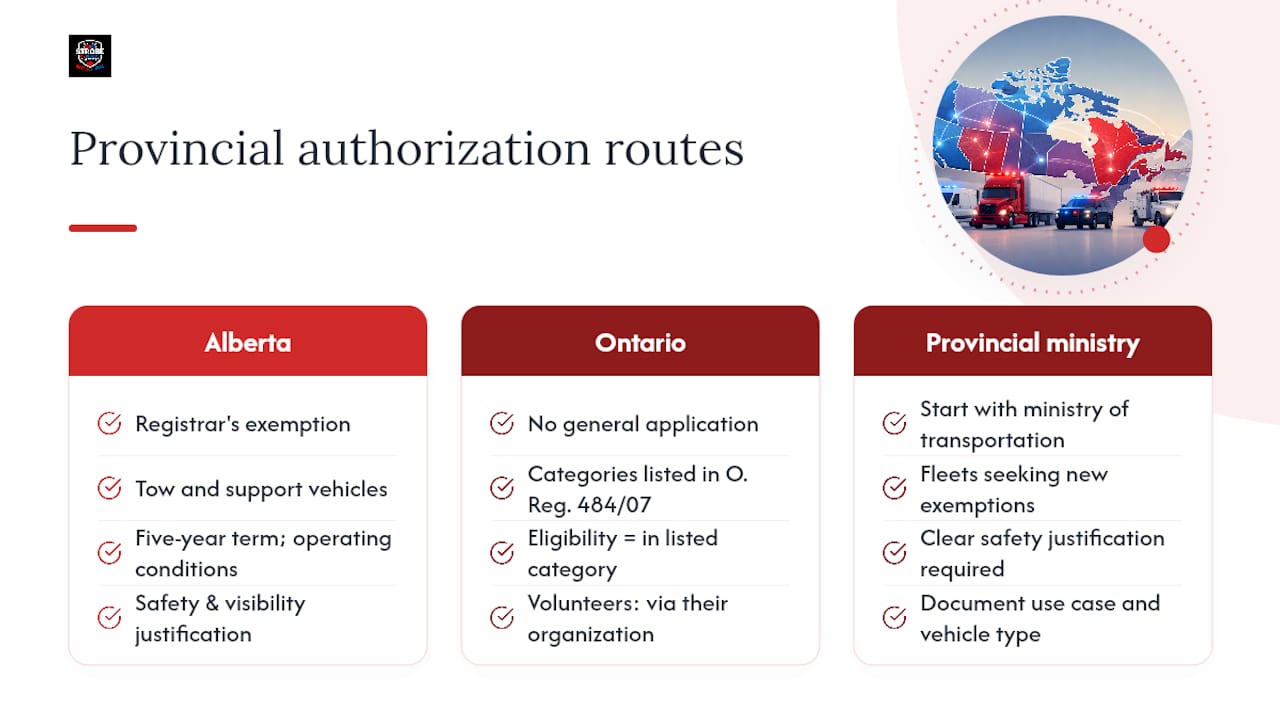
There is no single national permit for blue lighting in Canada, because authorization runs through each province’s own regulatory or registrar process rather than a federal system. In Alberta, that process took the form of a Registrar’s exemption specific to tow trucks and support vehicles, covering a defined five-year term with explicit operating conditions attached.
Ontario doesn’t run a general application process for private operators at all. Instead, O. Reg. 484/07 lists the specific vehicle categories already authorized, and eligibility depends on falling into one of those listed categories rather than applying for a new one. Volunteer medical responders follow a slightly different path, obtaining their green-light permission through their volunteer organization along with the identification they’re required to carry.
If your fleet believes it has a legitimate case for a new or expanded exemption, the realistic starting point is your provincial ministry of transportation, since that’s the body with authority to issue, modify, or review these exemptions. Expect the process to require a clear safety justification, not just an operational preference, given that Alberta’s own exemption was built and extended around measurable visibility and safety outcomes rather than convenience. Document your use case, your vehicle type, and the specific problem the lighting would solve before starting that conversation.
Are the rules changing? Recent developments to watch
Alberta’s decision to extend its blue-lamp exemption for tow trucks and support vehicles is the clearest recent signal that provinces are willing to revisit these rules when safety data supports it, rather than leaving exemptions to expire and disappear quietly, as reported by Global News. That extension suggests the province views the program as working, at least well enough to keep running it rather than converting it into permanent legislation just yet.
Other provinces have not announced comparable expansions at the same scale, which means the current provincial patchwork, tight in Ontario, exemption-based in Alberta, amber-focused in Nova Scotia, is likely to persist rather than converge toward one national standard. Fleet operators shouldn’t expect a uniform Canada-wide blue-light rule to appear soon.
The practical lesson for anyone managing a multi-province fleet is that these regulations are live documents, not settled law you check once and forget. An exemption tied to a five-year term, like Alberta’s, needs a calendar reminder well before its expiry, since a lapsed exemption with no renewal in place turns a legal light into an illegal one overnight. Checking provincial transportation ministry pages or e-laws databases periodically, rather than relying on information gathered years earlier, is the only reliable way to catch a change before it catches you.
Why enforcement varies so much between provinces
Even where the underlying statutes look similar on paper, how strictly they get enforced differs from one province, and sometimes one municipality, to the next. Some jurisdictions treat an unauthorized blue lamp as a straightforward equipment violation handled with a routine fine, while others escalate faster, particularly if the lighting setup could plausibly be mistaken for an actual emergency vehicle by other drivers.
Alberta’s exemption comes with enough specific, checkable conditions, amber pairing, stopped-only use, cab controls, an interior indicator, that an officer can verify compliance relatively quickly on scene. Ontario’s more restrictive approach under O. Reg. 484/07 means enforcement there often centres on a simpler question: does this vehicle appear on the authorized list at all, rather than assessing a set of operating conditions.
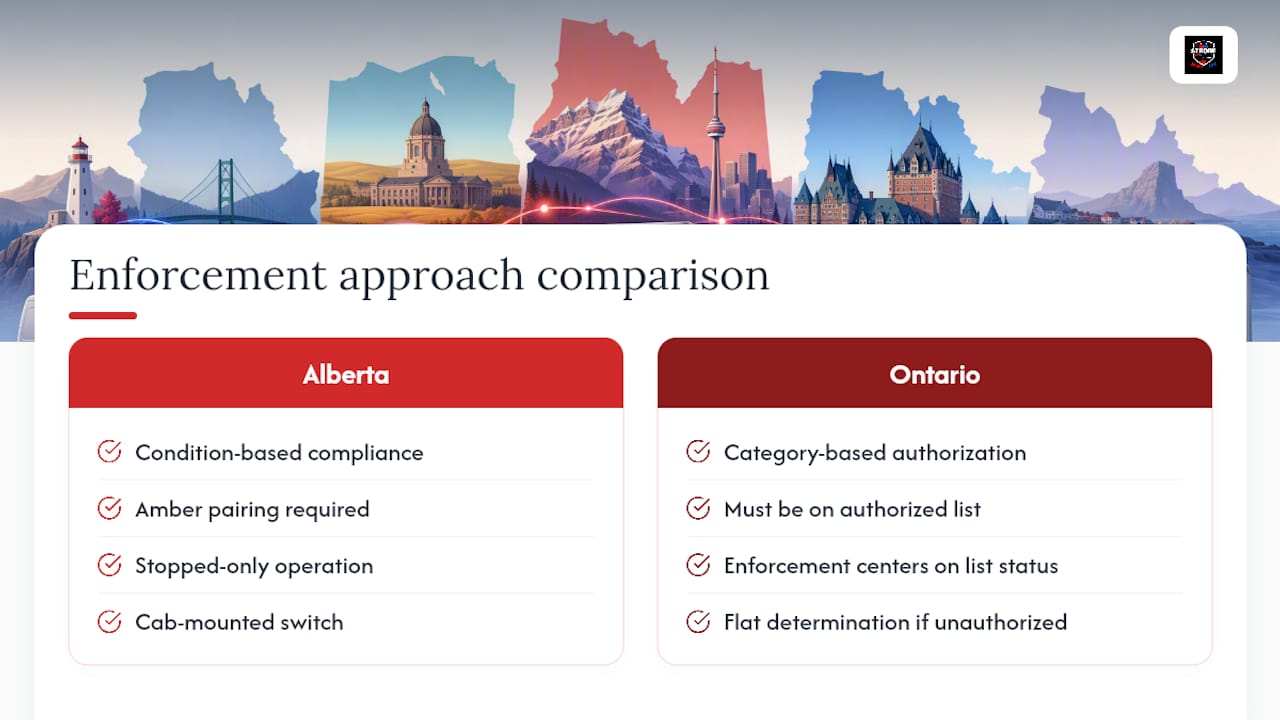
That difference in structure, condition-based compliance versus category-based authorization, tends to produce different enforcement rhythms. A tow operator in Alberta might reasonably expect an officer to check specific operational details, like whether the blue lamp was active while the truck was moving. A commercial operator in Ontario running unauthorized blue lighting is more likely to face a flat determination that the vehicle simply isn’t on the approved list, with less room for a conditions-based defence.
For a fleet operating across provincial lines, that variability is exactly why standardizing your internal policy to the strictest applicable province, and documenting the legal check for each jurisdiction you operate in, protects you better than assuming enforcement will be lenient everywhere.
If you have legal permission: Strobe My Ride products to consider
Once you’ve confirmed your province’s rule and your vehicle actually qualifies for blue or another authorized colour, Strobe My Ride carries the light bars, beacons, and scene lighting Canadian fleets use to outfit compliant vehicles, all shipped from Ottawa across the country. We’re not the office that grants your exemption. We’re the supplier you talk to once you already have it, with the catalogue depth to match the SKU to the job.
For tow and roadside vehicles, the Spot Lux 7X3 is a compact spot light suited to scene illumination once you’re stopped and working. For full-size coverage, the Patrol Bar Quad 50 Slim and the Patrol Bar Quad 60 both offer full-size lightbar options with STT functionality, worth comparing side by side against your vehicle’s mounting space and your province’s permitted colours.
Specifications, certifications, and permitted colours vary by SKU and by jurisdiction, so visit each product page for the exact details, and contact Strobe My Ride directly if you need guidance matching a specific product to your province’s rule before you order.
Sources
- Ontario
- Registrar’s exemption : installation and use of blue flashing lamps on tow trucks and support vehicles 2023-2028 - Open Government
- Vehicle Warning Lights Regulations - Motor Vehicle Act (Nova Scotia)
FAQ
Is it illegal to flash your headlights to warn of police in Canada?
This falls under provincial highway traffic legislation rather than the blue-light rules covered here, and the legality varies by province and by the specific circumstances involved. Check your provincial highway traffic act or consult a legal professional for a definitive answer in your jurisdiction.
Is it illegal to have LED lights inside your car in Canada?
Interior LED accent lighting is generally treated separately from exterior warning lamps like blue or red beacons, but provinces can restrict interior lighting that’s visible from outside the vehicle or that could be confused with emergency equipment. The colour restrictions discussed throughout this article, particularly around blue and red, apply specifically to exterior warning and emergency lighting, not general interior accent lighting.
Are headlights mandatory to be turned on in Alberta?
Alberta’s rules around headlight use fall under its own highway traffic legislation rather than the blue-light exemption discussed here, so check Alberta’s current traffic safety regulations directly for headlight requirements.
Can you turn right at a red light in Canada?
This is governed by provincial traffic law rather than the emergency-lighting regulations covered in this article, and rules can vary between provinces and even municipalities. Consult your provincial highway traffic act or local signage for the current rule in your area.
Where can I buy compliant warning lights once I’ve confirmed my province’s rule?
Strobe My Ride stocks light bars, beacons, and scene lighting for Canadian fleets, shipped from Ottawa across the country, with specifications and permitted colours varying by SKU and jurisdiction. Review individual product pages, such as the Spot Lux 7X3 or the Patrol Bar Quad 60, for the details specific to your vehicle and province.


