


Yes, tow trucks in Quebec may be equipped with flashing green lights, but only under narrow conditions. Since December 21, 2023, owners may install them, though activation is restricted to moments when an emergency service requires the tow truck’s presence, and amber lights must be running at the same time. Green never converts a tow truck into an emergency vehicle. The regulation also caps the number of lights at a maximum allowed by law, and technical standards call for SAE certified units or LED modules flashing at 1 to 4 Hz.
TL;DR:
- Green lights may only activate when called in by an emergency service and amber lights are already on, with a maximum of eight green lights per vehicle.
- Lights must meet SAE certification or flash at 1 to 4 Hz using LED modules, with green areas smaller than amber from all angles.
- Green activation is limited to emergency responses, allowing towing on shoulders or off-limits areas only when safety permits and never for routine calls.
- Fleets must maintain valid certificates, track renewal dates, and ensure green lights do not obstruct airbags or overpower amber visibility.
- Proper hardware, placement, and documented dispatch procedures are essential to legal compliance and effective green light use.
What are Quebec’s tow truck green light regulations at a glance?
Quebec’s Flashing Green Light Regulation gives tow operators a narrow, conditional permission rather than a blanket right. Here is what governs day-to-day use:
- A driver may activate the green light only when the tow truck has been called in by an emergency service, such as police or fire, responding to a collision or roadway hazard.
- Amber rotating or flashing lights must be active whenever the green light is on. Green alone is never permitted.
- Activating the green light does not grant emergency-vehicle status. Speed limits, traffic signals, and the Highway Safety Code still apply in full.
- Installing the light is optional. Employers who own the trucks decide whether to equip them at all, and that choice sits separately from the activation rules that govern actual use, according to SAAQ’s guidance for tow truck operators.
The practical takeaway for fleet managers: installation is a business decision, but every activation still has to trace back to a genuine emergency-service request. Treat the two as separate policy questions, because conflating them is where most compliance gaps start.
What technical standards apply to tow truck green lights?
The regulation is specific about the hardware itself, not just when it can be switched on. Lights must meet one of two paths to qualify:
- Certified under standards such as SAE J845 or SAE J595.
- Built from LED modules with a flash rate between 1 Hz and 4 Hz, per the LegisQuebec regulation text (C-24.2, r. 25.1).
Maximum 8 green lights per vehicle, and no more than 3 visible from any single direction (front, rear, or either side). That numeric cap is the one figure every fleet manager should memorize before ordering hardware, because it applies regardless of how many total units get mounted around the vehicle.
Placement carries its own constraints beyond the count:
- Dimension limits apply per light, and they differ depending on how many units are visible from a given direction at once.
- No green unit may interfere with airbag deployment or obstruct the driver’s field of view, a requirement flagged directly in SAAQ’s operational notes for tow operators.
- The green luminous area visible from any direction must stay smaller than the amber luminous area visible from that same direction. Amber has to remain visually dominant on every side of the truck, not just on average.
That last point trips up more installers than the light count does. A fleet can technically have fewer green units than the eight-light maximum and still fail the standard if the green lenses are large enough to outshine the amber from one angle.
When can a driver actually use the green light?
Activation hinges on one condition: the tow truck must be required by an emergency service at that moment, and the amber lights must already be running. Outside that window, the green light stays off, full stop.
When those conditions are met, drivers gain two specific allowances tied directly to the Highway Safety Code:
- Travel on the shoulder where circumstances call for it.
- Stop the vehicle in locations that would normally be off limits.
Both allowances come with a hard qualifier: they apply only when it can be done safely, without endangering the driver, other road users, or anyone at the scene. Neither allowance authorizes speeding, running signals, or treating a green light as a substitute for the escort or protocols an emergency service would otherwise provide.
- Allowed: activating green and amber together while positioning on the shoulder to recover a vehicle at a police-directed collision scene.
- Not allowed: using the green light to justify faster response driving to a routine tow call with no emergency-service request attached.
Pro Tip: Build a one-line dispatch confirmation into your job sheet. If the dispatcher can’t name the requesting emergency service by name, the driver shouldn’t be flipping on the green light.
How do operators get and keep their green light authorization?
Quebec’s regulation does not treat the green light as a one-time equipment purchase. It ties ongoing use to documentation and conduct, administered through the certificate framework set out under C-24.2, r. 25.1 and formalized by Décret 1696-2023.
- Issuance. The certificate is issued through the process the regulation lays out, and its content requirements are defined in the regulation’s annex rather than left to informal practice.
- Renewal. Renewal follows the statutory timing built into the regulation itself. Fleet managers should track expiry dates the same way they track vehicle inspection or licence renewal dates, rather than assuming an indefinite grant.
- Revocation triggers. A certificate can be pulled for reasons tied to employment records, failure to follow the operational protocols described above, or an invalid operator licence.
- Municipal validation. Practical administration often runs through municipal channels, so the certificate needs a working contact method that a municipality or the SAAQ can actually reach.
Keep a copy of the current certificate in the cab and a scanned copy on file at the dispatch office. Losing track of a renewal date is a far more common problem than any deliberate misuse.
How can fleets build compliant policies around this regulation?
Turning the regulation into daily practice comes down to a handful of concrete fleet policies rather than a lengthy manual. Start with dispatch discipline: no green activation without a named emergency service on the record for that call. That single rule closes most of the exposure fleets face.
- Require dispatchers to log which emergency service requested the tow before authorizing green activation.
- Train drivers on the amber-first rule: amber activates before, and stays on alongside, any green light.
- Build a maintenance checklist that checks green lens condition and mounting position, since a cracked or repositioned lens can quietly shift the amber-to-green luminous balance out of compliance.
- Document every certificate and tie its renewal date into whatever scheduling system already tracks vehicle inspections.
On the hardware side, positioning inboard and keeping green lens area modest relative to amber is the practical way installers preserve amber dominance without guesswork. Strobe My Ride stocks green dash units built for exactly this kind of low-profile, inboard placement, including the Fire Dash green dash warning light and the compact Fire Dash Mini Responder. Fleets running larger amber setups often pair those with a full-size unit like the Patrol Bar Quad 50 Slim lightbar to keep the amber luminous area comfortably ahead of any green addition. Browse the full Quebec tow truck warning light collection before ordering, and always verify the certification and flash-rate specs listed on the individual product page rather than assuming one SKU matches another.
Where can you verify these rules directly?
Every claim in this brief traces back to primary sources, and fleet managers should bookmark them for audits or driver training sessions.
- SAAQ’s flashing green light page for tow trucks, the plain-language explanation of the rule.
- C-24.2, r. 25.1 on LegisQuebec, the regulation’s full legal text.
- Décret 1696-2023, the Gazette publication that formalized the amendment.
Where can fleet managers source compliant lighting?
Strobe My Ride is a Canadian-owned supplier stocked in Ottawa and shipping across Canada, built specifically for tow and roadside operators navigating rules like these. Rather than guessing which off-the-shelf beacon might satisfy the amber-dominance requirement, browse products organized by category and jurisdiction, so you compare units by function instead of chasing scattered listings.
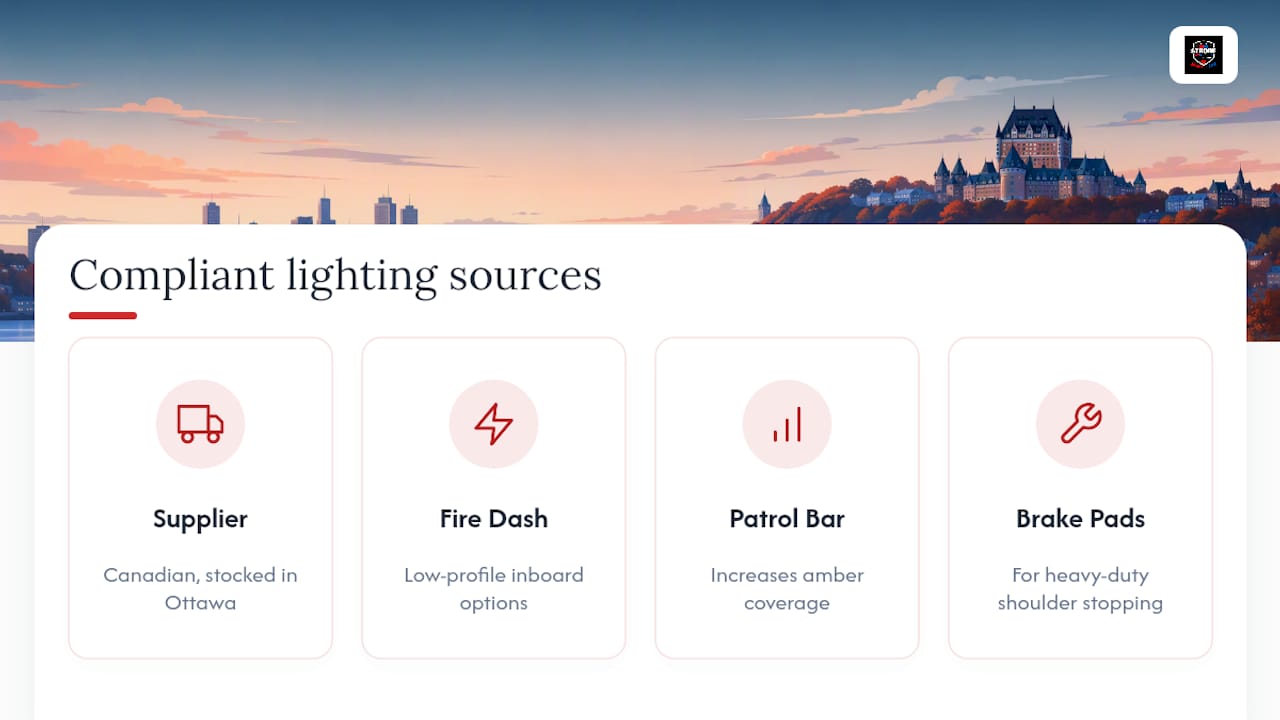
For a driver’s cab, the Fire Dash green dash warning light or its compact sibling the Fire Dash Mini Responder offer low-profile options suited to inboard placement. Fleets upgrading amber coverage to keep it visually dominant alongside any green addition can look at the Patrol Bar Quad 50 Slim lightbar. Every product page lists its own certifications and specifications, so confirm those details against your specific vehicle and application before ordering. If your fleet also runs heavy-duty stopping equipment on the shoulder, heavy-duty brake pads built for Canadian driving conditions are worth reviewing as a companion consideration. Explore the full Quebec tow truck warning light collection to find the right fit for your fleet today.


