


Lumens measure the total quantity of visible light a source emits in all directions; candela measures luminous intensity in one specific direction. For everyday room or area brightness, check lumens. For beam throw, long-range spotting, or warning-light visibility, check candela.
Quick reference — which spec to check first:
- Ambient or area lighting (shop floors, scene lighting, flood coverage): check lumens
- Beam throw, spotlight, or long-range visibility: check candela (peak beam intensity)
- Warning lights and emergency strobes: check effective candela, not raw lumens
- Both metrics together: task lighting where you need adequate area coverage and directed intensity
Key takeaways
Candela determines how far and how intensely a light reaches in one direction; lumens determine how much light a fixture produces in total — and for vehicle warning lights, effective candela is the spec that predicts real-world visibility.
| Point | Details |
|---|---|
| Lumens for area coverage | Check lumens when you need to know how well a fixture illuminates a space or work surface. |
| Candela for throw and warning | Check peak or effective candela when beam reach, spotlight distance, or warning-light visibility matters. |
| Beam angle changes everything | Narrowing beam angle multiplies candela from the same lumen source; always read both figures together. |
| Verify measurement method | Request IES test reports or SAE class markings; unverified lumen or candela claims are marketing, not specs. |
| Strobe My Ride work lights | The NX514 (4,250 lm), NX520 (23,200 lm), and NX525 (46,400 lm) illustrate how lumen scale maps to task, mid-range, and large-area flood applications. |
Table of Contents
- What do lumens and candela actually measure?
- Why two lights with the same lumens can behave very differently
- How to convert between lumens and candela
- How manufacturers measure and report these specs
- Which metric matters for your specific application?
- Marketing pitfalls that inflate specs
- Canadian procurement guidance for vehicle and emergency lighting
- Strobe My Ride: verified specs, Canadian support
- Sources
What do lumens and candela actually measure?
A lumen (lm) is the SI unit of luminous flux — the total quantity of visible light a source sends out across every direction simultaneously. Think of it as the total volume of light leaving a fixture, regardless of where that light ends up.
A candela (cd) is the SI base unit of luminous intensity: how much of that light is concentrated into one specific direction. The candela is formally defined by fixing the luminous efficacy of monochromatic radiation at 540 × 10¹² Hz, which is the frequency where the human eye is most sensitive. That biological grounding is why photometric measurements weight wavelengths by eye response rather than raw energy.
A useful way to picture the difference: imagine a garden hose running at full flow. The total water volume per minute is the lumen count. Screw on a narrow nozzle and that same volume becomes a high-pressure jet — the pressure at the nozzle tip is the candela. Same total output, very different directional intensity.
According to ICO Optics, one candela is roughly equivalent to the luminous intensity of a single candle flame. The formal relationship is: lm = cd × sr, where sr is the steradian, the unit of solid angle. A full sphere subtends 4π steradians (approximately 12.57 sr), so a perfectly uniform 1 cd source emitting in all directions would produce about 12.57 lm total.
Pro Tip: Lux (lx) is a third related unit — it measures illuminance on a surface (lm/m²). Lux tells you how much light actually lands on a work surface or road, which is why lighting designers use all three: lumens for source output, candela for directional intensity, and lux for surface brightness.
Why two lights with the same lumens can behave very differently
Optics are the reason. A fixture’s reflectors, lenses, and housing determine how lumens are distributed across angles. Concentrate 1,000 lm into a 10° beam and you get a tight, high-candela spotlight that throws light hundreds of metres. Spread those same 1,000 lm across a 120° flood pattern and the candela value drops sharply, but the fixture illuminates a wide area evenly.
This distinction plays out across several real-world scenarios:
- Flashlights and spotlights: a high-candela thrower with a narrow beam reaches farther than a high-lumen floodlight of equal wattage
- Vehicle scene lights: wide-flood fixtures prioritise lumens and lux on the ground; a narrow spot on the same truck priorities candela for distance
- Lightbars and warning strobes: effective candela in the direction of oncoming traffic is the critical metric, not total lumen output
- Signage and task lighting: both matter — enough lumens for area coverage, enough directional intensity to read fine detail
Fire Apparatus Magazine notes that marketing often favours lumen counts while failing to communicate optics or beam distribution, and that lumens alone do not indicate how a light will perform on the ground or at distance. For emergency lighting, this gap between advertised lumens and real-world visibility can have safety consequences.
Pro Tip: When safety is the goal, ask the manufacturer for peak candela (maximum cd in the primary beam axis) or ground-illumination values (lux at a specified distance). A lumen number without beam-angle data tells you almost nothing about throw or warning visibility.
How to convert between lumens and candela
The core relationship is straightforward. From ICO Optics’ photometric unit reference:
lm = cd × sr and therefore cd = lm ÷ sr
The steradian value (sr) depends on the beam angle (θ). The formula is:
sr = 2π × (1 − cos(θ ÷ 2))
where θ is the full beam angle in degrees, converted to radians by multiplying by π/180 before applying the cosine.
Three worked examples
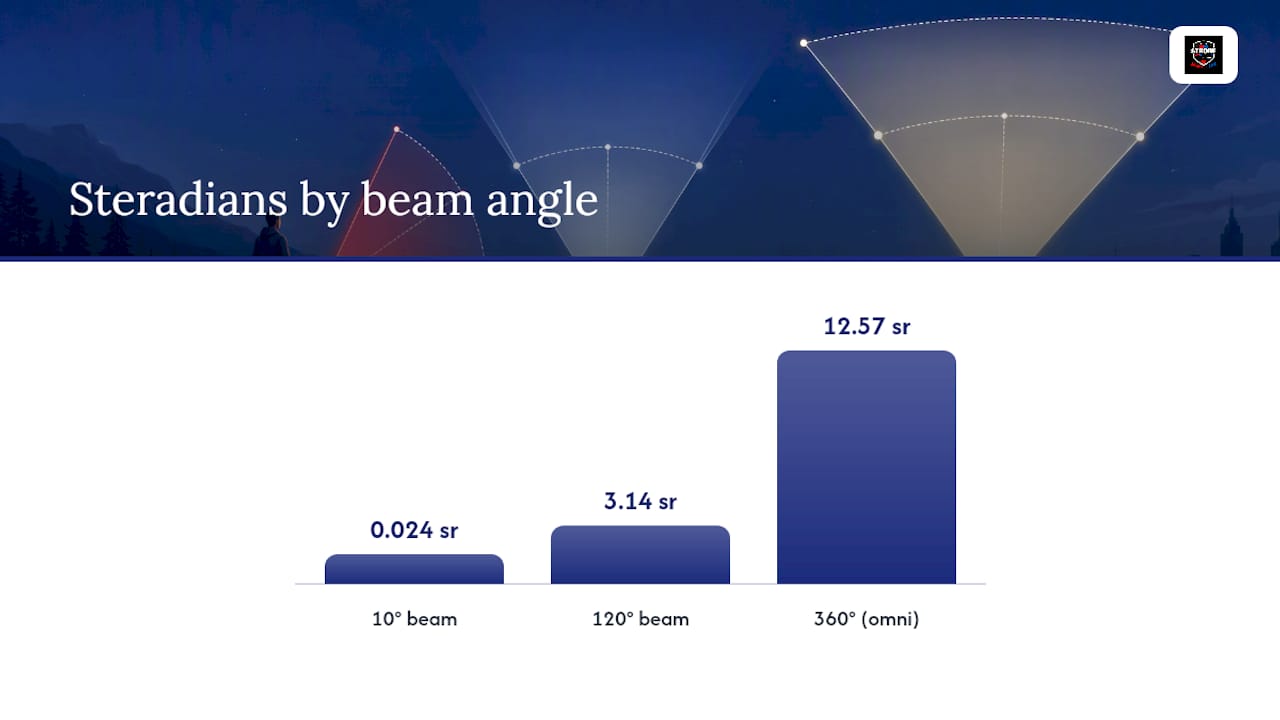
Example 1 — Narrow spotlight (10° beam) sr = 2π × (1 − cos(5°)) = 2π × (1 − 0.9962) ≈ 2π × 0.0038 ≈ 0.024 sr A fixture producing a moderate lumen output through a narrow 10° beam will have very high candela intensity
Example 2 — Wide flood (120° beam) sr = 2π × (1 − cos(60°)) = 2π × (1 − 0.5) = 2π × 0.5 ≈ 3.14 sr A fixture producing 4,250 lm through a 120° flood: cd = 4,250 ÷ 3.14 ≈ 1,353 cd
Example 3 — Full-sphere theoretical (360°) sr = 4π ≈ 12.57 sr A 1,000 lumen omnidirectional source has a moderate average candela intensity
The practical takeaway: narrowing the beam angle multiplies candela dramatically from the same lumen source. When you see a product claiming very high candela from modest lumens, check the beam angle — it will be narrow.
| Beam angle | Steradians (sr) | 1,000 lm → cd |
|---|---|---|
| 10° | 0.024 | very high cd |
| 10° | 0.024 | moderately high cd |
| 60° | 3.14 | moderate cd |
| 120° | 3.14 | lower cd |
| 360° | 12.57 | low cd |
How manufacturers measure and report these specs
Two instruments dominate photometric testing.
An integrating sphere captures all light emitted by a source and measures total luminous flux in lumens. The fixture sits inside a hollow, reflective sphere; sensors record the total light bouncing around the interior. This is the standard method for lumen ratings.
A goniophotometer rotates a light source (or a detector) through many angles, recording intensity at each point. The result is a full luminous intensity distribution curve, from which peak candela, effective candela, and beam distance are derived. This instrument is what backs a credible candela claim.
Terms to know when reading specs:
- Peak beam intensity: the maximum candela value, measured along the primary beam axis
- Effective candela: candela after accounting for housing, lens, and installation losses — a more realistic predictor of in-service performance than theoretical peak
- Beam distance: the distance at which illuminance falls to 0.25 lux (the ANSI/PLATO standard threshold for flashlights; other standards use different thresholds)
- Raw vs. effective lumens: raw lumens are measured at the LED chip; effective lumens account for losses through optics and housing
Standards to look for:
- IES (Illuminating Engineering Society): publishes LM-79 and LM-80 test methods for LED products; an IES test report is a strong trust signal
- ANSI/SAE: SAE International standards (e.g., SAE J845, SAE J595) define flash patterns, candela requirements, and test methods for vehicle warning lights
- CIE (Commission Internationale de l’Éclair age): the international body for photometric definitions and measurement methods
The NIST definition of the candela underpins all of these standards, since every photometric measurement traces back to the SI base unit.
When procuring lights for a fleet or emergency application, request the measurement method and test report alongside the spec sheet. A lumen or candela number without a stated test method is a marketing claim, not a verified specification.
Which metric matters for your specific application?
The right metric depends on what the light needs to accomplish.
| Use case | Primary metric | Secondary metric | Why |
|---|---|---|---|
| Ambient / area lighting | Lumens (lm) | Lux at surface | Total output determines how well a space is lit |
| Task lighting (close range) | Lux (lm/m²) | Lumens | Surface illuminance matters more than direction |
| Spotlight / throw | Candela (cd) | Beam angle | Directional intensity determines reach |
| Vehicle warning lights | Effective candela (cd) | Flash pattern | Visibility to oncoming traffic is directional |
| Scene / work lights on vehicles | Lumens + lux | Beam angle | Wide coverage needed; ground illuminance is the goal |
The three Noxsolis work lights available through Strobe My Ride illustrate how lumen scale maps to application. The compact Noxsolis NX514 produces 4,250 lm — well suited to close-range task lighting on a tow truck or utility vehicle where a moderate flood covers the immediate work area. The Noxsolis NX520 steps up to 23,200 lm flood output at 290 W, appropriate for larger scene coverage on a construction or roadside response vehicle. At the top end, the Noxsolis NX525 delivers 46,400 lm flood at 580 W — a fixture designed for maximum area illumination where a wide, high-lux footprint on the ground is the priority.
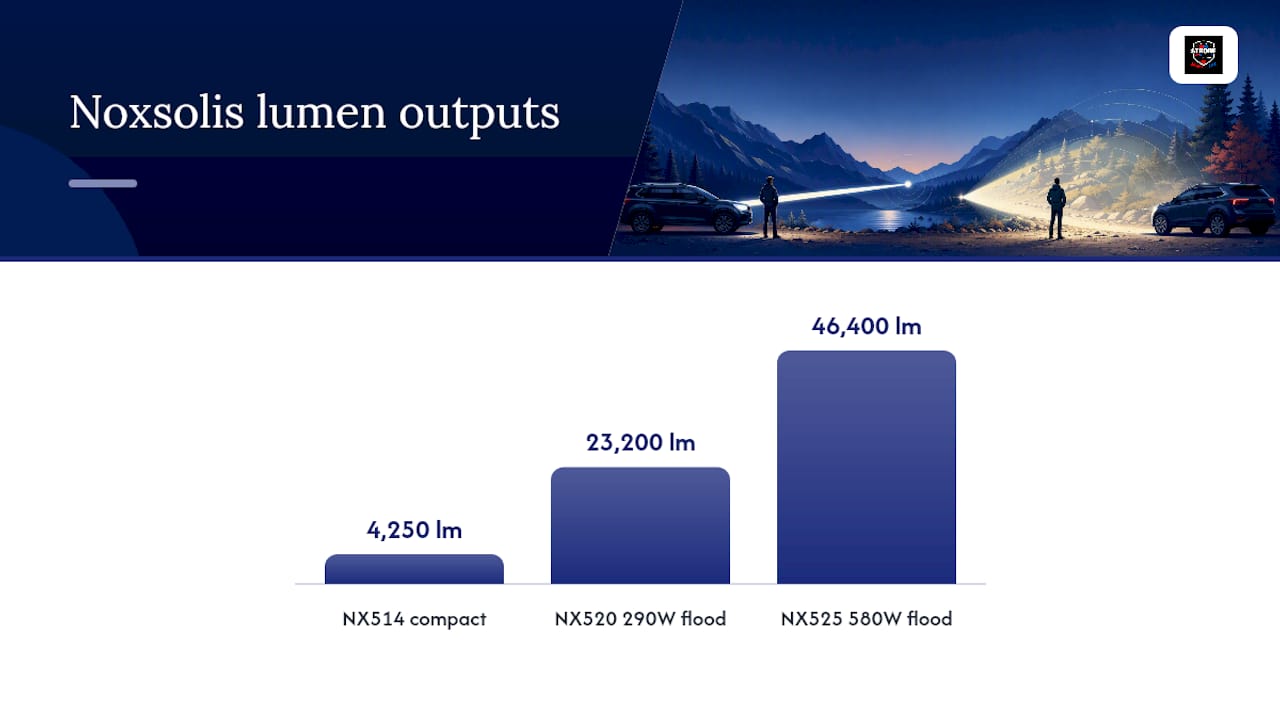
For scene and work lighting like these flood fixtures, lumens and lux on the work surface are the governing specs. For warning lights on the same vehicle, shift your attention to effective candela and SAE class markings.
Product-spec checklist when comparing lights:
- Total lumens (lm) and whether they are raw or effective
- Peak candela (cd) and beam angle (degrees)
- Measurement method (integrating sphere, goniophotometer, IES test report)
- SAE, ECE, or ANSI class marking where applicable
- IP rating for weather resistance (IP67 or IP69K for harsh environments)
- Warranty terms and country of support
Marketing pitfalls that inflate specs
Lumen inflation is the most common issue. Manufacturers sometimes quote LED chip lumens measured before the light passes through any optics, housing, or lens. By the time light exits the fixture, real-world output can be meaningfully lower. Always ask whether a lumen figure is source lumens (at the chip), system lumens (at the fixture output), or effective lumens (accounting for all losses).
A few other patterns to watch for:
- Spotlight candela applied to a flood product: a manufacturer measures peak cd in the tightest part of the beam, then uses that number to describe a fixture that is primarily a flood light
- Mixing radiometric and photometric units: watts or milliwatts of radiant power are not lumens; a product quoting “output power” in watts is not giving you a photometric measurement
- No beam angle disclosed: a candela figure without a stated beam angle cannot be verified or compared; it may reflect a very narrow test condition
- Unspecified test conditions: temperature, drive current, and stabilization time all affect output; reputable manufacturers state these in their test reports
Fire Apparatus Magazine’s analysis of lumen myths makes the point plainly: optics and beam distribution often determine real-world performance far more than the headline lumen number. For emergency lighting, that gap between marketing copy and field performance is a safety issue.
Red flags in a product listing:
- Lumen count with no beam angle or measurement method stated
- Candela claim with no test report available
- “Equivalent to X lumens” language without a direct measurement
- No IP rating or vague “waterproof” language instead of a rated standard (e.g., IP67 or IP69K)
Canadian procurement guidance for vehicle and emergency lighting
For fleet managers and procurement staff in Canada, the candela vs. lumens distinction has direct compliance implications. SAE International standards — including SAE J845 for omnidirectional warning lights and SAE J595 for directional warning lights — specify minimum effective candela values and flash-pattern requirements. Canadian provincial regulations reference SAE classes when setting requirements for amber warning lights on tow trucks, construction vehicles, and emergency response units. Transport Canada’s Motor Vehicle Safety Regulations (CMVSS) also reference photometric performance standards for lighting equipment.
When effective candela falls below the threshold for the applicable SAE class, a warning light may not meet the visibility requirement for its intended use, regardless of how many lumens it produces. This is why procurement based on lumen counts alone can result in non-compliant or under-performing equipment.
For Canadian emergency warning light standards, the governing principle is that the light reaching an observer in the target direction is what matters. Effective candela, not raw lumens, predicts that.
Procurement checklist for Canadian fleets:
- Request peak candela and effective candela values (not just lumens)
- Confirm the SAE or ECE class marking and ask for the corresponding test report
- Verify IP rating: IP67 (submersion to 1 m) or IP69K (high-pressure wash-down) for vehicles exposed to road spray, pressure washing, or harsh weather
- Check mounting and aiming guidance — a light aimed incorrectly loses effective candela in the target direction
- Confirm warranty coverage and whether the supplier provides Canadian technical support
Pro Tip: Ask the supplier for ground-illumination values (lux at a specified distance and mounting height) for scene lights, and for effective candela after housing and lens losses for warning lights. These figures, rather than raw specs, reflect what the light will actually deliver once installed on your vehicle.
For roadside scene lighting specifically, mounting height and aiming angle affect the lux footprint on the ground significantly. A 23,200 lm flood mounted too high and aimed too far forward may leave the immediate work zone under-lit, even though the lumen count looks adequate on paper.
Strobe My Ride: verified specs, Canadian support
If you work on or respond to Canadian roads, you need lighting that comes with real photometric data, not just a headline lumen count. Strobe My Ride supplies SAE-rated warning lights, LED work lights, scene lights, and full vehicle upfitting products to tow operators, fleet managers, municipalities, and emergency services across Canada — with transparent specifications, fast domestic shipping, and technical support from people who understand the difference between a candela claim and a verified test report.
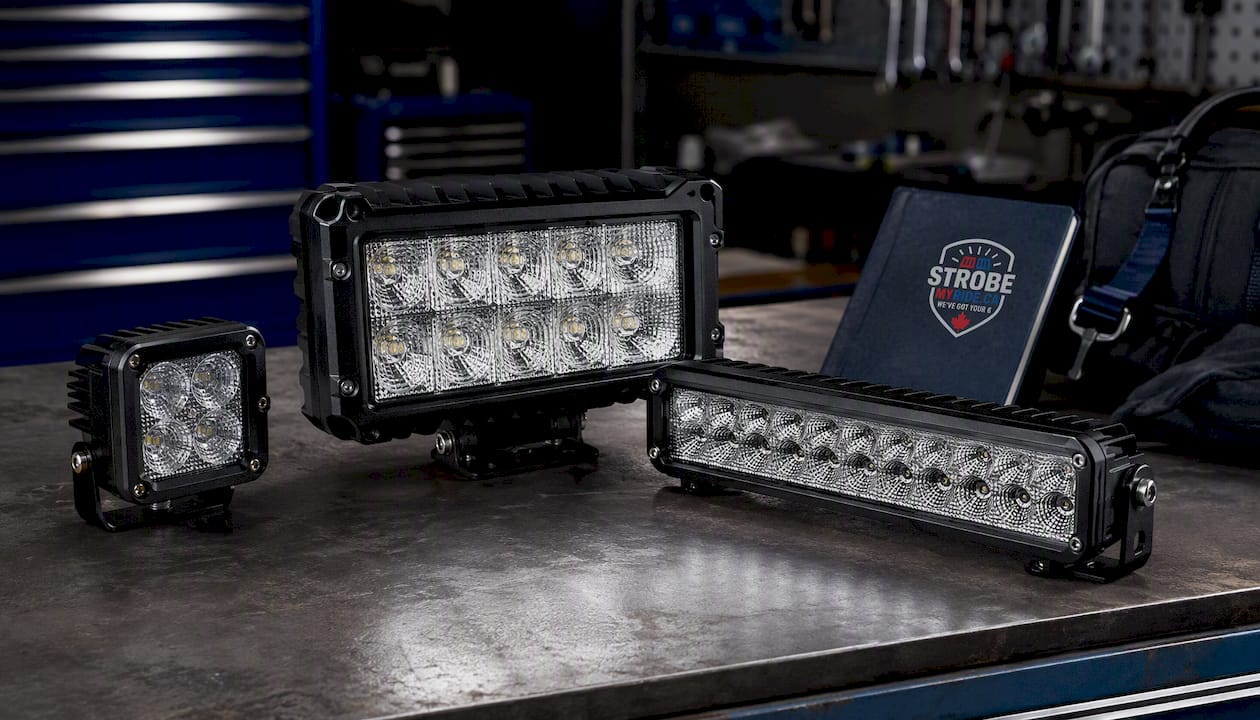
The NX514, NX520, and NX525 work lights are stocked and ready to ship. If you need help matching lumen output or effective candela to your vehicle’s specific application, Strobe My Ride’s team can walk through the specs with you. Browse the full work light collection or contact Strobe My Ride directly to get the right fixture for your fleet.
Sources
Standards and measurement references:
- NIST — SI units: luminous intensity
- Fire Apparatus Magazine — Debunking myths about lumens
- ICO Optics — Photometric units explained
Strobe My Ride product pages (specimen specifications):
For LED light bars and additional vehicle upfitting options, the GVX LED light bar is one partner option worth reviewing alongside Strobe My Ride’s own range.
Recommended
- LED vs Halogen Warning Lights: Which Wins? | Strobe My Ride – Strobe My Ride
- Fleet Beam 120 - LED Work Light Combo Beam Canada | Strobe My Ride – Strobe My Ride
- Light Bar vs Beacon: Which One Fits the Job? | Strobe My Ride – Strobe My Ride
- Roadside Scene Lighting Solutions That Work | Strobe My Ride – Strobe My Ride


