

Are Purple Flashing Lights Legal in Ontario?
Yes. Purple flashing lights are not currently regulated as a restricted warning-light colour under Ontario’s Highway Traffic Act.
The Ontario Ministry of Transportation has confirmed in writing that flashing purple, white and amber lights are not restricted in the same way as flashing red, blue and green lights. According to the Ministry, any driver may place purple lights on a vehicle.
That does not make a vehicle an emergency vehicle. It does not grant the driver the right-of-way, permission to disregard traffic laws or any other special authority. It simply means that Ontario’s current legislation does not reserve purple flashing lights for one particular class of vehicle.

For Ontario tow operators, purple can therefore be used as an additional visibility and recognition colour alongside the amber warning lighting required for towing operations.
What Ontario’s Highway Traffic Act Actually Regulates
Ontario’s Highway Traffic Act does not create one blanket rule prohibiting every flashing light that is not amber.
Instead, it specifically restricts particular colours and combinations.
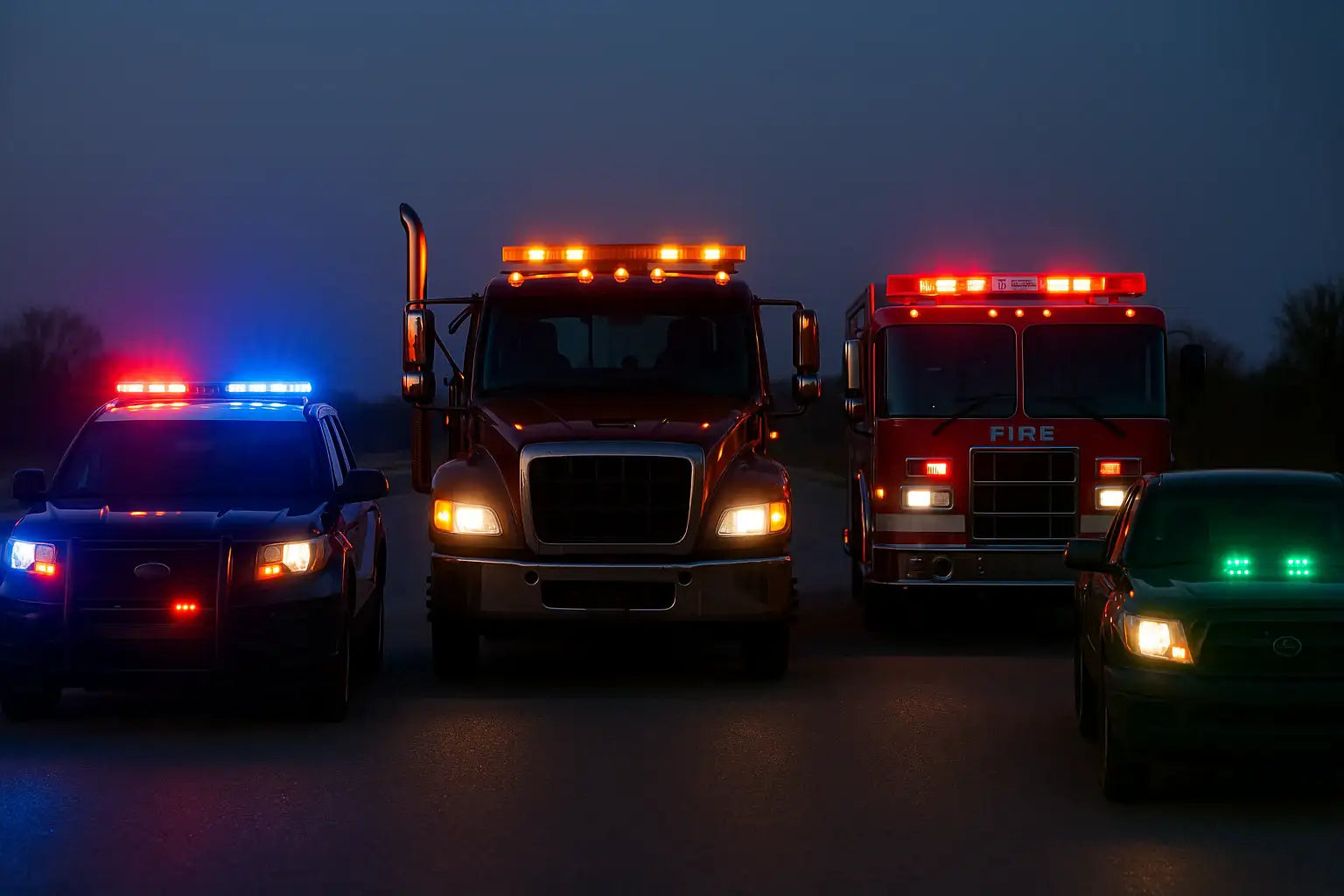
Flashing red lights are restricted primarily to authorized emergency and enforcement vehicles. Red-and-blue combinations are also restricted, while flashing blue lights have specific authorized uses, including designated snow-removal equipment. Flashing green lights are limited to authorized volunteer firefighters and certain volunteer medical responders. These restrictions are set out in section 62 of the Highway Traffic Act and Ontario Regulation 484/07.
Purple does not appear among those restricted warning-light colours.
White and amber flashing warning lights are also not generally restricted by colour under the HTA, although their installation and operation may still be subject to other equipment, visibility, glare, vehicle-use or industry-specific requirements.
What the MTO Said About Purple Lights
In a written response dated February 17, 2026, Ontario’s Ministry of Transportation addressed the use of different flashing-light colours on vehicles.
The Ministry stated that the restrictions applying to red, blue and green do not apply to purple, white and amber because those colours are not regulated in the same manner under the Highway Traffic Act. The response further stated that “any driver may place them on their vehicle.”
The MTO also explained that:
-
Purple lights have commonly been used for funeral processions.
-
Amber lights are commonly used as cautionary lighting on tow trucks, construction equipment, road-maintenance vehicles, utility vehicles and other service vehicles.
-
White lights are commonly used for auxiliary or work lighting.
-
Purple, white and amber lights do not provide special privileges.
This is an important distinction. The Ministry did not say that purple is reserved for funeral vehicles. It said that purple has generally or commonly been used for funeral processions. That is a description of customary use—not a legal restriction.
Excerpt from email:


Purple Funeral Lights Are a Tradition, Not an Ontario Law
Purple warning lights have long been associated with hearses, funeral escorts and funeral processions in Ontario and other parts of Canada.
That association has led some people to assume that funeral vehicles legally own or control the colour purple. They do not.
Ontario’s Highway Traffic Act does not contain a provision reserving purple flashing lights exclusively for:
-
Funeral homes
-
Hearses
-
Funeral escorts
-
Funeral processions
-
Cemetery vehicles
Funeral vehicles also receive no automatic emergency-vehicle authority simply because they display purple lights. The lights may help other drivers recognize a procession and respond courteously, but they do not authorize the procession to disregard traffic signals, stop signs or other rules of the road.
Purple’s historical association with funeral vehicles does not create a legal monopoly over the colour.
What Lighting Is Required on an Ontario Tow Truck?
Purple does not replace amber.
Ontario’s tow-truck equipment requirements state that a tow truck must be equipped with a lamp capable of producing intermittent flashes of amber light. That amber lamp must be used when the tow truck is stopped on a highway while towing, transporting or providing roadside-assistance services to a motor vehicle.
Amber remains the primary cautionary warning colour for tow trucks in Ontario.
Ontario’s slow-down and move-over protection is also tied to the presence of a stopped tow truck displaying flashing amber lights. Drivers approaching a stopped tow truck must slow down, proceed cautiously and, where there are multiple lanes and it can be done safely, move over to create space.
That legal protection does not arise because a tow truck displays purple. It arises because the vehicle is a tow truck displaying the required flashing amber warning lights.
For that reason, an amber-and-purple system should be configured so that:
-
Amber remains clearly visible as the primary warning colour.
-
Purple operates as an additional recognition colour.
-
Purple does not replace the required amber output.
-
The system does not imitate a restricted red-and-blue emergency-light configuration.
-
The lighting is operated only where it serves a legitimate warning or safety purpose.
Does Ontario Require SAE-Certified Amber Lights on Every Tow Truck?
Ontario’s tow-truck equipment regulation requires a lamp capable of producing intermittent flashes of amber light, but the relevant clause does not expressly state that every tow-truck warning lamp must be labelled SAE J595 or SAE J845.
That distinction matters.
However, professional tow operators should still use warning lights that meet the applicable SAE performance standard:
-
SAE J595 generally applies to directional warning lights, including many surface-mount and grille lights.
-
SAE J845 generally applies to omnidirectional warning devices such as beacons and certain 360-degree warning lights.
SAE compliance provides measurable standards for light intensity, colour, flash performance and visibility. It is considerably more meaningful than a manufacturer simply describing a product as “bright” or “professional-grade.”
The practical standard should therefore be simple: use properly tested amber warning lights as the primary system, then add purple where additional recognition is desired.
What About White Flashing Lights?
Many Ontario tow operators have already added white warning lights to their amber systems to increase visual contrast and improve daytime conspicuity.
The MTO has stated that flashing white is not a restricted colour under the Highway Traffic Act in the same manner as red, blue or green. White is also widely used for scene illumination, work lighting and supplementary warning output.
But legality and responsible use are not the same issue.
High-output white warning lights can be extremely effective during daylight. At night, particularly when directed toward approaching traffic from the rear of a stationary tow truck, the same output can create:
-
Glare
-
Temporary visual impairment
-
Reduced depth perception
-
Difficulty seeing workers beside the vehicle
-
A visual wall that hides the actual location of the hazard
More brightness does not always create more safety.
Rear-facing white warning lights should be carefully aimed and should use nighttime dimming or reduced-output operating modes wherever possible. White flood or scene lights should not be directed continuously into approaching traffic.
Purple may offer a useful alternative because it provides colour contrast and vehicle recognition without producing the same intense, colourless glare associated with high-output white LEDs.
Why Combine Amber and Purple?
Amber is familiar, legally required for tow-truck operations and universally understood as a caution signal.
Its weakness is that it is also everywhere.
Drivers routinely encounter amber lights on:
-
Snow plows
-
Construction vehicles
-
Garbage trucks
-
Security vehicles
-
Utility vehicles
-
Wide loads
-
Tractors
-
Maintenance equipment
-
Delivery vehicles
-
Parking-control vehicles
Because amber is so common, drivers may notice it without immediately recognizing that a roadside worker is standing only a few feet from live traffic.
Purple provides a visually distinct secondary signal. Used with amber, it may help drivers recognize that the vehicle ahead is not simply another slow-moving work truck, it is a roadside-service vehicle operating near an active traffic lane.
The intended message is not “emergency vehicle.”
The intended message is:
Tow truck ahead. Roadside worker present. Slow down and move over.
Responsible Amber-and-Purple Operation
A professional amber-and-purple warning system should be designed around visibility rather than spectacle.
Amber should remain the dominant and legally compliant warning colour. Purple should supplement that output to improve recognition and visual contrast.
Operators should also consider:
-
SAE-compliant primary amber lighting
-
Full front, side and rear warning coverage
-
Synchronized, predictable flash patterns
-
Reduced nighttime intensity
-
Limited rear-facing white output
-
Proper mounting height and aiming
-
Separate scene-light and warning-light controls
-
Avoiding unnecessarily rapid or chaotic flash patterns
No warning-light colour can compensate for poor placement, blocked light heads or excessive glare.
The Bottom Line
Purple flashing lights are not reserved for funeral vehicles under Ontario law.
Funeral processions have traditionally used purple, but that customary use is not written into the Highway Traffic Act as an exclusive legal entitlement. The Ontario Ministry of Transportation has stated that purple, white and amber flashing lights are not regulated like red, blue and green lights and that any driver may place them on a vehicle.
For tow trucks, however, amber remains essential.
A tow truck must continue to display the required flashing amber warning lighting when operating at the roadside. Purple may be added as an auxiliary recognition colour to increase contrast, improve early identification and encourage approaching drivers to slow down and move over.
Purple does not create emergency powers. It does not grant the right-of-way. It does not replace amber.
It is an additional visibility tool intended to help protect the people who work only metres, or sometimes centimetres, from moving traffic.
Amber remains the warning. Purple strengthens the recognition.
Be Seen. Be Safe.
This article provides general information about Ontario vehicle-lighting requirements and should not be treated as individualized legal advice. Vehicle owners and operators remain responsible for complying with all applicable provincial legislation, equipment regulations, municipal requirements, operating standards and permit conditions.