


Rechargeable LED road flares are portable electronic signalling devices that use bright LED arrays to warn approaching drivers of roadside hazards, without fire, toxic smoke, or single-use waste. Unlike traditional pyrotechnic flares, these reusable units meet the minimum 150-metre visibility requirement set by Ontario commercial testing standards, and many exceed it. Canadian drivers and emergency responders are choosing rechargeable LED road safety flares because they are safer to handle, legal to reuse, and far more practical in the rain, snow, and darkness that define Canadian roads. The Signal Flare 360 from Strobe My Ride adds multi-colour selection and synchronised flashing, giving responders a clear way to direct traffic flow at any scene.
How do rechargeable LED road flares work?
Rechargeable LED road flares operate on lithium-ion or similar rechargeable battery technology. You charge them between uses, deploy them at a scene, and recover them when the emergency is over. That cycle repeats hundreds of times before any component needs replacing.
The core technology is straightforward. A cluster of high-output LEDs draws power from the internal battery and projects light in a wide arc. The best units achieve 360-degree light coverage so drivers approaching from any angle see the warning. That all-around visibility is something a directional burn flare simply cannot match.
Key features that affect performance
Not every LED road safety flare performs equally. These are the features that separate a reliable unit from one that fails when you need it most:
- Runtime: Quality rechargeable units deliver 8–20 hours per charge, which covers extended roadside incidents, overnight breakdowns, and multi-hour construction closures.
- Flash modes: Multiple flash patterns, typically up to nine modes, let you match the signal to the situation. A slow pulse works for a parked breakdown; a rapid strobe suits a high-speed highway closure.
- Magnetic base: A magnetic base locks the flare to any steel surface, including vehicle frames, guardrails, and equipment. This prevents the unit from rolling or blowing off the road in wind.
- Durability ratings: Look for waterproof, shock-resistant, and crush-proof construction. Canadian winters involve freezing rain, road salt, and heavy boots stepping on equipment.
- Colour options: Red signals danger and stop. Amber signals caution and slow down. Green and blue are used by specific responder classes in certain provinces. The Signal Flare 360 from Strobe My Ride offers all four colours, giving you the right signal for the right situation.
- Synchronisation: Some units can sync their flash patterns with other flares in the set. Synchronised flashing creates a visual corridor that tells drivers exactly where to steer.
Pro Tip: Charge your LED road safety flares fully after every deployment, not just when the battery is low. Partial charges over time can reduce battery capacity on some lithium-ion cells. A full charge cycle after each use keeps runtime consistent.
What are the official Canadian safety standards for emergency road signals?
Canadian safety standards for emergency road signals set a clear baseline. Flare visibility regulations vary by province, and commercial vehicles face stricter requirements than private passenger vehicles. Understanding which rules apply to your vehicle class and province is the first step toward legal compliance.
Visibility distance requirements
Ontario commercial testing standards require emergency warning devices to be visible for at least 150 metres to oncoming traffic. That 150-metre threshold gives a driver travelling at 100 km/h roughly five seconds of reaction time. Five seconds is the minimum needed to slow, change lanes, and avoid a stopped vehicle safely.
Rechargeable LED road flares with high lumen output and 360-degree coverage meet this standard in most conditions. In fog or heavy snow, placement distance becomes even more critical because the effective visibility range shrinks. Placing flares farther back compensates for reduced atmospheric clarity.
Recommended placement distances
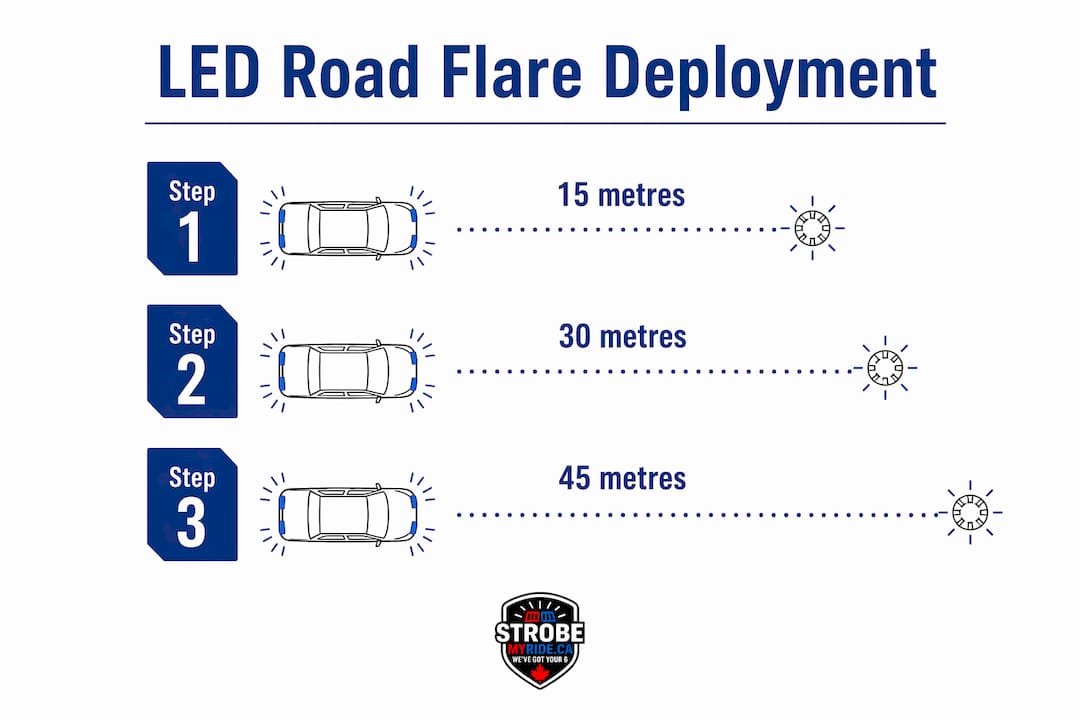
Transport Canada guidance and provincial road safety resources recommend placing warning devices at 15, 30, and 45 metres behind a stopped vehicle. This graduated spacing gives approaching drivers a sequence of warnings rather than a single point of light.
| Placement position | Distance from vehicle | Purpose |
|---|---|---|
| First flare | 15 metres | Immediate warning at close range |
| Second flare | 30 metres | Mid-range alert for slowing traffic |
| Third flare | 45 metres | Far warning for highway-speed drivers |
| Curve adjustment | Beyond 45 metres | Placed before the curve, not after |
On curves or hills, the 45-metre flare moves to the point where oncoming drivers first lose sight of your vehicle. That adjustment is not optional. A flare placed after a blind curve provides no warning at all.
Commercial versus private vehicle requirements
Commercial vehicle operators in Canada face requirements that go beyond what applies to private drivers. Provincial rules for commercial vehicles often specify the number of warning devices carried, the type of device permitted, and the minimum visibility standard. Tow truck operators, fleet drivers, and roadside assistance crews should review their provincial motor carrier regulations and confirm their equipment meets the applicable standard. The Canadian emergency warning light standards page at Strobe My Ride provides a plain-language breakdown of SAE standards and provincial differences worth reviewing before you purchase.
Colour restrictions also apply in some provinces. Red and amber are the most broadly permitted colours for roadside warning use. Blue is restricted to police in most provinces. Green is used by volunteer firefighters and incident commanders in certain jurisdictions. Confirm your province’s rules before deploying coloured flares in a non-emergency context.
Why choose rechargeable LED flares over traditional pyrotechnic flares?
Chemical flares produce an open flame that burns at extremely high temperatures. That flame ignites spilled fuel, dry grass, and roadside debris. LED flares eliminate fire hazards entirely because they produce light without combustion. For tow truck operators, roadside assistance crews, and anyone working near a vehicle that may have a fuel leak, that difference is not minor. It is the difference between a controlled scene and a fire.
Safety, cost, and environmental impact
The practical advantages of battery-operated road flares compound over time. A single rechargeable unit replaces dozens of disposable chemical flares over its service life. Chemical flares contain perchlorate and heavy metals that leach into soil and waterways when discarded on roadsides. Rechargeable units generate no roadside waste.
| Factor | Chemical pyrotechnic flare | Rechargeable LED flare |
|---|---|---|
| Fire hazard | Open flame, burns at high heat | None, cool to touch |
| Reusability | Single use, then discarded | Hundreds of reuse cycles |
| Environmental impact | Toxic residue, roadside waste | No chemical waste |
| Visibility coverage | Directional, limited arc | 360-degree all-around |
| Weather performance | Wind and rain can extinguish | Unaffected by weather |
| Runtime control | Burns until exhausted | Adjustable, switchable off |
The cool-to-touch design of rechargeable LED road flares matters most when you are placing and retrieving devices in traffic. A chemical flare that has been burning for ten minutes reaches temperatures that cause serious burns through gloves. An LED unit can be picked up immediately after use with bare hands.
Performance in Canadian weather conditions
Canadian winters test every piece of roadside equipment. Chemical flares struggle in heavy rain and can be extinguished by wind or standing water. LED road safety flares rated for waterproof operation perform identically in a January blizzard and a July rainstorm. The magnetic base keeps the unit in place when highway wind gusts hit. The sealed housing keeps moisture out of the electronics.
Pro Tip: Keep a set of rechargeable LED road safety flares in a dedicated kit bag in your vehicle, separate from your jumper cables and tow strap. Dedicated storage means you grab the right bag immediately at a scene, without searching through equipment in the dark.
How to properly deploy LED road flares for maximum safety
Proper deployment starts before you touch a flare. The sequence matters because every second you spend on the road without warning devices in place is a second of exposure to oncoming traffic.
Step-by-step deployment sequence
-
Move your vehicle off the road. Pull as far onto the shoulder as possible. If the vehicle cannot move, activate your hazard lights immediately and stay inside until traffic clears enough to exit safely.
-
Put on high-visibility clothing. A reflective vest takes five seconds to put on and dramatically increases your visibility to approaching drivers. Keep one in your kit bag.
-
Grab your LED road safety flares before exiting. Carry all three units in one hand so you can place them in a single pass along the shoulder.
-
Place the first flare at 15 metres behind the vehicle. Walk along the shoulder, not the travel lane. Activate the flare before setting it down so it is already signalling as you move to the next position.
-
Place the second flare at 30 metres. Use the same flash mode on all units for a consistent visual pattern, or activate synchronisation if your flares support it. Synchronised flashing creates a pulsing corridor effect that is far more attention-grabbing than three independent units.
-
Place the third flare at 45 metres. On a curve or hill, extend this distance until the flare is visible from the point where oncoming drivers first see the road ahead. Placement starting closest to the vehicle and extending outward is the standard method recommended for LED flare deployment.
-
Use colour to direct traffic. If your flares offer colour selection, amber signals caution and lane change. Red signals stop or danger. Place the red unit closest to the hazard and amber units at the outer positions to guide drivers through the scene.
-
Retrieve flares in reverse order. When the scene is clear, collect the farthest flare first and work back toward the vehicle. This keeps warning devices in place as long as possible during recovery.
Maintenance and charging routines
A flare that fails at a scene is worse than no flare at all because you may have relied on it in your safety plan. Check battery level monthly. Charge fully after every deployment. Inspect the housing for cracks or water ingress after any incident involving impact. Store units in a temperature-stable environment. Extreme cold reduces lithium-ion battery capacity temporarily, so a flare stored in an unheated vehicle in january may show reduced runtime until it warms up.
The LED road flares selection guide at Strobe My Ride covers what to look for in Canadian conditions, including cold-weather battery performance and housing durability ratings worth checking before you buy.
Signal Flare 360: rechargeable LED road flares from Strobe My Ride
Strobe My Ride supplies the Signal Flare 360 to Canadian drivers, fleet operators, and emergency responders who need a reliable, reusable emergency road signal.
The Signal Flare 360 is rechargeable, offers red, green, blue, and amber colour selection, and supports synchronised flashing across multiple units. That combination gives you the right colour for your province’s requirements and the synchronised corridor effect that directs traffic clearly through any scene. Strobe My Ride ships across Canada with fast delivery and backs its products with industry-leading warranties. If you work on Canadian roads, the Signal Flare 360 belongs in your kit.
Key takeaways
Rechargeable LED road flares are the safest, most practical, and most cost-effective emergency signalling solution for Canadian drivers and responders, meeting the 150-metre visibility standard while eliminating fire hazards and single-use waste.
| Point | Details |
|---|---|
| Visibility standard | Canadian guidelines require emergency signals visible at a minimum of 150 metres to oncoming traffic. |
| Placement sequence | Place flares at 15, 30, and 45 metres behind the vehicle, adjusting farther on curves or hills. |
| LED advantages over chemical flares | LED units are cool to touch, reusable, weather-resistant, and produce no toxic roadside waste. |
| Colour and sync features | Multi-colour and synchronised flashing, as on the Signal Flare 360, direct traffic more clearly than single-mode units. |
| Maintenance routine | Charge fully after every deployment and inspect housing monthly to keep units ready for the next incident. |
FAQ
What are LED road flares?
LED road flares are rechargeable electronic signalling devices that use bright LED arrays to warn approaching drivers of roadside hazards. They replace single-use chemical flares and are reusable, cool to touch, and safe around fuel spills.
Are LED flares effective in Canadian winter conditions?
Yes. Waterproof and shock-resistant LED road safety flares perform reliably in rain, snow, and freezing temperatures. Unlike chemical flares, they cannot be extinguished by wind or standing water.
How far away should LED road flares be placed?
Place warning devices at 15, 30, and 45 metres behind a stopped vehicle. On curves or hills, extend the farthest flare to the point where oncoming drivers first see the road ahead.
How long do rechargeable LED road flares last per charge?
Quality rechargeable units typically provide 8–20 hours of runtime per charge. Runtime varies by flash mode, with rapid strobe patterns drawing more power than slow pulse modes.
What colours are permitted for roadside flares in Canada?
Red and amber are the most broadly permitted colours for roadside warning use across Canadian provinces. Blue is generally restricted to police, and green is used by volunteer firefighters and incident commanders in specific jurisdictions. Confirm your province’s rules before deploying coloured units.


