


For professional tow work, the practical choice is a full-size or mini amber LED lightbar paired with a dedicated scene light and an amber equipment beacon. That combination covers roadway conspicuity, task illumination, and parked-work signalling in one system. Strobe My Ride stocks all three categories, built for the duty-cycle and mounting demands of commercial towing rather than passenger-vehicle accessory use.
TL;DR:
- Full-size lightbars provide the widest visibility range and highest light output, making them ideal for highway recovery and heavy-duty towing.
- Mini lightbars and surface mounts are best suited for flatbeds, service trucks, and environments with limited roof clearance or aerodynamic restrictions.
- Proper mounting height and medium flash rates (1 to 4 flashes per second) significantly improve detection without causing excessive glare.
- Canadian regulations require lighting components to meet federal standards, but provincial rules vary, making jurisdiction-specific compliance checks essential.
- Ordering from a local supplier like Strobe My Ride ensures in-stock options, faster deployment, and certification documentation for fleet-wide implementation.
Which tow truck lighting options actually fit commercial work?
Tow operators tend to shop for one of two things: a bar that gets seen from a distance on the highway, or a compact setup that fits a crowded flatbed deck without adding drag or catching on cargo straps. Neither is objectively “better” than the other. The right pick depends on the job.
Full-size lightbars sit across the cab roof and deliver the widest visible angle and the most light output, which matters most for highway recovery and heavy-duty towing where approaching traffic needs to register a stopped vehicle from several hundred metres out. Mini lightbars trade some of that spread for a lower profile, useful on flatbeds, service trucks, and vehicles where roof clearance or aerodynamics matter. Surface-mount lights go a step further, sitting almost flush against sheet metal for grille, mirror, or deck-rail placement where a raised bar isn’t practical. Beacons remain the simplest warning device, a single rotating or LED-flash dome typically used to mark a stationary vehicle during roadside work. Scene or work lights are a different category entirely: they’re built for flood-pattern illumination of the work area, not warning conspicuity, and they belong alongside a lightbar rather than instead of one.
Here’s what each of those categories looks like in Strobe My Ride’s current lineup, organized by the job they’re built to do.
Highway and heavy recovery (full-size lightbars):
- The Patrol Bar Quad 50 Slim w/ STT is a full-size lightbar built for cab-roof mounting on trucks doing highway recovery, where a slim profile still needs to deliver wide-angle output.
- The Patrol Bar Quad 60 w/ STT extends that same full-size format for operators who want the longest bar length available for maximum lit surface area.
Flatbed, crane truck, and compact deployments (mini lightbars and surface mounts):
- The Patrol Bar Quad 24 Mini Lightbar, available in amber, white, blue, and green configurations, suits flatbeds and service vehicles where a low-profile bar is the only option that clears deck hardware.
- The New Signal Vector Surface Mount is built for low-profile, near-flush installation where a raised bar isn’t practical, such as grille or mirror-arm placement.
- The Fleet SM Stealth Smoked Lens Surface Mount uses a smoked lens housing for a discreet daytime appearance while still delivering full output when activated.
Roadside service and night work (off-road beam, beacons, and scene lighting):
- The Patrol Beam Dual Force Quad is an LED off-road style lightbar that doubles as a high-output work and warning adjunct, useful for operators who need auxiliary beam output beyond the primary roof bar.
- The Fleet Beacon Equip Amber LED Equipment Beacon supplements a roof-mounted bar for parked-work signalling, a compact option when a full bar isn’t warranted for the task.
- The Signal Scene LED Scene Work Light is a flood-pattern work light designed to illuminate the work area around a stopped vehicle, not to serve as a warning device.
Strobe My Ride’s roadside assistance lighting resource groups these categories together for operators comparing configurations before they commit to a fleet-wide spec. As a general system approach, most experienced fleets lean on an amber lightbar for conspicuity, a dedicated scene light for task illumination, and an equipment beacon for parked-work signalling, rather than trying to make one light do all three jobs.
How do you choose the right lightbar for a tow fleet?
Start with the job the truck actually does. A flatbed running highway recoveries at 2 a.m. has different needs than a service truck doing driveway jump-starts in a subdivision, even though both are technically “towing.”
- Match the form factor to the operating environment. On-road transport and highway recovery favour full-size bars for maximum visible angle and light output at distance. Roadside service work, tight yards, and flatbed decks favour mini bars or surface mounts that avoid clearance conflicts.
- Check mounting height and visible angle together. A bar mounted low on a deck rail won’t project the same distance as one mounted on the cab roof, regardless of how bright the individual LEDs are.
- Confirm the flash pattern options. Fleets running mixed conditions (daylight highway shoulders versus night residential streets) benefit from lightbars with selectable or programmable flash patterns rather than a single fixed sequence.
- Verify the IP rating and weatherproofing. Commercial towing means road spray, winter salt, and temperature swings; a rating suited to occasional-use accessory lighting isn’t the same as one built for daily commercial exposure.
- Review power options and serviceability. Ask whether the unit is plug-and-play for your existing harness, what the connector type is, and whether individual modules can be serviced without replacing the entire bar.
- Ask suppliers about warranty terms and stock availability. A fleet manager specifying ten trucks needs to know lead times and whether replacement units are stocked in Canada, not backordered from overseas.
Pro Tip: When getting a fleet quote, ask the supplier for the specific certification test record for each SKU rather than a general compliance statement. Federal rules require importers and manufacturers to hold these records, and a supplier who can produce them quickly is one worth doing repeat business with.
Procurement teams should also ask about duty-cycle expectations for the specific product line, since a light built for occasional roadside deployment carries different service life expectations than one designed to run for hours during an overnight recovery. Strobe My Ride’s tow truck light bars resource walks through this category background in more detail for buyers comparing full-size and mini formats before finalizing a fleet spec.
What colours and rules apply to tow truck lighting?
Lighting components sold in Canada are built against Technical Standards Document No. 108 (TSD 108), which sets photometric output, mounting location, and equipment requirements for vehicle lamps. This is the federal baseline every buyer should be aware of, though it works alongside provincial rules that govern how and when tow operators may actually activate specific colours and devices.
Provincial requirements vary meaningfully, and buyers need to check their own jurisdiction rather than assume a spec that’s legal in one province transfers automatically to another.
- Manitoba requires tow trucks to run at least one amber flashing light, activated only while working at the roadside, and allows red flashing lights only by permit with strict activation and deactivation conditions, according to Manitoba Transportation and Infrastructure.
- British Columbia distinguishes device types clearly. Its amber flashing lamp reference guide clarifies that a sequential flashing light bar is not the same thing as a directional arrow board, and directional devices carry their own separate rules.
- Quebec has its own established norms around amber and green combinations for towing roles in certain municipal contexts, covered in more detail in Strobe My Ride’s guide to amber versus green lights in Quebec.
- Alberta and Saskatchewan have their own allowances worth reviewing before ordering, outlined in Strobe My Ride’s Alberta and Saskatchewan lighting guide.
Federal guidance also makes clear that manufacturers and importers must hold certification test records for the lighting components they sell. That’s a practical checkpoint for any buyer: ask your supplier for that documentation on the specific SKU you’re purchasing, not a general assurance that “everything we sell is compliant.” Strobe My Ride cannot provide legal or regulatory advice on your specific vehicle or route, and provincial transportation authorities remain the correct source for confirming what’s permitted in your operating area before a lightbar goes into service.
How should you mount lightbars to maximize visibility?
Getting the hardware right is only half the job. Mounting position and flash configuration determine whether that hardware actually does its work at a live scene.
Research reviewed by the AAA Foundation for Traffic Safety found that alternating flash patterns paired with moderate flash rates, roughly 1 to 4 flashes per second, produced strong detection results without needing complex or erratic sequences. The same review found that amber and green are both highly visible colours, but each can increase glare for approaching drivers if intensity isn’t managed carefully.
- Mount the primary lightbar as high as the vehicle structure reasonably allows; higher mounting improves detection distance, particularly against a cluttered roadside background.
- Avoid orienting the brightest lamp heads directly toward oncoming driver sightlines, since higher intensity that helps long-distance detection can increase disability glare at night.
- Keep the total lamp count in a display reasonable rather than stacking every available light head at full output. The AAA Foundation review found that a moderate number of lights per display tends to balance detection against glare, and adding more lights beyond that can raise discomfort glare while making it harder for drivers to spot a person standing near the vehicle.
- Pair the warning lightbar with a dedicated scene light for the actual work area rather than trying to use the warning bar’s spill light to illuminate the hookup or repair zone.
- Add an amber equipment beacon for stationary, parked-work phases, since a beacon signals “stopped and working” differently than an active flash pattern signals “approaching hazard.”
Coordinating intensity with mounting height and supplemental scene lighting matters more than chasing the highest available lumen figure, since a brighter bar mounted poorly can create as much of a glare problem as it solves in detection distance.
Why buy from a Canadian lighting supplier?
Strobe My Ride is Canadian-owned and stocked out of Ottawa, supplying tow and roadside operators, fleets, municipalities, and volunteer fire departments across the country. The catalog spans full-size and mini lightbars, surface mounts, beacons, and scene lighting, all held in Canadian inventory rather than sourced on a per-order basis from overseas. For a fleet manager trying to get ten trucks equipped before a winter contract starts, that in-market stock is often what separates a two-week install schedule from a two-month one.
How to order tow truck lightbars from Strobe My Ride
Once you’ve settled on a form factor, the ordering process is straightforward. Browse the tow truck light bars collection or the mini light bars collection to compare specific SKUs side by side, and check each product page for the certification and duty-rating details specific to that unit rather than relying on category-wide assumptions.
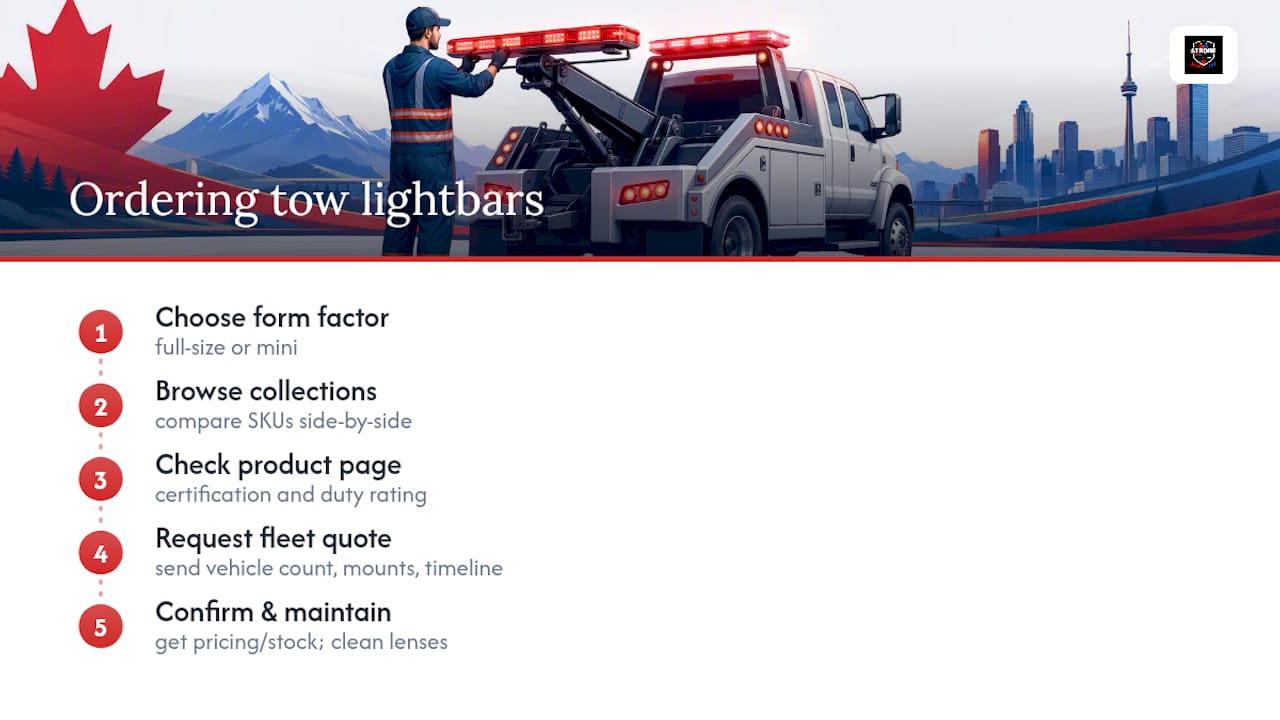
Fleet managers outfitting more than one or two vehicles should request a fleet quote directly rather than ordering unit by unit through the standard checkout. Reach out through Strobe My Ride’s contact channels with your vehicle count, mounting preferences, and target timeline, and get pricing and stock confirmation before committing to a spec across the whole fleet. For operators still narrowing down between a full-size bar and a mini configuration, the LED warning lights collection is a practical starting point for comparing options in one place, and it’s worth keeping headlight and lens surfaces clean with a proper optical cleaning product once the new lighting is installed, since road film cuts visible output regardless of how good the LEDs are underneath it.
Sources
- Roadside assistance vehicle lighting: review of scientific research and state regulations - AAA Foundation for Traffic Safety
- Technical Standards Document No. 108 - Revision 8
- Tow truck lighting — Manitoba Transportation and Infrastructure
- Amber flashing lamp reference guide — British Columbia Ministry of Transportation & Infrastructure
- Trucks, buses, MPVs: Federal lighting equipment location requirements - Transport Canada


