


Portable LED arrow lights for lane tapers are high-intensity flashing devices that direct drivers around work zones and lane closures using dynamic, sequential LED signals. Traffic cones alone no longer reliably guide distracted drivers through a taper. Adding a portable arrow light to your cone layout gives drivers an unmistakable, lit directional cue that cones simply cannot provide. In Canada, these devices fall under the Manual on Uniform Traffic Control Devices (MUTCD) and provincial standards such as Ontario’s OTM Book 7 and British Columbia’s 2020 Traffic Management Manual. Choosing the right device and deploying it correctly protects workers, satisfies regulators, and keeps traffic flowing.
What are portable LED arrow lights for lane tapers?
Portable LED arrow lights for lane tapers are self-contained warning boards that display flashing arrow patterns to guide drivers away from a closed or restricted lane. The industry term for these devices is “flashing arrow board” (FAB), and you will see that term throughout Canadian regulatory documents. The LED lane taper lights you see on trailers, trucks, and portable stands are all FABs, regardless of how suppliers label them.
FABs work by illuminating a grid of LED elements in programmed sequences: a sequential arrow pointing left or right, a double arrow, a chevron pattern, or a full-panel flash. Each mode communicates a different instruction to approaching drivers. Sequential arrows are the most common choice for lane tapers because they create a strong visual sweep that pulls the driver’s eye in the correct direction.
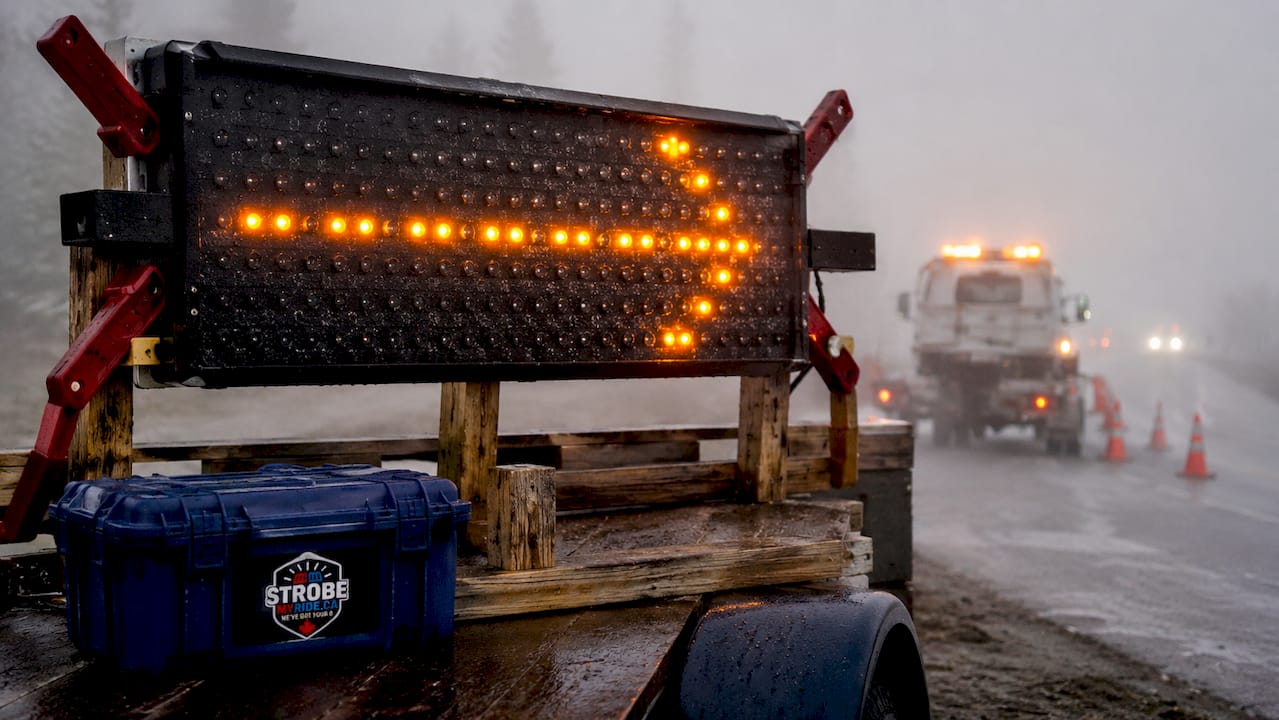
The distinction between a FAB and a simple amber beacon matters legally. A beacon warns of a hazard. A FAB directs movement. Canadian work zone regulations treat them as separate device categories with separate placement and specification requirements. Using a beacon where a FAB is required is a compliance failure, not a minor substitution.
How are portable arrow boards classified by road speed?
Arrow board selection in Canada follows strict Type A, B, and C classifications based on road speed and volume. Each type has minimum panel dimensions, lamp element counts, and legibility distances that are not negotiable.
Type A: low-speed roads under 70 km/h
Type A boards carry a minimum illuminated panel area of 1,152 square inches. They are designed for roads posted below 70 km/h, such as urban arterials and local construction zones. The legibility distance requirement is shorter than higher-type boards, reflecting the lower approach speeds involved.
Type B: intermediate roads from 70 to 105 km/h
Type B boards require a minimum panel area of 1,800 square inches. These are the most common boards you will encounter on provincial highways and rural two-lane roads. The larger panel compensates for higher approach speeds, giving drivers more time to react.
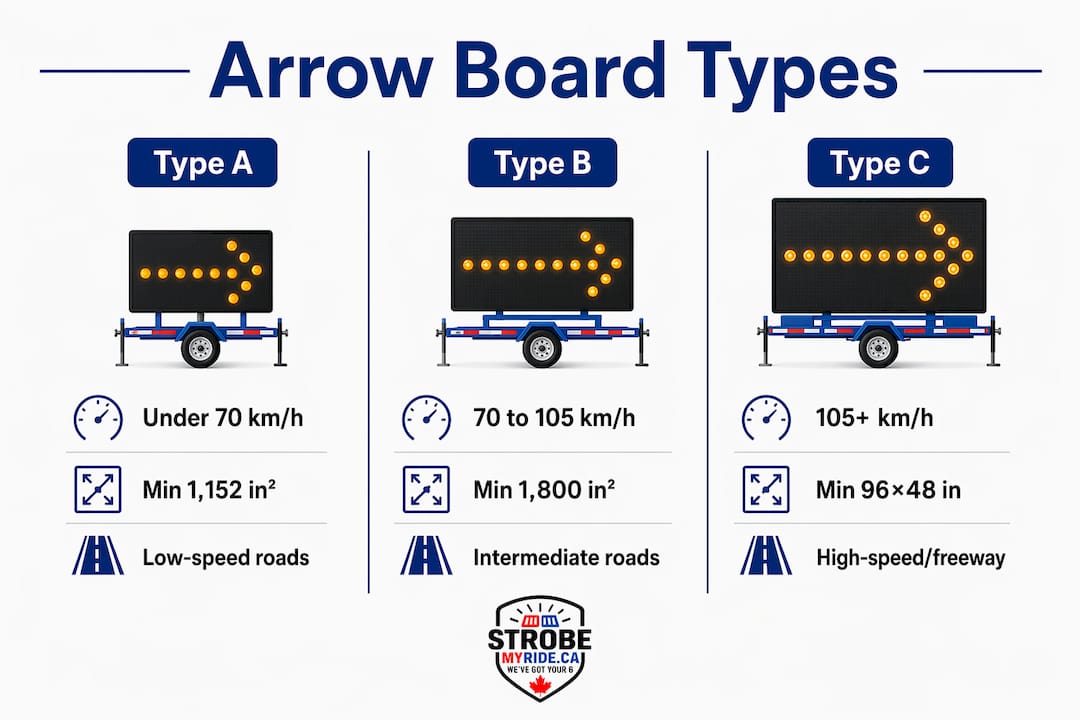
Type C: high-speed roads at 105 km/h and above
Type C boards for freeway use require at least 15 illuminated elements, a minimum panel area of 96×48 inches (roughly 4,608 square inches), and a legibility distance of 1 mile. Mounting must allow fold-down capability with an electric actuator so a single operator can raise and lower the board safely. These boards are mandatory on 400-series highways and other high-speed corridors in Ontario, and on BC freeways.
The table below summarises the three classifications:
| Type | Minimum panel area | Typical road speed | Minimum lamp elements |
|---|---|---|---|
| A | 1,152 in² | Under 70 km/h | Specified by standard |
| B | 1,800 in² | 70–105 km/h | Specified by standard |
| C | 4,608 in² (96×48 in) | 105 km/h and above | 15 elements minimum |
Pro Tip: Deploying a Type A board on a 90 km/h road is one of the most common Traffic Control Plan rejection triggers. Always confirm the posted speed before specifying your board type, not after.
A frequent deployment mistake is selecting a board based on what is available in the yard rather than what the road speed demands. TCP rejections often arise from mismatched device choice versus road speed classification. Even a fully functional, well-maintained board causes permit denial if it is the wrong type for the road.
How do BC and Ontario regulate portable arrow lights?
Provincial regulations add requirements on top of the MUTCD baseline. British Columbia and Ontario are the two provinces with the most detailed and actively enforced frameworks for FABs.
British Columbia requirements
BC’s 2020 Traffic Management Manual mandates Flashing Arrow Boards for all lane closures on roads with posted speeds at or above 70 km/h, with no substitutes permitted. This is a hard rule, not a recommendation. A flagging operation alone does not satisfy the requirement on those roads.
WorkSafe BC requires all Traffic Control Persons (TCPs) to carry a current, three-year High-Risk TCP certification with a minimum exam score of 80%. The certification must be on-site and available for inspection. Expired or incorrect certification level is treated as a non-compliance event, not an administrative oversight.
Key BC requirements include:
- FABs are mandatory at speeds of 70 km/h and above, with no alternative device accepted.
- TCP certification must be High-Risk level with an 80% minimum exam score and a three-year renewal cycle.
- Traffic control is mandatory for any construction site that poses risk to workers, regardless of how brief the job is.
- Provincial OHS regulations impose legal obligations to install compliant traffic control systems, including arrow boards and channelising devices.
- Stop-work orders can be issued for non-compliance, even on small-scale or short-duration jobs.
Pro Tip: In BC, keep a printed copy of your Traffic Management Plan on-site at all times. Inspectors can arrive unannounced, and a missing plan is treated the same as a missing device.
Ontario requirements
Ontario’s Ministry of Transportation requires OTM Book 7 compliance with site-specific validation of arrow boards within approved Traffic Control Plans. The phrase “MTO approved” is widely misunderstood. MTO approval is a site-specific TCP validation process, not a blanket product certification that applies to every job. A board that was validated on one project still requires documentation linking it to the specific conditions of the next project.
Arrow boards operating in Ontario must function reliably across a temperature range that includes down to -40°C. Canadian winters are not a special condition to plan around. They are the baseline. If your board’s operating specification does not cover -40°C, it does not meet the standard. For a full breakdown of Ontario’s traffic control lighting standards, the OTM Book 7 requirements cover device placement, flash modes, and mounting height in detail.
What deployment factors affect safety and compliance?
Getting the device right is only part of the job. Deploying it correctly determines whether your work zone actually protects workers and satisfies an inspector.
Taper length calculation
Taper length is calculated based on lane width and posted road speed, and every work zone requires its own calculation. A taper that is too short forces drivers into abrupt lane changes, which increases crash risk significantly. The most frequent mistake in work zone design is inadequate taper length, not a faulty light device. BC and Ontario manuals both require site-specific taper calculations even for road types that appear similar to previous jobs.
The formula varies by jurisdiction, but the principle is consistent: higher speeds and wider lanes require longer tapers. Do not reuse a taper design from a previous project without confirming the posted speed and lane width match exactly.
Integration with cones, drums, and barriers
Arrow boards work as the advance warning device at the upstream end of the taper. Cones, drums, and barriers define the taper geometry itself. The arrow board tells drivers a lane closure is ahead. The cones show them where to go. Removing either element degrades the system. Place the FAB at the recommended advance distance from the first taper cone, not at the cone itself.
Dimming for night operation
Dimming is a mandatory standard, not an optional feature. Arrow boards must reduce brightness to at least 50% during night operation, and written proof of this capability is required during procurement. A board that cannot dim is non-compliant for night use, full stop. Request the dimming specification sheet from your supplier before purchasing.
MUTCD §6L.06 also requires arrow panels to provide 25–40 flashes per minute and support multiple modes including sequential arrows and full-panel flash. These are not preferences. They are minimum performance requirements.
Mounting options and height
- Trailer-mounted hydraulic mast boards are the preferred choice for high-speed roads. They offer stability, power independence, and consistent mounting height. Many units include solar panels and batteries for multi-day autonomous operation without a vehicle power source.
- Vehicle-mounted boards attach to the rear of a truck or shadow vehicle. They are faster to deploy and better suited to moving operations or short-duration closures.
- Portable stand-mounted units are used for low-speed, short-duration work. They are the lightest option but offer the least stability in wind or high-traffic conditions.
Arrow board mounting height must be at least 2.1 metres above the roadway for trailer-mounted setups. For vehicle-mounted units, the standard recommends mounting as high as practical to maximise visibility. Low mounting reduces legibility distance and can create compliance issues on Type B and C deployments.
Trailer-mounted hydraulic mast boards are common across Canada precisely because they meet height standards without requiring a specific vehicle configuration. Their solar and battery systems also eliminate the risk of a board going dark mid-shift due to a vehicle engine shutting off.
Pro Tip: For industrial and construction sites where traffic control intersects with broader occupational health and safety obligations, provincial OHS compliance frameworks apply alongside traffic management standards. Confirm both sets of requirements before finalising your Traffic Control Plan.
How do you select a compliant portable arrow board?
Procurement is where compliance is won or lost. A board that looks right but lacks documentation will fail the TCP approval process.
Use this checklist when evaluating any FAB for Canadian road use:
- Panel area: Confirm the illuminated panel area meets the Type A, B, or C minimum for your road speed. Get this in writing from the supplier.
- Element count: Verify the number of lamp elements meets the classification minimum. For Type C, that is 15 elements.
- Flash modes: Confirm the board supports sequential arrow, double arrow, chevron, and full-panel flash modes at 25–40 flashes per minute.
- Dimming capability: Require written documentation that the board dims to at least 50% for night operation. Do not accept verbal assurances.
- Operating temperature: Confirm the board operates reliably down to -40°C. This is the Canadian baseline, not an extreme condition.
- Fold-down mechanism: For Type C boards, verify the electric actuator fold-down capability for single-operator use.
- Supplier documentation: Ask for documentation that links the board’s specifications to MUTCD and OTM Book 7 requirements. This documentation supports your TCP submission directly.
The OTM Book 7 approval process is site-specific. A supplier who claims their board is “MTO approved” for all uses is misrepresenting the process. What you need is a board whose specifications align with the standard, plus documentation you can include in your TCP package for each project.
For portable units used in lower-speed or emergency scenarios, the Signal Arrow Rapid Deploy from Strobe My Ride is a foldable LED directional arrow designed for fast setup in lane taper applications. Review the product specifications against your road speed classification before deployment.
Pro Tip: Ask your supplier for a specification sheet formatted for TCP submission. A well-organised supplier will have this ready. If they do not, that tells you something about how seriously they treat compliance.
Key takeaways
Portable LED arrow lights for lane tapers require correct type classification, site-specific taper calculations, mandatory 50% night dimming, and full documentation to pass Traffic Control Plan approval in Canada.
| Point | Details |
|---|---|
| Match board type to road speed | Use Type A under 70 km/h, Type B for 70–105 km/h, and Type C at 105 km/h and above. |
| Site-specific taper calculations are mandatory | Reusing taper designs from previous jobs increases crash risk and causes TCP rejections. |
| Dimming is a compliance requirement | Arrow boards must reduce brightness to at least 50% at night; get written proof from your supplier. |
| Provincial rules add to MUTCD minimums | BC mandates FABs at 70 km/h and above; Ontario requires site-specific OTM Book 7 validation for every project. |
| Documentation drives approval | Supplier spec sheets linked to MUTCD and OTM Book 7 are required for TCP submissions, not optional paperwork. |
Portable arrow lights from Strobe My Ride
Traffic professionals across Canada need arrow lights that deploy fast, hold up in Canadian weather, and come with the documentation that TCP approvals require.
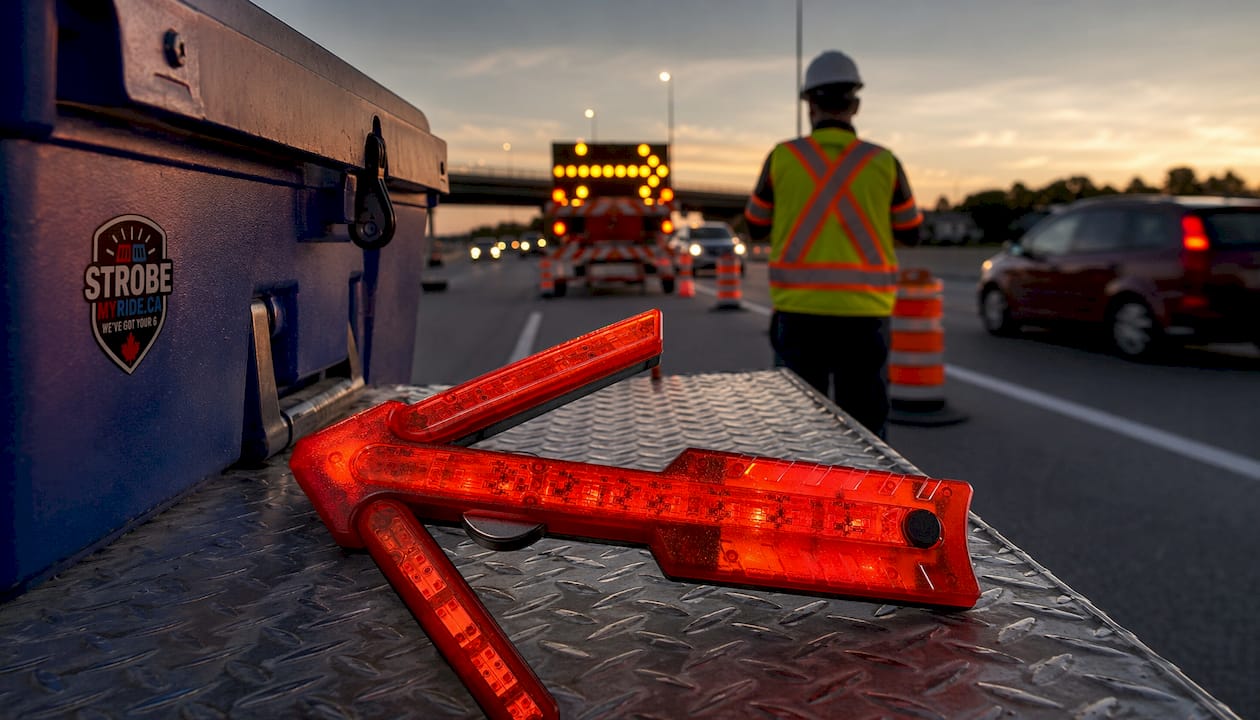
The Signal Arrow Rapid Deploy from Strobe My Ride is a foldable LED directional arrow built for quick lane taper deployment. Its high-intensity LEDs deliver strong visibility in both daylight and night conditions, and the foldable design means one person can set it up without tools. Strobe My Ride ships across Canada with fast turnaround and backs its products with expert support for compliance questions. Browse the full range of portable arrow safety lights to find the right fit for your next project.
FAQ
What is a flashing arrow board (FAB)?
A flashing arrow board is a portable LED panel that displays sequential arrow and flash patterns to direct drivers around lane closures and work zones. It is the standard industry term for what is commonly called a portable arrow light or LED lane taper light.
When is a Type C arrow board required in Canada?
A Type C board is required on roads posted at 105 km/h and above, including freeways and 400-series highways. It must have a minimum panel area of 4,608 square inches, at least 15 lamp elements, and an electric fold-down actuator.
Is “MTO approved” a product certification?
No. MTO approval is a site-specific validation within a Traffic Control Plan, not a blanket product certification. A board must be documented as meeting OTM Book 7 specifications for each individual project submission.
Does an arrow board need to dim at night?
Yes. MUTCD §6L.06 and OTM Book 7 both require arrow boards to reduce brightness to at least 50% during night operation. This is a mandatory standard, and written proof of dimming capability is required at procurement.
What happens if a work zone uses the wrong arrow board type?
Using the wrong board type for the road speed classification causes TCP rejection and can result in stop-work orders under provincial OHS regulations. Compliance failures apply even to short-duration or small-scale jobs.
Recommended
- Signal Arrow Rapid Deploy – Foldable LED Flare Directional Arrow Canada | Strobe My Ride – Strobe My Ride
- Portable Arrow Safety Lights for Roadside Work | Strobe My Ride – Strobe My Ride
- Vehicle lighting troubleshooting tips: your 2026 Canadian guide | Strobe My Ride – Strobe My Ride
- Emergency Lights That Work When Roads Get Worst | Strobe My Ride – Strobe My Ride


