


A traffic advisor is a directional LED lighting device that uses arrow patterns and sequential flash sequences to guide vehicles safely through or around roadside work zones and emergency scenes. For construction crews, tow operators, and emergency responders working on Ontario roads, these devices are a critical layer of traffic control. They work alongside beacons and mini bars, but serve a distinct purpose: when a lane closure is active or traffic must slow down and move over, a traffic advisor shows drivers exactly where to go. Regulatory frameworks including the Ontario Traffic Manual (OTM) Book 7, O.Reg 213/91, and the Occupational Health and Safety Act (OHSA) all shape how and when these devices must be deployed.
What are the regulatory requirements for traffic advisors in Ontario?
The Ontario Traffic Manual Book 7 is the primary standard governing traffic control in work zones across the province. OTM Book 7 underpins the legal duty of reasonable care under OHSA, making it far more than a guideline. Employers who fail to follow its requirements face direct exposure under provincial occupational health and safety law.
OHSA and its construction regulation, O.Reg 213/91, set out specific rules for traffic control persons and the conditions under which traffic advisor devices may be used. O.Reg 213/91, Section 23 prohibits traffic control persons from managing more than one lane at a time and bars them from working in zones where posted speeds exceed 90 km/h. This is where traffic advisors fill a real operational gap. They can direct traffic in high-speed or multi-lane environments where a single flag person cannot safely manage the flow alone.
Traffic control persons cannot simultaneously direct traffic and perform other duties. That constraint matters on busy job sites where crews are stretched thin. A properly mounted traffic advisor on a work vehicle or trailer can maintain continuous directional guidance without pulling a worker away from other tasks.
Compliance failures carry serious consequences. Signage deficiencies at construction sites are among the top violations recorded in Ontario, with corporate fines reaching $1,500,000 and individual jail terms of up to 12 months for serious breaches. Those numbers reflect how seriously the Ministry of Labour treats inadequate traffic control.
Key regulatory obligations for Ontario roadside professionals include:
- Maintaining a site-specific Traffic Control Plan (TCP) that references OTM Book 7 requirements
- Ensuring all traffic control persons hold current competency certification
- Deploying traffic advisors as a supplement to, not a replacement for, formal signage and flagging
- Restricting flag persons to single-lane control and removing them from zones exceeding 90 km/h
- Documenting equipment inspections and wiring checks as part of site safety records
Traffic advisors supplement but do not replace formal traffic control plans and signage per Ministry of Labour inspections. Any site that relies on a light bar alone, without a TCP and certified personnel, is out of compliance regardless of how good the equipment is.
What types of traffic advisor devices are available?
Traffic advisor devices fall into three broad categories: full-size directional light bars, mini bars, and beacon combinations with integrated arrow modules. Each serves a different operational context, and choosing the wrong format for your application affects both safety and compliance.
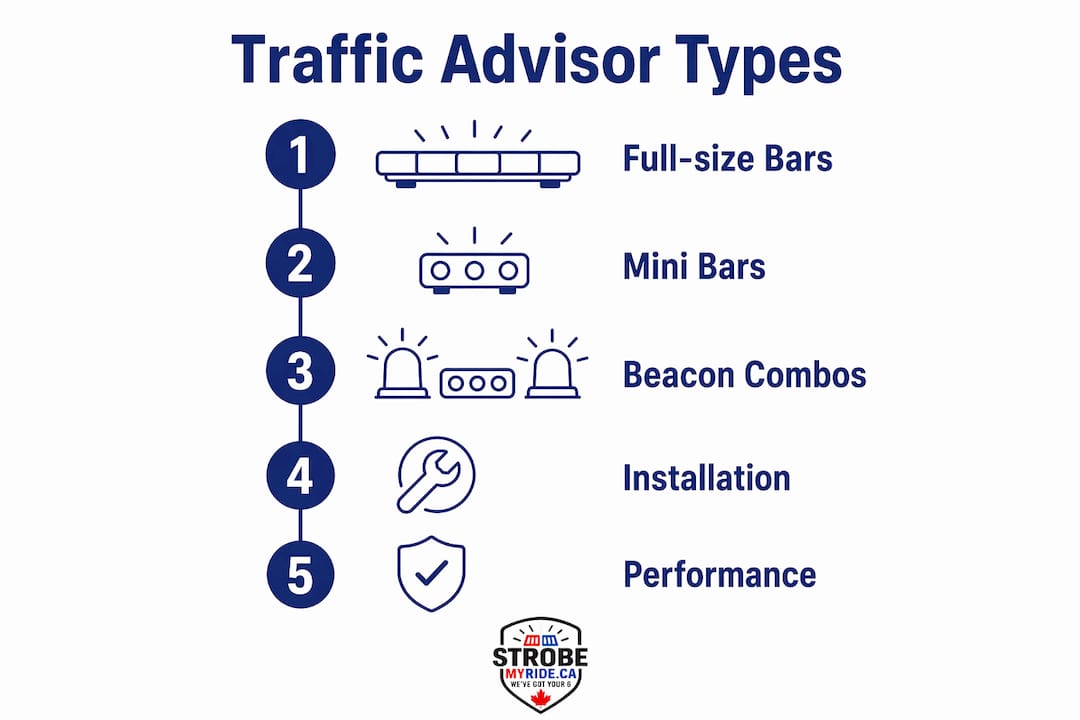
Full-size directional light bars
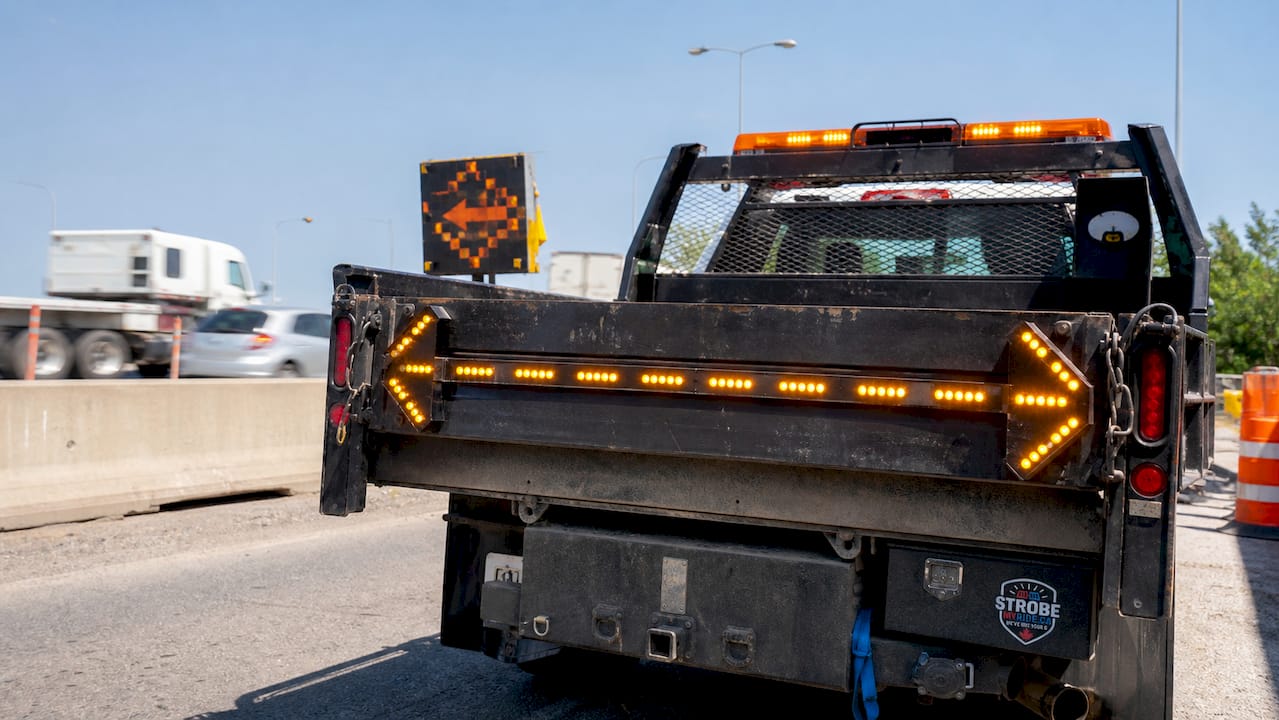
Full-size traffic advisor light bars typically span 47 to 60 inches and mount to the rear of a work vehicle, tow truck, or trailer. They display multi-segment arrow patterns, left and right directional sweeps, and split-direction signals for merge situations. The arrow pattern is the core function. It tells approaching drivers which lane to vacate and where to move, reducing the ambiguity that causes rear-end collisions in work zones.
Mini bars and compact units
Mini bars are shorter units, often 36 inches or less, suited to tow trucks, pilot cars, and emergency response vehicles where rear deck space is limited. They sacrifice some visibility distance compared to full-size bars but remain effective at lower-speed roadside stops. Many compact units now include the same pattern libraries as their full-size counterparts, including scan-lock modes that hold a steady directional arrow rather than cycling through sequences.
Key features that affect performance
Quality traffic advisor light bars include scan-lock flash patterns, low-power modes, aluminum housing, and a rated lifespan of 50,000+ hours. Each of those features has a direct operational benefit.
- Scan-lock patterns hold a fixed directional arrow during active lane closures, eliminating the visual confusion of a cycling sequence
- Low-power mode reduces current draw during extended deployments, protecting the vehicle’s electrical system on long shifts
- Aluminum housing dissipates heat generated by high-intensity LEDs, which is critical during continuous daytime operation
- 50,000-hour lifespan means a device used eight hours per day will last well over a decade before LED degradation becomes a concern
- Pattern memory recall saves your last-used configuration so the device restores the correct pattern after a power cycle, without manual reprogramming at the scene
Daytime visibility is a separate consideration. Amber LEDs must produce sufficient candela output to be seen against direct sunlight. Tinted rear glass on some vehicles can reduce effective output by a meaningful margin, so rear-deck or external mounting is always preferable to in-cab placement for traffic advisor applications.
For a detailed breakdown of features and mounting options, the traffic advisor buying guide at Strobe My Ride covers pattern selection, wiring configurations, and vehicle-specific fitment.
Pro Tip: Always verify that your traffic advisor’s amber output meets OTM Book 7 visibility requirements for the posted speed limit in your work zone. Higher-speed corridors demand higher candela ratings, not just more flash patterns.
How do you integrate traffic advisors into a roadside traffic control plan?
A traffic advisor does not operate in isolation. It is one component within a broader Traffic Control Plan, and understanding where it fits prevents both safety failures and compliance gaps.
TCP versus TMP: knowing the difference
A Traffic Control Plan (TCP) covers short-duration or recurring work zone setups, typically for a single shift or a defined construction phase. A Traffic Management Plan (TMP) applies to longer-term projects that affect multiple routes, require detours, or involve coordination with municipalities. Distinguishing between short-term TCPs and long-term TMPs avoids permit delays and improves work zone safety. Using a TMP framework for a one-day tow recovery, for example, creates unnecessary administrative burden. Using a TCP for a six-month road rehabilitation project leaves gaps in route management and stakeholder communication.
Where traffic advisors fit within a TCP
The TCP defines the physical layout of the work zone: advance warning signs, taper lengths, buffer zones, and the position of traffic control persons. The traffic advisor mounts to the last work vehicle in the queue, facing oncoming traffic, and provides real-time directional guidance within the zone already defined by static signage. It does not replace the advance warning signs or the taper. It reinforces the message those signs already delivered.
Appropriate deployment scenarios include:
- Single-lane alternating traffic on two-lane roads, where the arrow indicates which direction has the right of way
- Lane closures on multi-lane highways, where the arrow directs traffic to merge left or right before the taper
- Tow truck recovery operations, where the advisor on the tow vehicle warns approaching traffic and indicates the clear lane
- Emergency response staging, where fire, EMS, or police vehicles block a lane and the advisor directs traffic past the scene
- Snow removal and grading operations, where the slow-moving work vehicle needs continuous rear-facing directional guidance
Installation and wiring best practices
Mount the traffic advisor as high as possible on the rear of the vehicle to maximise visibility over following traffic. The device should be level and centred on the vehicle’s rear axis so the arrow pattern reads symmetrically to approaching drivers. For correct wiring practices, Strobe My Ride’s guide on wiring traffic advisors properly covers circuit protection, switch placement, and controller mounting.
Pro Tip: Run a dedicated fused circuit for your traffic advisor rather than tapping into an existing lighting circuit. Shared circuits can cause voltage drops that dim LEDs and reduce visibility exactly when you need maximum output.
Heat management during installation also matters. Aluminum housing improves thermal performance and device lifespan, particularly during extended shifts and daytime use. Avoid mounting the unit in a position where airflow is blocked by the vehicle body, a toolbox, or other equipment. Restricted airflow accelerates LED degradation even in units with aluminum construction.
What are the common pitfalls when using traffic advisors?
The most frequent compliance failure is treating a traffic advisor as a standalone solution. A light bar mounted to a tow truck does not constitute a traffic control plan. Traffic advisors alone cannot substitute for formal, site-specific traffic control plans compliant with OTM Book 7 and OHSA regulations. Ministry of Labour inspectors look for the complete package: advance signage, a documented TCP, certified personnel, and appropriate lighting.
Other common errors include:
- Skipping OTM Book 7 training. Book 7 certification is mandatory for traffic control workers in Ontario. Operators who deploy traffic advisors without understanding the broader TCP framework create liability for their employer.
- Ignoring local regulatory updates. Ontario’s traffic control standards are updated periodically. Professionals who set up their equipment once and never revisit their TCP templates risk working to outdated specifications.
- Using the wrong flash pattern for the situation. A cycling sequence that sweeps left and right is appropriate for a merge. A scan-lock arrow is correct for a sustained lane closure. Using the wrong pattern confuses drivers and undermines the device’s purpose.
- Neglecting device maintenance. Lens fogging, corroded connectors, and cracked housings all reduce output. A traffic advisor that is 30% dimmer than its rated output may not meet visibility requirements at highway speeds.
- Overlooking heat management. Continuous operation in direct sunlight on a hot day pushes LED junction temperatures higher. Units without adequate thermal management will throttle output or fail prematurely.
On the horizon, flashing amber arrow signals used in the United States show reduced collision rates and improved driver comprehension, but require adaptation before Canadian adoption. The Transportation Association of Canada has published synthesis research on the topic. Ontario professionals should monitor TAC publications for any regulatory shifts that bring flashing amber arrow technology into the Canadian standard.
The Ontario Book 7 lighting requirements guide from Strobe My Ride provides a practical reference for staying current with provincial standards as they evolve.
Key takeaways
A traffic advisor is a legally required directional lighting device that must operate within a compliant TCP, not as a standalone substitute for signage, certified personnel, or OTM Book 7 training.
| Point | Details |
|---|---|
| Regulatory foundation | OTM Book 7 and O.Reg 213/91 govern when and how traffic advisors must be deployed in Ontario work zones. |
| Advisors supplement, not replace | A traffic advisor works alongside formal TCPs, advance signage, and certified flag persons. It cannot substitute for any of these. |
| Equipment features matter | Scan-lock patterns, aluminum housing, and 50,000-hour LED lifespan directly affect safety performance and long-term reliability. |
| TCP versus TMP distinction | Short-duration work uses a TCP; long-term multi-route projects require a TMP. Choosing the wrong framework creates permit and compliance risks. |
| Maintenance and heat management | Inspect lenses, connectors, and housings regularly. Restricted airflow accelerates LED degradation even in aluminum-housed units. |
Strobe My Ride’s Patrol Arrow for professional traffic control
When you need a traffic advisor built for the demands of real roadside work, the Patrol Arrow directional warning bar from Strobe My Ride delivers the pattern variety, durability, and visibility that Ontario professionals require. It features directional arrow sequences, scan-lock capability, and an aluminum housing designed for continuous operation on long shifts.
Strobe My Ride ships across Canada with fast turnaround and backs its products with industry-leading warranties. Whether you run a tow fleet, manage a construction crew, or respond to roadside emergencies, the Patrol Arrow is built to meet the demands of your work zone. Visit the traffic advisor light bars collection to compare models, review specifications, and find the right fit for your vehicle and application.
FAQ
What is a traffic advisor used for?
A traffic advisor is a directional LED light bar mounted to the rear of a work vehicle to guide approaching traffic through or around a lane closure, work zone, or emergency scene using arrow patterns and sequential flash sequences.
Is a traffic advisor required by law in Ontario?
Ontario’s OTM Book 7 and O.Reg 213/91 do not mandate a traffic advisor on every job site, but they require adequate traffic control measures. In high-speed zones or multi-lane closures where a flag person cannot safely manage traffic alone, a traffic advisor is the practical means of meeting that obligation.
Can a traffic advisor replace a flag person?
No. A traffic advisor supplements certified traffic control persons; it does not replace them. O.Reg 213/91 requires competent flag persons for active traffic direction, and a light bar alone does not satisfy that requirement.
What flash pattern should I use during a lane closure?
Use the scan-lock arrow pattern during an active lane closure. This holds a fixed directional arrow pointing to the open lane, giving drivers a clear and unambiguous instruction rather than a cycling sequence that could be misread.
How long do traffic advisor light bars last?
Quality traffic advisor light bars carry a rated LED lifespan of 50,000+ hours. Proper heat management through aluminum housing and adequate airflow around the unit is the primary factor in achieving that rated lifespan during continuous roadside operation.
Recommended
- Traffic Advisor Light Bar Buying Guide | Strobe My Ride – Strobe My Ride
- How to Wire Traffic Advisors Properly | Strobe My Ride – Strobe My Ride
- Traffic Advisor Light Bars Canada | Arrow & Warning – Strobe My Ride – Strobe My Ride
- Traffic Advisor Lights for Safer Roadside Work | Strobe My Ride – Strobe My Ride


