


For most lane closures and shoulder work, the right call is a Type B or Type C arrow board for mobile and freeway operations, and a foldable rapid-deploy arrow for shorter, faster jobs. Strobe My Ride stocks matching options in the Patrol Arrow, the Fusion Amber Arrow Board, and the Signal Arrow Rapid Deploy. The section below maps each SKU to the deployment it was built for.
TL;DR:
- Most fleet operators should select arrow lights based on their specific traffic environment, with Type B suitable for mobile work on arterials and Type C for high-speed freeway applications.
- Panel size, lamp count, and dimming capabilities are critical specifications that directly impact legibility distance and safety, especially during night operations.
- Proper setup, including correct positioning relative to taper and appropriate display mode, is essential to ensure clear communication with approaching drivers and prevent accidents.
- Reliability depends mainly on wiring, connectors, and correct maintenance, making routine inspections and logging setup conditions vital for sustained performance.
- Support and certification from the supplier matter greatly, especially during emergencies, with locally stocked products like those from Strobe My Ride offering faster turnaround times across Canadian fleets.
Which arrow lights fit your fleet?
Picking the right arrow light comes down to matching the device to the job, not the other way around. A tow truck working a shoulder incident has different needs than a paving crew closing a freeway lane for six hours, and buying the wrong class of device means either underpowered visibility or paying for capability you don’t use.
Here’s how the three featured products map to common Canadian fleet and traffic-control tasks:
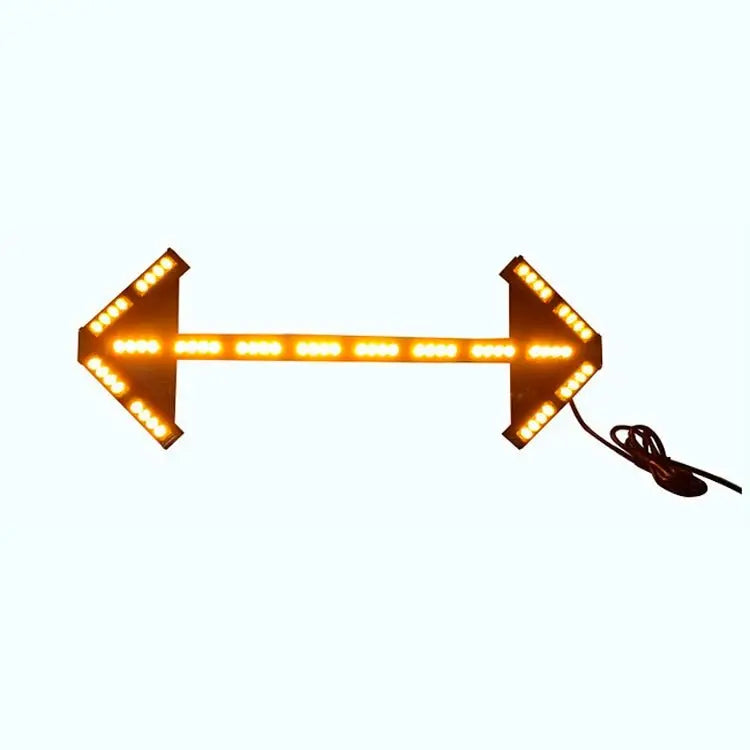
- Patrol Arrow – Traffic Directional Warning Bar: built for patrol, escort, and traffic-advisor roles where a vehicle-mounted directional bar needs to communicate lane shifts to approaching traffic in real time.
- Fusion Amber Arrow Board: suited to larger fleet operations and higher-speed roadways where a bigger illuminated panel and longer legibility distance matter more than portability.
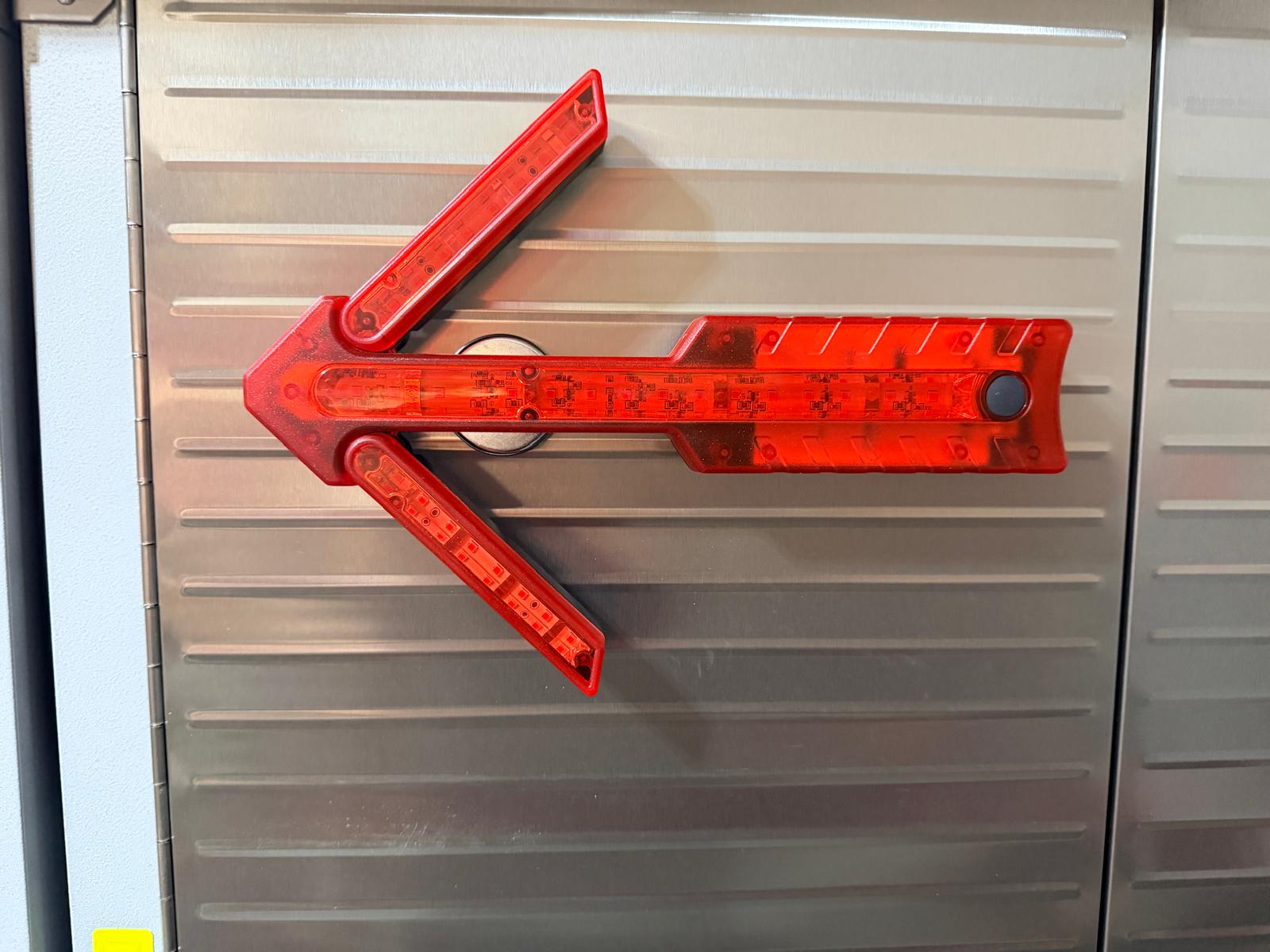
- Signal Arrow Rapid Deploy – Foldable LED Flare Directional Arrow: designed for rapid-deploy scenarios, service trucks, and cone-based setups where a crew needs to get a directional signal on the ground fast and pack it up just as quickly.
Think of it as three deployment categories: mobile (Patrol Arrow), stationary/higher-speed (Fusion Amber Arrow Board), and rapid-deploy (Signal Arrow Rapid Deploy). Most fleets end up running at least two of these categories across their vehicle mix, since a snow-removal truck and a utility service van rarely face the same traffic conditions on the same shift. Browse the full lineup on the SMR arrow and traffic advisor collection if your operation spans more than one category.
What types of arrow lights exist, and where do they belong?
Arrow lights split into a handful of device classes, and each one is built around a specific speed environment and operating style.
- Portable arrow lights run on battery or magnetic mount and suit low-speed, short-duration jobs like driveway work, shoulder incidents, or utility stops in urban zones.
- Foldable rapid-deploy arrows collapse for storage and set up in minutes, making them a fit for service trucks and crews that move between multiple short jobs in a single shift.
- Truck or trailer-mounted arrow boards (FABs) are the standard for mobile and stationary lane closures on arterial roads and freeways, where legibility distance and panel size carry more weight than portability.
- Vehicle-mounted directional bars, like a patrol-style traffic advisor, sit permanently on the vehicle and switch between directional and caution modes as the job changes.
As a rule of thumb, urban and low-speed work rarely needs more than a Type A panel, arterial roads generally call for Type B, and freeway or high-speed corridors call for Type C, where the insight on Type B versus Type C boards notes that Type B covers most mobile and arterial jobs while Type C is reserved for confirmed high-speed applications. If your crew works a mix of environments, size up rather than down.
What specs actually matter when buying an arrow board?
Panel type and illuminated panel area drive legibility distance more than anything else on the spec sheet. A Type A panel is legible at shorter range than a Type C panel, so matching panel type to your posted speed isn’t optional if the board needs to give drivers enough warning time to react.
Lamp or element count is the second number to check. MUTCD sets minimum lamp counts per panel type, but commercial arrow boards commonly ship with 15, 25, or 30 lamps to build in redundancy, since a single failed lamp on a 13-lamp minimum board can distort the arrow shape while a higher-count board barely notices.
- Confirm illuminated panel area (in² or m²) on a test certificate, not the outer frame dimensions.
- Ask for lamp-count documentation rather than relying on a marketing label alone.
- Check dimming capability. Boards should be capable of at least 50% dimming from full brilliance for nighttime use, per BC’s traffic control manual guidance on FABs.
- Compare power sources: vehicle-wired, standalone battery, LiFePO4 packs, and solar-assist all carry different runtime trade-offs for multi-day jobs.
- Verify mounting hardware and payload ratings match your vehicle before ordering.
Pro Tip: Ask the supplier for the panel’s active display area and lamp-count test data up front. A board that looks similar in a product photo can differ significantly in legibility distance once you compare the actual certified numbers.
One field study worth knowing about: Minnesota DOT testing found that LED and full-width bar configurations increased lane-change compliance compared to older incandescent rotators, which is part of why LED has become the default choice for directional and warning applications across the industry.
How do you set up arrow lights correctly in the field?
Getting the placement and display mode right matters as much as the hardware itself. A perfectly spec’d arrow board pointed at the wrong angle or positioned too close to the taper still leaves drivers guessing.
- Position the board relative to the taper, not the work area itself, so drivers see the directional signal before they reach the point where they need to merge.
- Choose directional mode for lane closures where traffic needs to move over, and reserve caution-only or four-corner flash for situations where no specific lane shift is required.
- Keep the panel level and at the recommended mounting height so the arrow shape stays legible and doesn’t wash out or distort at a distance.
- Set dimming for the time of day. Full brightness for daylight, reduced brightness at night, so the display stays legible without creating glare for approaching drivers.
- Run a pre-shift check: confirm the wireless controller pairs correctly, lamps aren’t dead or dim, and the mounting hardware is secure before the vehicle leaves the yard.
Wireless sequence controllers let a single operator manage the display from the cab, and photocell auto-dimming takes the guesswork out of matching brightness to ambient light. Neither feature is glamorous, but both cut down on the setup errors that show up most often during ride-alongs and safety audits.
Pro Tip: If your crew runs the same route regularly, log the mounting height and dimming setting that worked best for that corridor. It saves a repeat trial-and-error setup on the next shift.
What standards govern arrow light selection?
Arrow light selection touches a few different reference documents, and it’s worth knowing which one governs which decision before you lock in a spec sheet or a contract.
- MUTCD §6L sets the baseline definitions for permitted arrow-board displays, including when directional versus caution patterns apply, and informs the Type A/B/C sizing conventions used across the industry, per the Manual on Uniform Traffic Control Devices.
- Transport Canada’s TSD 108 sets photometric, lens-area, and mounting requirements for lamps and reflective devices, and manufacturers must certify compliance and meet photometry test requirements, detailed in TSD 108 rev. 8.
- Transport Canada’s lighting location guidance lists required lamp functions, colours, and typical mounting locations for trucks and buses, covered in federal lighting equipment location requirements.
- Provincial traffic-control manuals, such as the BC traffic control manual excerpts on FABs, add operational detail on mounting height, visibility, and dimming that MUTCD doesn’t spell out.
Because provincial requirements vary and contract specs often reference a specific document, treat this as a starting point for research, not a final answer. Confirm the applicable standard with your jurisdiction or contracting authority before finalizing a purchase order.
Where can you get SKU-specific certs and support?
Strobe My Ride is a Canadian-owned supplier stocked in Ottawa and shipping across the country, serving tow and roadside operators, snow-removal and construction fleets, municipalities, volunteer fire departments, and commercial vehicle operators. Product certifications, specifications, and permitted colours vary by individual SKU and jurisdiction, so the details below are a starting point, not a substitute for checking the product record.
- Review the Patrol Arrow – Traffic Directional Warning Bar product page for mounting and lamp details specific to that unit.
- Review the Fusion Amber Arrow Board product page for panel size and power specifications.
- Review the Signal Arrow Rapid Deploy product page for foldable setup and portability specs.
- Contact Strobe My Ride directly for test certificates, compliance documentation, or installation advice tied to a specific SKU and your province.
How do you avoid the most common arrow light setup mistakes?
The biggest safety hazard isn’t a faulty unit. It’s a correctly working arrow light placed, aimed, or timed wrong. Mounting a board too low, or tilting it so the arrow shape washes out at distance, quietly undoes the legibility the panel was designed to deliver.
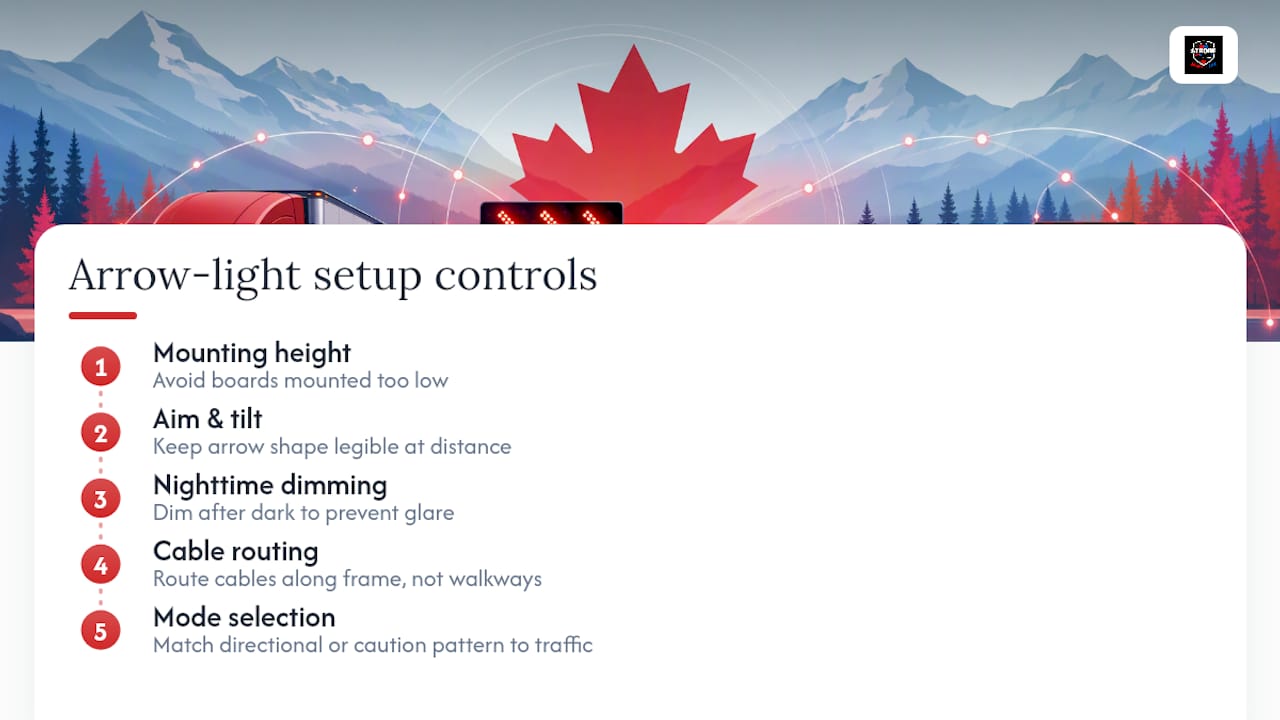
A second common hazard is running full daytime brightness after dark. An arrow board at full brilliance on an unlit rural road can create disability glare for oncoming drivers, which works against the goal of guiding them safely rather than blinding them at the exact moment they need to react. Dimming isn’t a nice-to-have feature. It’s a safety control, and skipping it on a night shift creates real risk for both the travelling public and the crew working behind the display.
Cable management around the mounting point is another spot where things go wrong. A controller cable or power lead left loose near a walkway or work area becomes a trip hazard for crew members moving equipment in low light. Route cables along the vehicle frame or trailer edge, not across the ground where boots and hand trucks pass.
Finally, don’t assume one display mode fits every job. Using directional mode when the situation actually calls for caution only, or vice versa, sends the wrong signal to approaching drivers and increases hesitation exactly where you need decisive lane changes. Match the pattern to the actual traffic movement required, every time you set up.
How do you keep arrow lights reliable over time?
Most arrow light failures trace back to connections, not the LEDs themselves. LEDs are solid-state and rarely fail outright, but the wiring harnesses, connectors, and controller pairings that link them to power take the brunt of vibration, moisture, and temperature swings on a working vehicle.
Start with a visual check before every shift: look for cracked lenses, corroded connectors, and any lamp that’s dimmer than its neighbours. A lamp that’s noticeably weaker than the rest of the panel is often the first sign of a failing connection rather than a dead LED.
If a wireless controller stops responding, check the pairing sequence and battery level in the remote before assuming the board itself has failed. Loose or corroded ground connections are a frequent culprit behind erratic flash patterns, so a quick continuity check can save a return trip to the shop.
For seasonal fleets running heavy winter use, budget time each fall for a full inspection: mounting hardware, cable routing, lens condition, and dimming function. A five-minute check in October beats an emergency swap in a January storm. Keep a log of which units have had issues so patterns show up before a full failure does. If a unit needs parts or troubleshooting beyond what a field check can resolve, that’s the point to contact Strobe My Ride for guidance rather than guessing at a fix.
What should you budget for arrow lights?
Price scales closely with panel size, lamp count, and portability features, which makes the arrow light category a wide spread rather than a single price point. Portable magnetic or cone-mount units sit at the lower end of that spread, since they carry fewer lamps and smaller panels than a full arrow board.
Foldable rapid-deploy arrows land in the mid-range, reflecting the added engineering that goes into a collapsible frame that still holds up to repeated field use. Full-size truck or trailer-mounted arrow boards, particularly Type C units built for freeway work, sit at the top of the range because of their larger illuminated panel area, higher lamp counts, and more robust mounting hardware.
Runtime and power source also factor into total cost. A battery-only unit is cheaper upfront but may need more frequent charging or swaps on multi-day jobs, while a vehicle-wired or LiFePO4-equipped board costs more initially but reduces downtime on longer deployments. Strobe My Ride positions its arrow lineup, including the Signal Arrow Rapid Deploy, as one of the more accessible entry points into LED arrow lighting in Canada, without cutting corners on lamp count or build quality. When comparing quotes, weigh the per-unit price against lamp count, panel certification, and expected service life, not sticker price alone.
Does manufacturer support matter as much as the hardware?
It does, and it shows up fastest when something goes wrong mid-contract. A fleet with a failed controller during a night shift needs a supplier who answers the phone and ships a replacement part, not a support ticket that sits for a week.
Strobe My Ride is Canadian-owned and stocked in Ottawa, shipping across the country to tow operators, municipalities, construction fleets, and volunteer fire departments. That domestic stock position matters for turnaround time compared to ordering from an overseas supplier and waiting on customs. Among the recommended options, the Patrol Arrow suits vehicles that need a permanent directional bar, the Fusion Amber Arrow Board suits larger fleets running higher-speed corridors, and the Signal Arrow Rapid Deploy suits crews that need a foldable unit they can move between jobs in a single shift.
Ask any supplier directly about warranty terms, replacement part availability, and whether they can provide SKU-specific test certificates before you commit to a fleet-wide order. Readers looking for a broader primer on how compliance documentation fits into fleet purchasing may also find the DOT compliance guide useful background reading.
Get the right arrow light for your fleet from Strobe My Ride
Strobe My Ride carries one of the more affordable full lineups of LED arrow lighting available in Canada, without narrowing your options down to a single display colour or a single mounting style. The Signal Arrow Rapid Deploy uses duo colour functionality, amber for directional work, amber and white for general warning, and white for scene or work lighting, so one portable unit covers three jobs instead of three separate purchases. It mounts by magnet or cone base, which suits crews that need a mini arrow they can move between stops in a single shift without wiring anything permanent.
For fleets that need a permanent vehicle-mounted solution, the Patrol Arrow and Fusion Amber Arrow Board round out the lineup for patrol, escort, and higher-speed roadway work. If you’re outfitting a mixed fleet, browse the full arrow and traffic advisor collection and reach out to Strobe My Ride’s team for SKU-specific specs, test certificates, or a quote sized to your fleet.
Sources
- TSD 108 rev. 8 — Lamps, reflective devices, and associated equipment (Transport Canada)
- Trucks, buses and MPVs: federal lighting equipment location requirements (Transport Canada)
- Traffic control manual (BC Ministry of Transportation) — Part B traffic control (excerpts on FABs)
- Truck-mounted arrow board size & lamp guide (OpTraffic)


