


Fleets should prioritise five lighting classes: LED work/scene lights, warning lightbars or mini bars, beacons, hideaways, and search lights. LED technology is now the operational default across all five because of its durability and lower failure rate under vibration. The fixture that looks right on a spec sheet still fails on the job if beam pattern, IP rating, and CAN-bus compatibility were not checked before purchase.
TL;DR:
- Beam pattern and optical quality are more important than lumen output, as they directly affect visibility distance and safety.
- Proper mounting and aiming are crucial to ensure the light coverage matches the intended work zone and prevents glare or backscatter.
- Compatibility with vehicle electrical systems and CAN-bus modules is essential to avoid fault codes and flickering issues during operation.
- Regular maintenance, including visual checks and connector inspections, significantly reduces roadside failures caused by corrosion or impact damage.
- Choosing the right light class depends on the task, with specific fixtures designed for warning, work illumination, or long-range targeting, not just wattage or lumens.
Common utility truck lighting types and the jobs where each excels
Fleet managers often shop by wattage or lumen count first and product category second. That’s backwards. Start with the task, then work toward the fixture. A tow operator lighting a roadside recovery has almost nothing in common electrically or optically with a municipal crew illuminating a rear deck for loading, even though both trucks might carry LED fixtures from the same catalogue.
Each product class exists because it solves a distinct visibility problem:
- Light bars mount on the roof or grille and deliver wide-area warning visibility or combined warning/work output across a broad arc, often the primary fixture on tow, plow, and utility service trucks.
- Mini light bars offer the same multi-function warning role in a compact footprint, useful where roof clearance, weight, or mounting surface is limited.
- Beacons rotate or flash from a single elevated point and remain the simplest way to add 360 degree warning visibility to a vehicle that already has adequate work lighting.
- Scene/work lights flood a task area, typically the rear deck, a work zone, or the area around an open door, with steady, non-flashing illumination for hands-on tasks.
- Hideaways integrate into existing vehicle features (grille slats, mirror housings) for supplemental warning output without adding visible bulk.
- Flush mounts sit nearly level with the body panel, a common choice when departments want warning function without the profile of a raised fixture.
- Search lights throw a tight, long-range beam for locating objects, addresses, or hazards well beyond the range of a standard work light.
Roadside recovery generally calls for a light bar or mini bar for oncoming-traffic warning, paired with scene lights aimed at the hitch and work area. Bucket and crew work leans harder on scene/work lights positioned to cover the platform and ground crew without throwing glare back at the operator. Rear-deck loading is almost always a scene-light job, sometimes supplemented by a beacon if the truck backs into active traffic lanes.
Combo optics, meaning a single fixture that blends spot and flood patterns, work well when a truck needs both throw distance and side coverage from one mounting point and there is no room for two fixtures. Dedicated single-purpose lights make more sense when a crew consistently needs strong performance in one beam type, since a combo optic always trades some spot intensity for flood spread, or vice versa. Beam geometry and optical design predict usable visibility far better than a headline lumen figure does, a point LED CXR’s buyer’s guide makes directly. Two fixtures rated at the same lumen output can produce very different results in the field depending on lens design and reflector shape.
Before comparing specific models, map the job first: what needs to be seen, from what distance, and in what direction the truck sits relative to traffic or the work zone. Mounting constraints (available panel space, existing wiring runs, roof rack interference) narrow the shortlist just as much as the beam spec does.
The specifications that predict field performance (not marketing claims)
A lumen number on a product listing tells you almost nothing about how a fixture will perform once it’s bolted to a truck. Usable light is a function of beam geometry, lens quality, and how the fixture is aimed, not the raw output figure printed on the box. Fleets that specify by lumens alone routinely end up with fixtures that look powerful on paper and underperform on a dark job site.
Lighting and reflector defects accounted for 14% of all commercial vehicle out-of-service findings in North American roadside inspections during 2025, making it the third most common cause behind brakes and tires.
That figure alone justifies treating lighting specification as a procurement decision, not an afterthought bolted on after the truck is built.
A useful spec sheet for utility truck lighting should require:
- Beam pattern and optics, spot, flood, or combo, matched to the task distance and coverage angle, not just a wattage figure.
- IP rating appropriate to the environment: IP67 is generally adequate for outdoor exposure, while IP69K is the better standard where pressure washing or heavy road contamination is routine, such as winter plow operations or municipal wash-bay cycles.
- Thermal management design, since LEDs that run hot without adequate heat sinking degrade output and shorten rated lifetime well before the advertised hours are reached.
- Rated LED lifetime, understood as a factor in total cost of ownership rather than a marketing bullet point; a fixture rated lower but built with better heat dissipation can outlast a higher-rated one in real duty cycles.
- Voltage range and power draw, confirmed against the vehicle’s electrical system and against any body control module that monitors lighting circuits.
- Housing material, lens impact rating, and connector sealing, which determine whether the fixture survives gravel strikes, branch contact, and repeated vibration on rough terrain.
Electrical compatibility deserves particular attention because it’s the specification most likely to be overlooked at purchase and discovered only after installation. Many modern trucks use CAN-bus systems or body control modules that expect a certain current draw from each lighting circuit. A low-draw LED fixture swapped in for a legacy incandescent lamp can register as a fault, triggering warning codes or flicker behaviours that have nothing to do with the light itself failing.
Common specification mistakes worth avoiding include chasing a brightness number without checking beam control, and substituting a consumer-grade fixture for a commercial-rated one because the specifications look similar on a listing page, a mistake Dun Bri Group’s fleet lighting guide flags as one of the most frequent procurement errors. Modular fixtures with adjustable mounts and replaceable optics can reduce long-term costs for mixed-use fleets by letting crews adapt beam patterns to different jobs without swapping entire units.
Installation and vehicle-integration considerations that affect safety and reliability
A correctly specified fixture installed poorly still fails the crew. Mounting position and aim determine whether a scene light actually covers the work area or just adds glare that blinds the operator and washes out the ground crew’s night vision. Aim every fixture with the finished task in mind: hitch work needs downward coverage without backscatter into the driver’s mirrors, and platform lighting on a bucket truck needs to avoid throwing shadows across the exact spot a lineworker is trying to see.
Wiring practices matter as much as fixture choice. A short list covers the essentials:
- Run every lighting circuit through a properly fused connection sized to the fixture’s draw.
- Use relays for higher-draw fixtures rather than switching load directly through a dash switch.
- Route harnesses away from sharp edges, moving parts, and exhaust heat, using grommets wherever a wire passes through a body panel.
- Add strain relief at every connector so vibration doesn’t work the wire loose over months of duty cycles.
- Label circuits at installation so a technician troubleshooting six months later isn’t tracing wire by guesswork.
CAN-bus and body-control-module conflicts are among the most common integration headaches fleet electricians report. Because LED fixtures draw far less current than the incandescent bulbs many systems were originally designed around, a module can read that lower draw as a burned-out lamp and throw a fault code, a pattern documented in fleet lighting troubleshooting guidance. Resolving this usually means installing a load-matching module, using a manufacturer-specified resistor, or reconfiguring the body controller so it recognizes the new draw as normal.
Pro Tip: Before ordering a full lighting package for a new truck model, install a single fixture on one vehicle and run it through a full duty cycle first. It’s a fast, low-cost way to catch a CAN-bus conflict before you’ve wired ten trucks the same way.
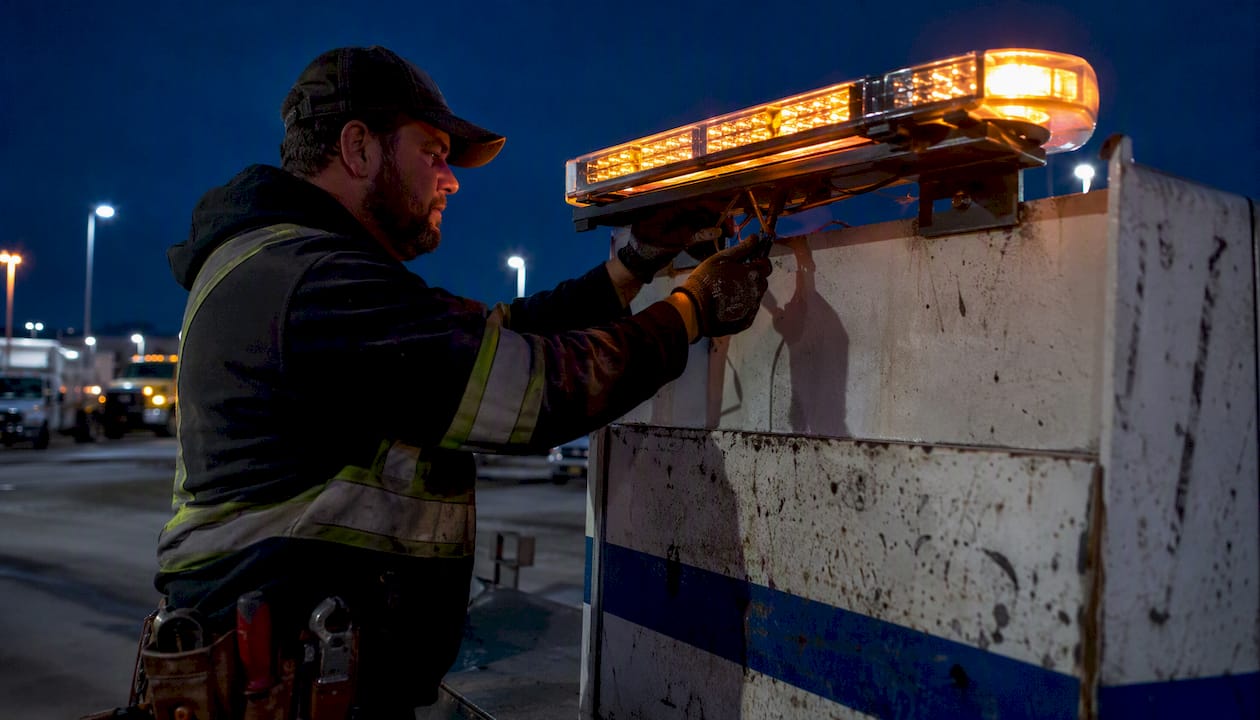
Where fleet policy or jurisdictional rules require that work lights cannot stay illuminated while the vehicle is in motion, wiring should interlock those circuits with a parking brake switch or transmission sensor rather than relying on the operator to remember a manual switch. Any installation involving body-controller reconfiguration, interlock wiring, or unfamiliar CAN-bus behaviour is a good point to bring in a certified upfitter or vehicle electrician rather than troubleshoot it truck by truck. For fleet-specific configurations, reviewing Strobe My Ride’s guidance on warning lights for utility vehicles before finalizing a mounting plan can help avoid rework later.
Common failure modes and quick diagnostics for fleet technicians
Most lighting failures on a work truck trace back to one of a small number of causes, and recognizing which one you’re dealing with cuts diagnostic time dramatically. Corrosion at connectors, caused by road salt and de-icing chemicals working into a housing over a winter season, ranks among the most persistent culprits, particularly for fleets running in northern climates. Physical impact from debris, branches, or backing into a low object accounts for another large share. Connector pin wear from repeated disconnect cycles, chafed harnesses rubbing against a body panel, voltage spikes from a failing alternator, and virtual fuse or module shutdowns round out the list technicians see most often.
Lighting and reflector defects made up 14% of commercial vehicle out-of-service findings across North American roadside inspections in 2025, trailing only brake and tire violations.
A practical diagnostic sequence, worked in order, saves time on almost every call:
- Start with a visual check of the fixture, lens, and mounting hardware for obvious cracks or impact damage.
- Inspect connectors for corrosion or discoloration inside the housing, not just at the visible exterior.
- Test voltage at the harness connector without piercing the insulation, which avoids introducing a new moisture entry point while confirming the circuit is live.
- If a single lamp is out, start troubleshooting at that lamp; if multiple lamps on the same circuit are affected, start at the nose box or junction point instead.
- Rule out a virtual fuse or module shutdown by checking whether the body controller has logged a fault code tied to that circuit.
A short preventive maintenance routine, run on a regular cadence rather than only after a complaint, catches most of this before it becomes a road failure. A 60-second lighting walk-around, lights on, hazards on, with a second person confirming brake-light function, is enough to catch the majority of common defects before a truck leaves the yard. Add a quarterly deeper check of connector interiors and harness routing points, since those are the components most likely to degrade silently between visible failures.
Strobe My Ride: catalogue fit and technical support for utility truck lighting
Strobe My Ride is a Canadian-owned supplier stocked in Ottawa and shipped across the country, built around the day-to-day reality of fleets that can’t afford a truck sitting idle over a lighting fault. Customers include tow and roadside operators, snow-removal and construction fleets, municipalities, volunteer fire departments, and commercial vehicle operators, the exact mix of buyers this guide has been written for.
The catalogue covers the product classes discussed above directly:
- Light bars and mini light bars for roof or grille mounting.
- Beacons, surface mounts, and hideaways for supplemental or discreet warning coverage.
- Scene and work lights for deck, platform, and task-area illumination.
- Search lights for long-range, targeted visibility.
- OEM flash modules for integration with existing vehicle wiring.
SKU-level compatibility, IP rating, and certification details vary by individual product and jurisdiction, so the specifics for any given fixture live on that product’s own page. Reviewing Strobe My Ride’s utility truck warning light collection is a practical starting point before narrowing to a specific fixture, and readers who want configuration examples for related fleet types can check the construction vehicle warning light guide or the municipal fleet lighting guide.
Product spotlight: Fleet Search high-output LED search utility light
Search lighting solves a specific problem this guide has covered but that generic work lights don’t address well: locating a target at range, whether that’s a hazard, an address, or a stranded vehicle in a recovery scenario, rather than flooding a nearby task area. The Fleet Search – High-Output LED Search Utility Light is the in-catalog fixture built for that role, and its product page is the authoritative source for beam pattern, voltage compatibility, IP rating, and mounting details, exactly the specification checklist covered earlier in this guide.
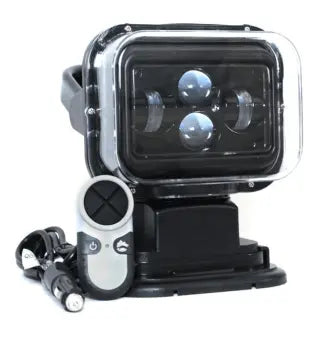
Rather than guessing whether a generic search light will hold up to a plow season or a rough recovery site, run its listed specifications against the criteria above: beam geometry, ingress protection, thermal design, and electrical compatibility with your vehicle’s existing circuits. If a question comes up that the listing doesn’t answer, Strobe My Ride’s technical support team can address vehicle compatibility questions directly.
Start by reviewing the Fleet Search LED utility light product page to confirm it fits your truck’s mounting position and duty cycle before adding it to a build order.


