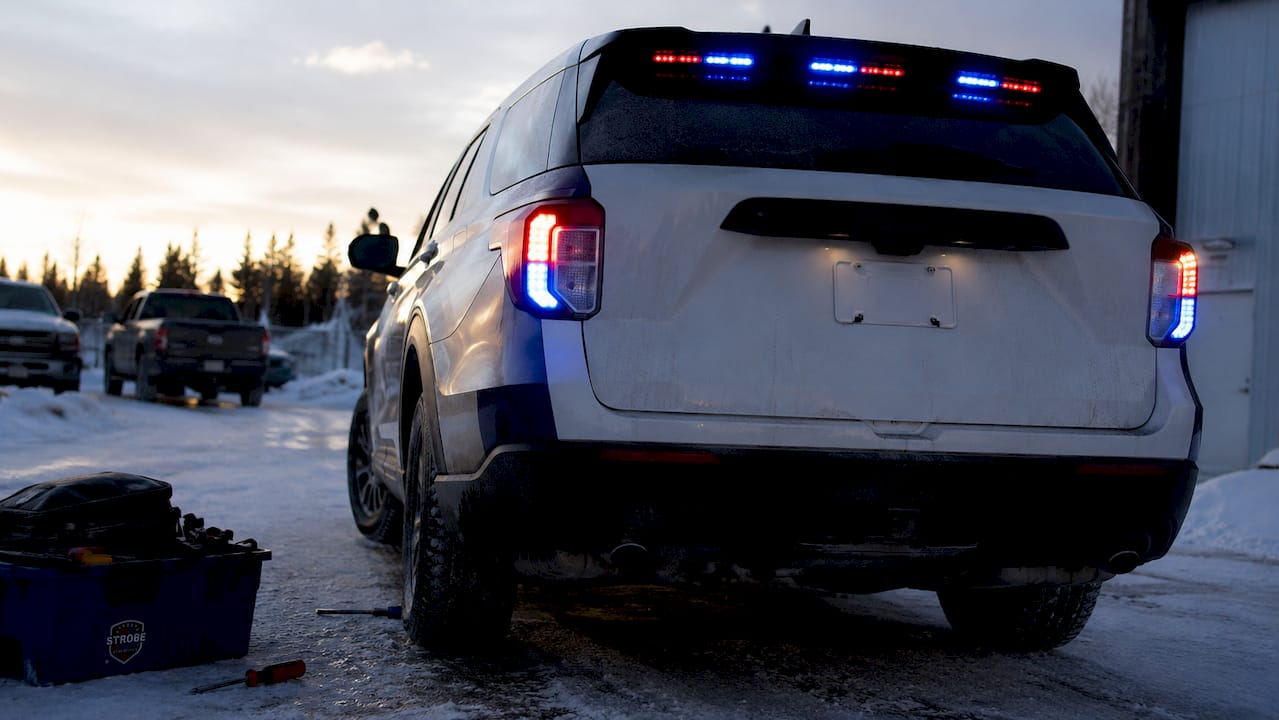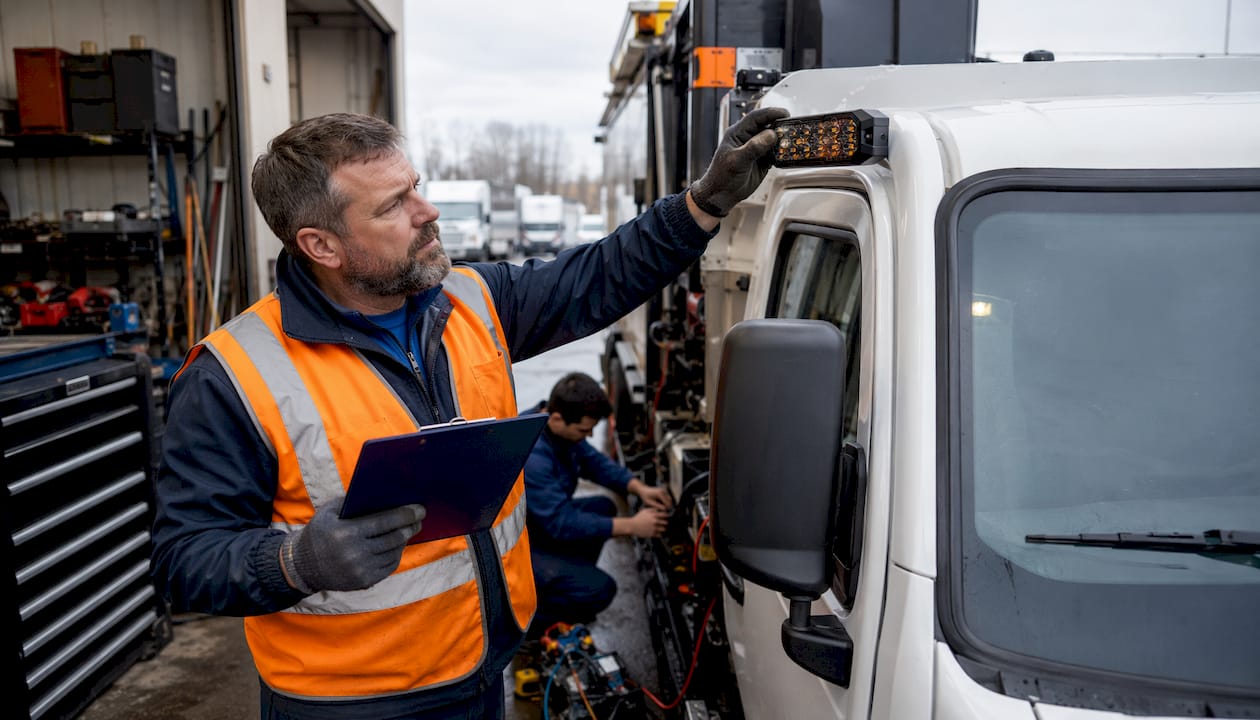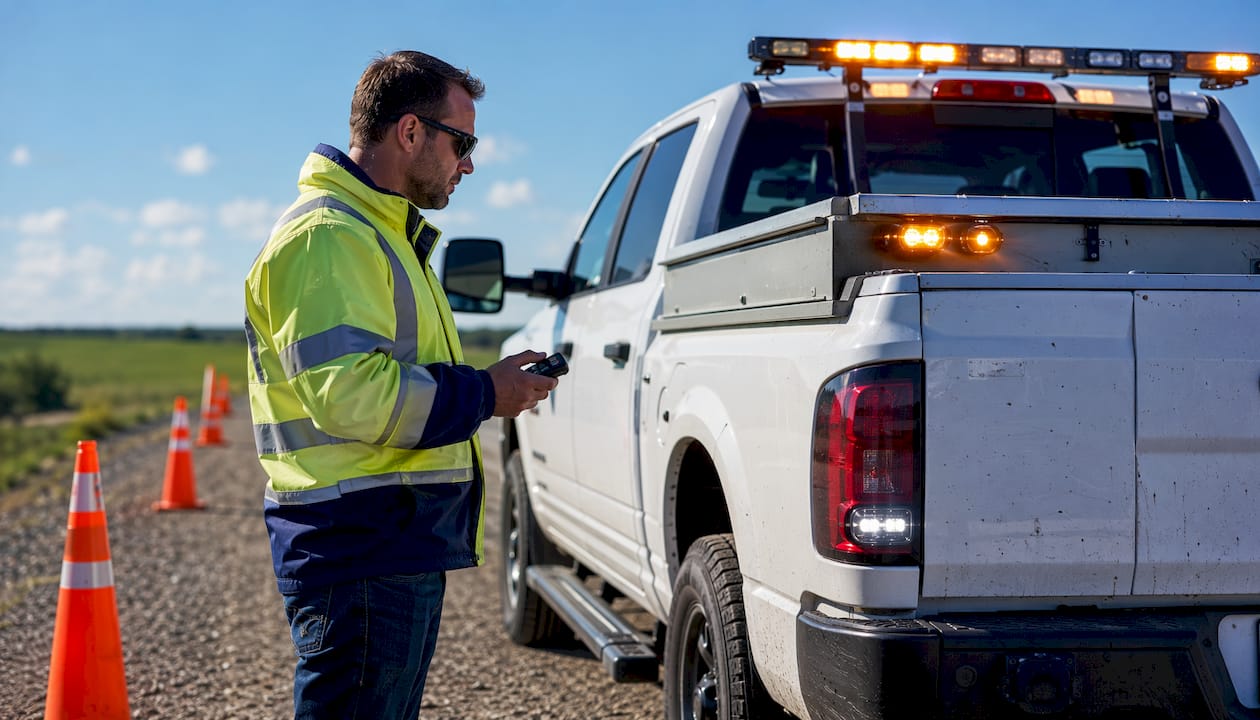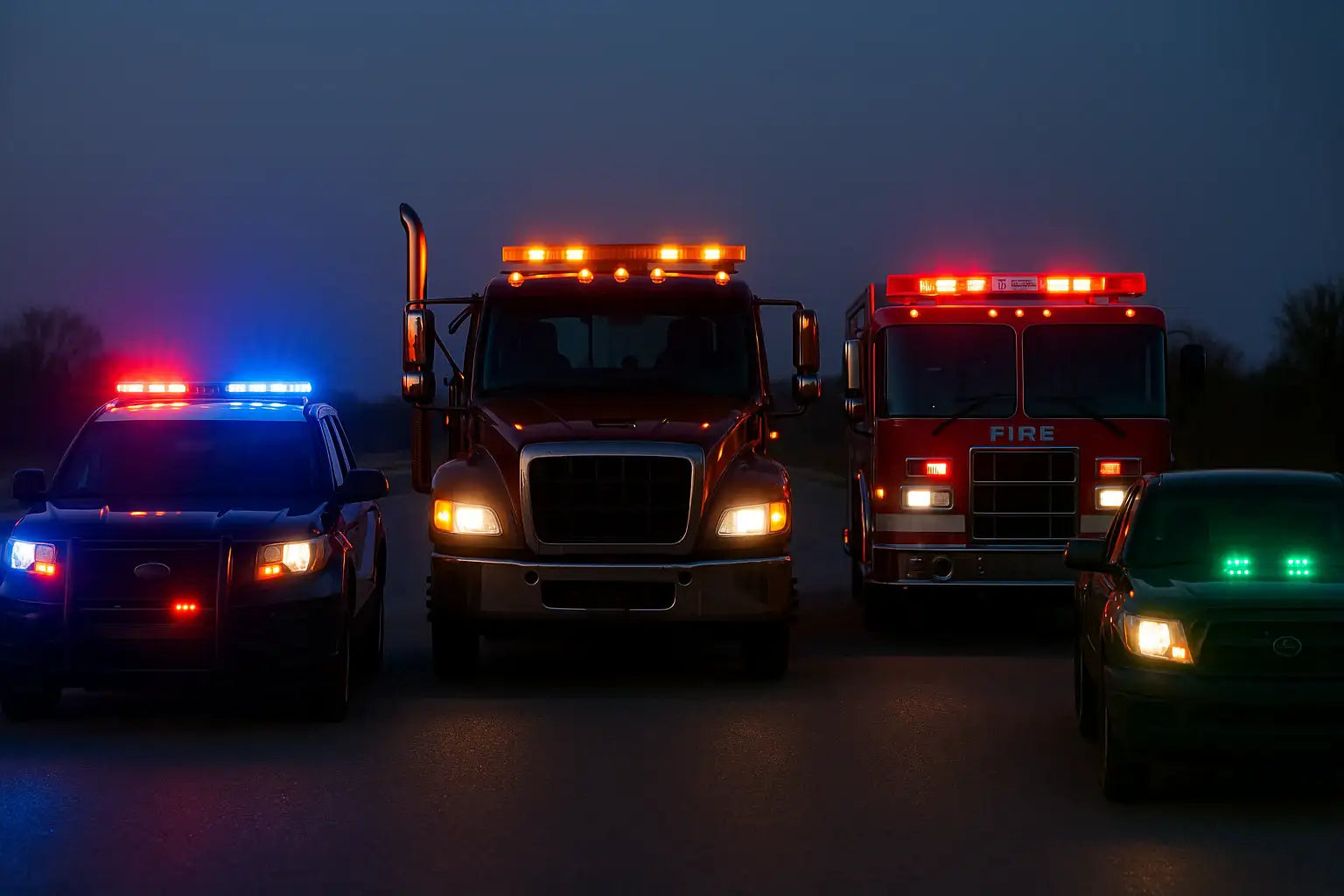
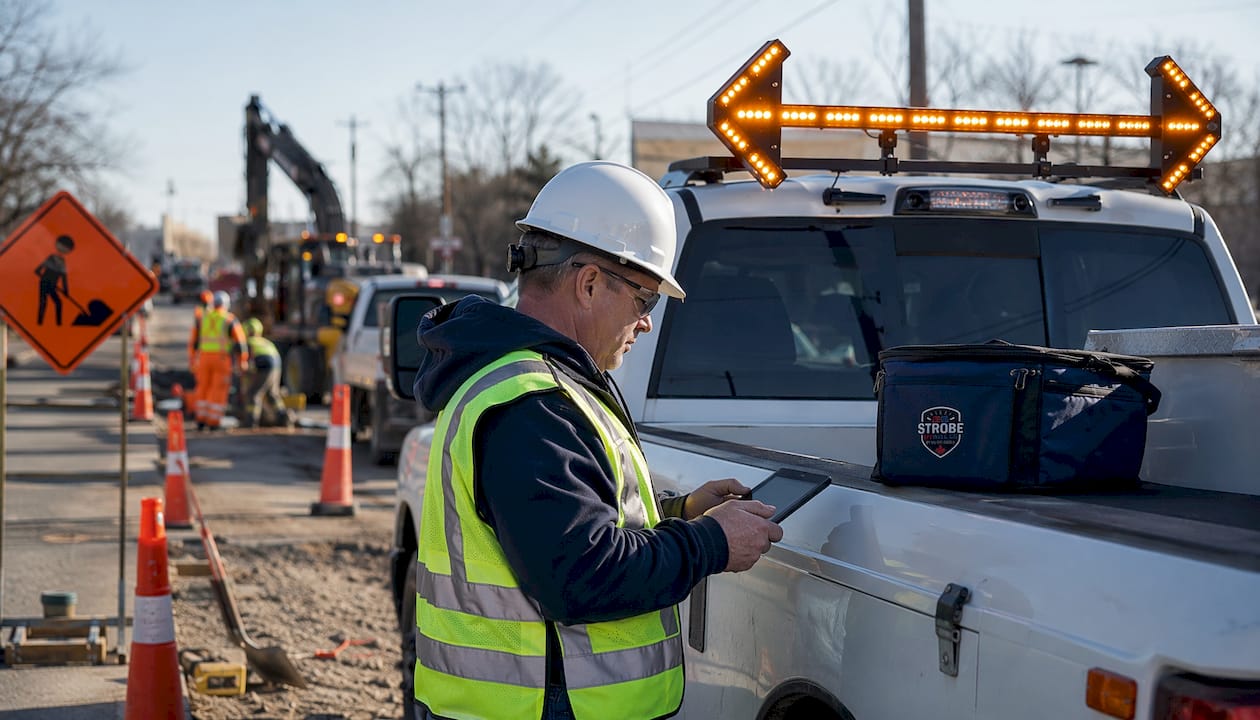
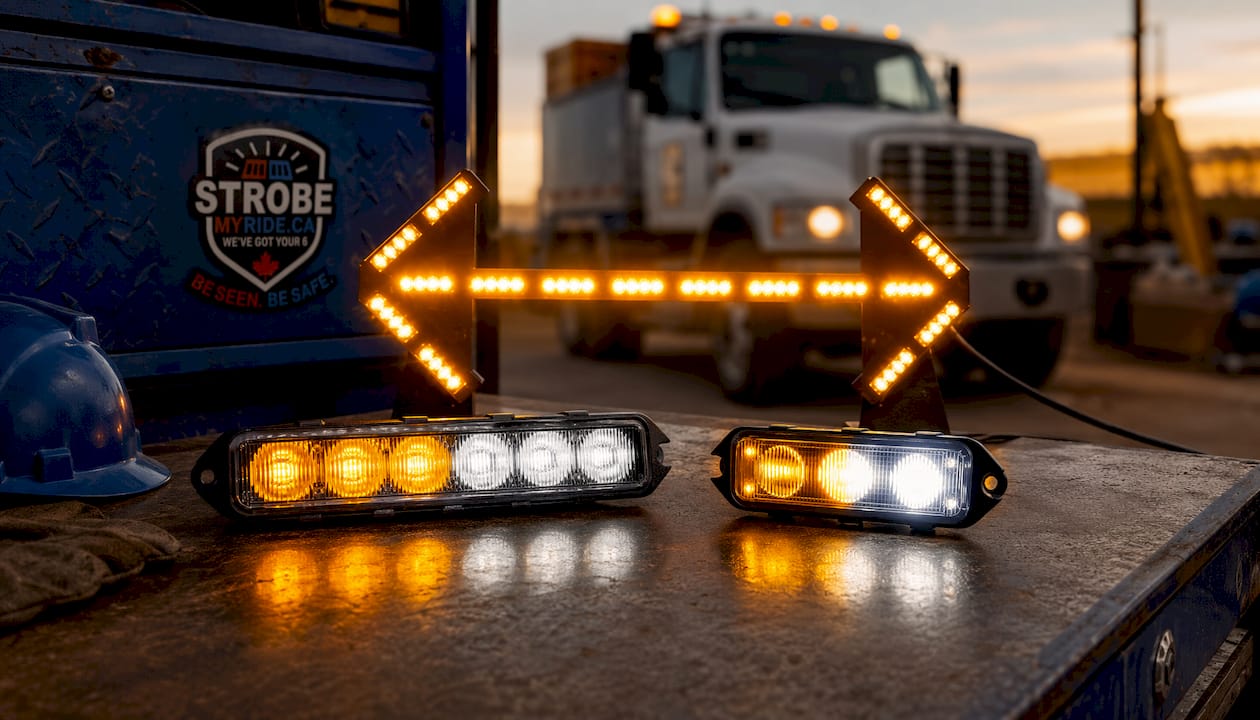
For Canadian construction fleets, the strongest shelf-ready picks are the Strobe My Ride Patrol series: the Patrol Arrow for directional traffic control and pilot/escort duties, the Patrol SM Quad for roof and deck surface-mount installations on service bodies and dump trucks, and the Patrol SM Mini Duo (Amber/White) for pick-ups and tight-footprint utility trucks. All three are sourced through Strobe My Ride with Canadian shipping, warranty support, and documentation to help you navigate CMVSS 108 and provincial permit requirements.
Quick shortlist for procurement decisions:
- Patrol Arrow – Traffic Directional Warning Bar: Best for oversize escort, pilot vehicles, and roadworks lane control. Integrated directional traffic advisor modes with professional photometric documentation.
- Patrol SM Quad – 6 LED Surface Mount Warning Light (Quad Colour): Best for service bodies, dump trucks, and utility trucks needing 360° coverage and directional flash patterns. Compact multi-head design with proven IP weatherproofing.
- Patrol SM Mini Duo (Amber/White) – Surface Mount LED Warning Light (T3 Style): Best for pick-ups, compact service trucks, and any application where deck space is limited. Dual-colour amber/white output doubles as scene lighting.
Provincial compliance varies significantly. Transport Canada’s CMVSS 108 governs mandatory vehicle lighting at the federal level, but BC CVSE, Alberta, Quebec, and Nova Scotia each layer on their own permit regimes, colour rules, and flash-rate requirements. Request Canada-specific documentation from your supplier before purchase — a US “DOT” label alone does not satisfy Canadian certification checks.
Table of Contents
- What types of warning lights work on construction trucks?
- How to choose the right strobe kit for your construction truck
- Recommended Strobe My Ride kits for Canadian construction trucks
- Installation tips for construction vehicle strobe lights
- Canada-specific compliance and provincial permit differences
- Key takeaways
- Strobe My Ride has the kits and documentation your fleet needs
- Authoritative sources and where to verify rules
What types of warning lights work on construction trucks?
Construction vehicles use several distinct categories of warning lights, and the right choice depends on the vehicle’s role, not just its size.
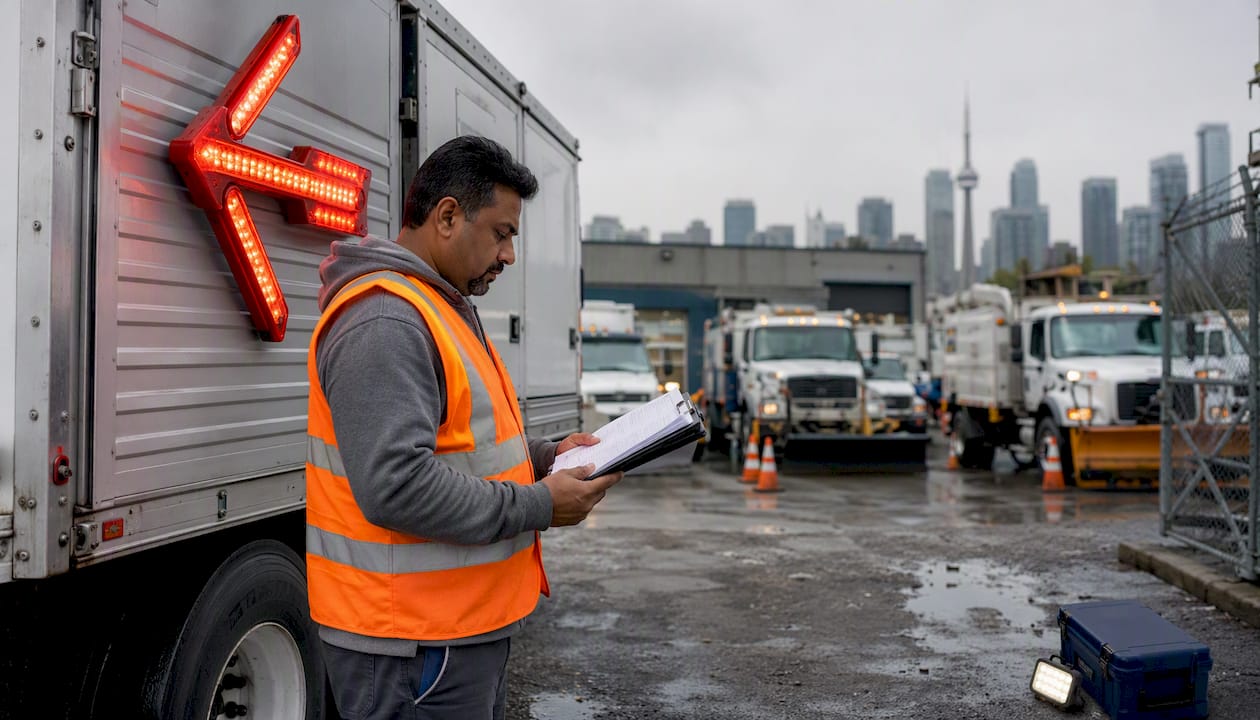
Full-length light bars and traffic advisors run the width of the cab roof or deck and combine 360° amber warning with a directional arrow board function. They suit pilot vehicles, oversize escort trucks, and any application where you need to signal lane changes or direct traffic flow. The Patrol Arrow falls into this category.
360° beacons and rotating/strobe beacons are single-head units mounted on a roof bracket or magnetic base. They provide omnidirectional amber visibility and are common on municipal maintenance trucks, graders, and equipment that moves slowly through active work zones. They are simple to install but offer no directional capability.
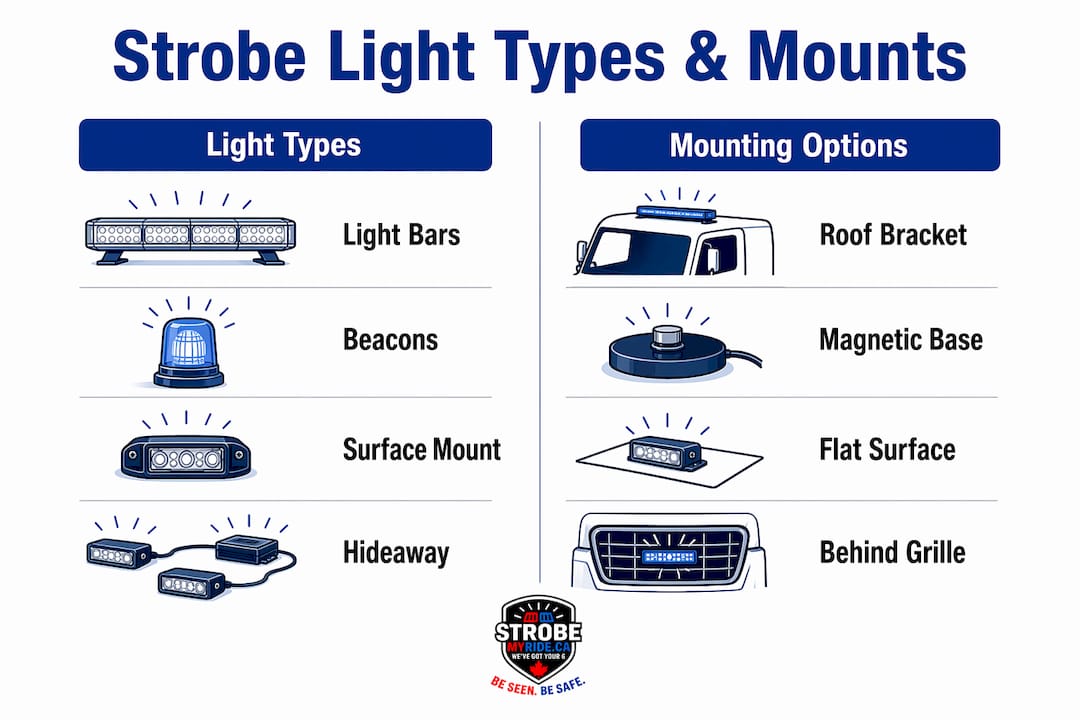
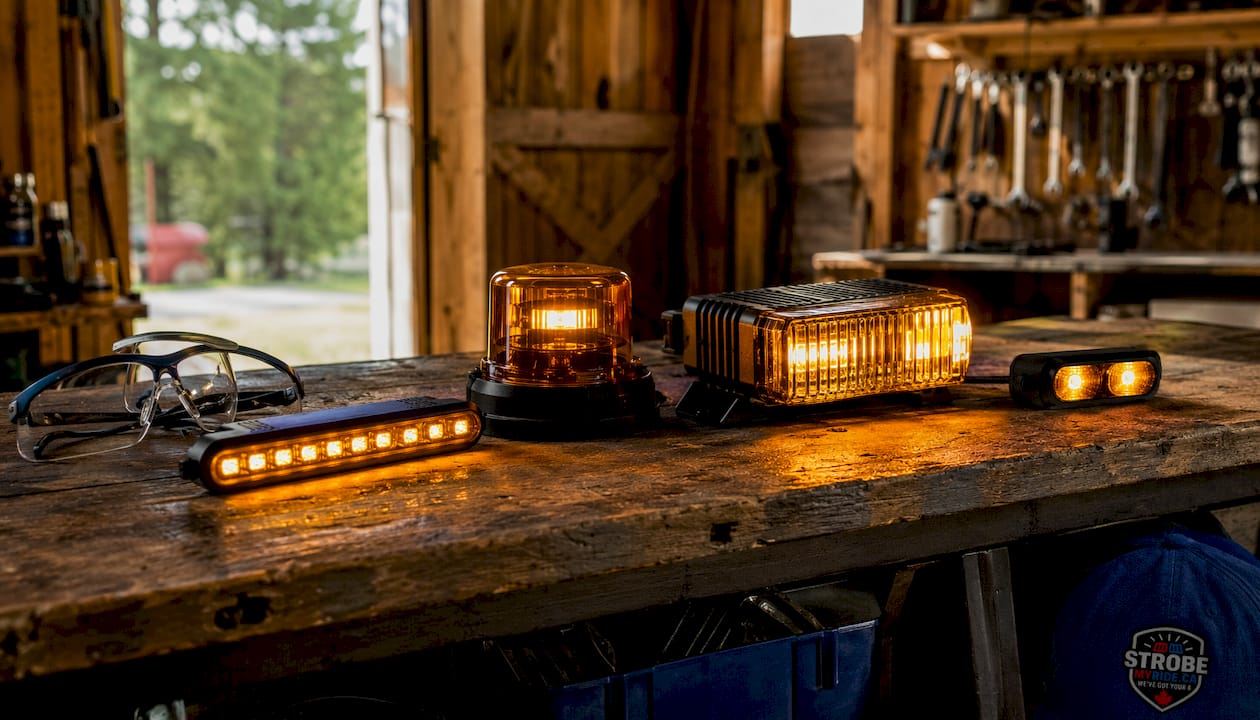
Surface-mount multi-head strobes (T3 and T4 style) are the most versatile option for vocational trucks. Multiple compact heads mount to the roof, deck, or cab corners and connect to a central controller. The Patrol SM Quad and Patrol SM Mini Duo are both surface-mount designs. They deliver strong photometric output with a small footprint, and their multi-head layout allows simultaneous 360° coverage and directional patterns from one kit.
Dash and hideaway flashers are concealed units installed behind grilles or inside tail-light housings. They work well as a secondary warning layer on pick-ups and light-duty service trucks but are rarely sufficient as the sole warning system on a construction vehicle operating on a public road.
Arrow boards and directional bars are purpose-built for traffic control at roadworks sites. Unlike a standard light bar, they display sequential arrow patterns to guide approaching drivers around a lane closure. If your vehicle is stationed at a work zone rather than moving through it, a dedicated arrow board or a bar with integrated traffic advisor modes is the correct tool.
For mounting, surface-mount strobes attach directly to flat surfaces with hardware or adhesive brackets, while beacons typically require a permanent roof bracket or a magnetic base for temporary use. Trailer-mounted units are common for slow-moving equipment trains. The fitment details matter for compliance, particularly in BC and Alberta, where fixed versus temporary mounting affects permit eligibility.
How to choose the right strobe kit for your construction truck
Evaluating a warning light kit goes beyond picking the brightest option. Work through this checklist in order before committing to a purchase.
- Define the primary use case. Is the vehicle a moving pilot truck, a stationary work-zone spotter, a dump truck on a public haul road, or a service body responding to breakdowns? The use case determines whether you need directional capability, 360° coverage, or both.
- Confirm vehicle class and roof footprint. A full-size light bar that fits a Class 8 dump truck will overhang a half-ton pick-up. Measure the available mounting surface and check clearance against any roof-mounted equipment, exhaust stacks, or body hardware.
- Check system voltage. Most pick-ups and light-duty trucks run 12V; heavy equipment and many Class 6–8 trucks run 24V. Confirm your vehicle’s electrical system before ordering. Kits that accept both 12V and 24V simplify fleet procurement across mixed vehicle classes.
- Calculate current draw and alternator headroom. Add the kit’s rated current draw to your existing electrical load. If the total approaches your alternator’s output, a relay and dedicated circuit are necessary to avoid voltage drop and nuisance fuse failures.
- Review flash modes and sync capability. Provincial regulations in Quebec specify flash rates between 60 and 90 flashes per minute for amber beacons, and SAE J845/J974 references appear in the regulatory text. Confirm the kit’s programmable flash modes cover the required range and that multiple units can be synchronised when running more than one head.
- Request photometric data. Candela output at the intended installation angle matters more than a peak lumen rating. Federal lighting location requirements note that supplemental devices must be photometrically certified at their installation angle — a spec sheet showing only forward output is not enough for a unit mounted at a 45-degree deck angle.
- Verify IP rating and corrosion resistance. Construction sites expose lights to water, mud, vibration, and road salt. An IP67 or IP68 rating is the practical minimum for any exterior-mounted unit. Check whether the housing and lens material are rated for UV exposure and temperature cycling.
- Confirm warranty terms and replacement policy. A warranty that covers the lens, housing, and LED array separately from the wiring harness is more useful than a blanket “limited warranty” with no stated duration.
- Assess price relative to documentation. Low-cost generic lights frequently lack photometric records and CMVSS-aligned test documentation. That gap creates liability exposure and can delay permit approvals. The price premium for a documented kit is recoverable in avoided rework.
Pro Tip: Request supplier-supplied Canada-specific compliance documentation and explicit photometric or SAE test records before purchase. A US “DOT” mark is not a substitute for CMVSS 108 certification records, as Transport Canada holds manufacturers and importers accountable for maintaining those records.
For a broader look at how construction vehicle strobes perform across different site conditions, Strobe My Ride’s installation guides cover common fitment scenarios in detail.
| Specification | Why it matters for procurement |
|---|---|
| Voltage (12V / 24V) | Must match vehicle electrical system; dual-voltage kits simplify mixed fleets |
| Flash modes and sync | Must meet provincial flash-rate rules (e.g., Quebec 60–90 fpm for amber beacons) |
| Photometric data at install angle | Required under federal guidance; affects permit approval |
| IP rating | Determines durability in mud, salt, and rain on active construction sites |
| SAE J845 / J974 reference | Referenced in Quebec regulations and useful for other provincial permit applications |
| CMVSS 108 documentation | Mandatory certification records; request from supplier before purchase |
Recommended Strobe My Ride kits for Canadian construction trucks
The three Patrol-series units below cover the most common construction vehicle configurations in Canada. The comparison table uses the dimensions that matter most for procurement and compliance.
| Product | Best for | Mounting type | Voltage | Flash modes & sync | IP rating | Warranty |
|---|---|---|---|---|---|---|
| Patrol Arrow – Traffic Directional Warning Bar | Pilot vehicles, oversize escort, roadworks lane control | Full-length bar, fixed roof or deck mount | 12V / 24V | Directional traffic advisor modes, multiple flash patterns, sync-capable | Weatherproof rated | Strobe My Ride warranty |
| Patrol SM Quad – 6 LED Surface Mount (Quad Colour) | Service bodies, dump trucks, utility trucks needing 360° and directional coverage | 4-head surface mount, roof or deck | 12V / 24V | Multiple flash modes, 360° and directional patterns, sync-capable | IP-rated for harsh sites | Strobe My Ride warranty |
| Patrol SM Mini Duo (Amber/White) | Pick-ups, compact service trucks, tight-footprint deck installs | T3-style compact surface mount | 12V / 24V | Dual-colour amber/white, multiple flash modes | IP-rated | Strobe My Ride warranty |
Patrol Arrow – Traffic Directional Warning Bar is the right choice when your vehicle’s primary job is directing traffic rather than simply being seen. The integrated traffic advisor modes let the operator switch between steady amber warning and sequential directional arrows without a separate controller. Professional photometric documentation is available, which matters when applying for a BC CVSE permit or satisfying a Quebec transport authority inspection. For oversize escort and pilot car operators, this bar covers both the visibility and the directional signalling requirement in one unit.
Patrol SM Quad suits the broadest range of heavy construction vehicles. Four compact heads distribute across the roof or deck to deliver coverage in all four quadrants, and the multi-colour option means a single kit can serve both amber warning and white scene-lighting functions. The compact head profile keeps the unit below the roofline on most service bodies, reducing wind resistance and avoiding conflicts with mandatory clearance lamps. Fleet procurement teams running mixed dump truck and service body inventories will find this kit covers both vehicle types without ordering separate SKUs.
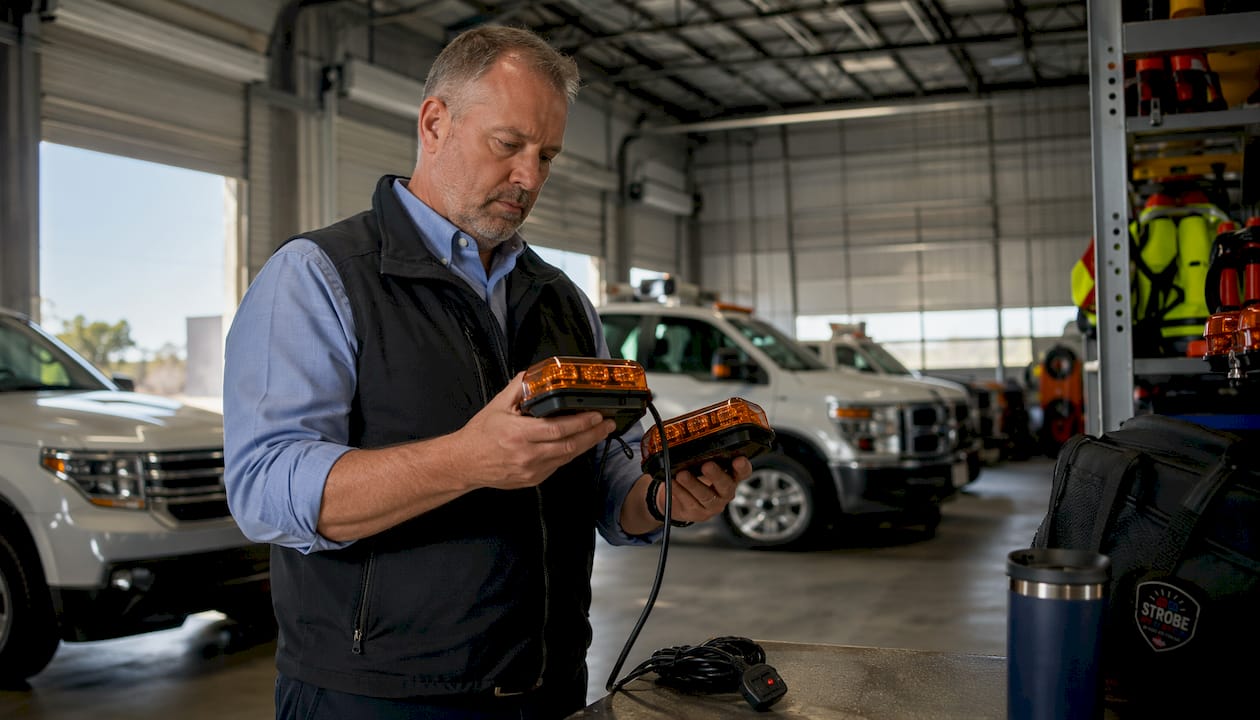
The Patrol SM Mini Duo is the practical answer for pick-ups and light-duty trucks where deck real estate is limited. The T3-style footprint mounts cleanly on a cab roof or rear deck without requiring a full bracket system, and the amber/white dual output means the same unit that warns approaching traffic can illuminate a roadside work area at night. For contractors equipping a fleet of half-tons alongside heavier equipment, the Mini Duo keeps the pick-up kit consistent with the rest of the fleet’s Patrol-series wiring and controller conventions.
All three units are available through Strobe My Ride with Canadian shipping, spec sheets, and photometric documentation on request. Strobe My Ride also supplies compatible harnesses, fixed mount hardware, and magnetic temporary mount kits as accessories. For fleet orders, contact Strobe My Ride directly for volume pricing and to confirm which documentation package applies to your province’s permit process.
Installation tips for construction vehicle strobe lights
Getting the mounting and wiring right the first time avoids costly rework and keeps your vehicle compliant at roadside inspections.
Mounting considerations:
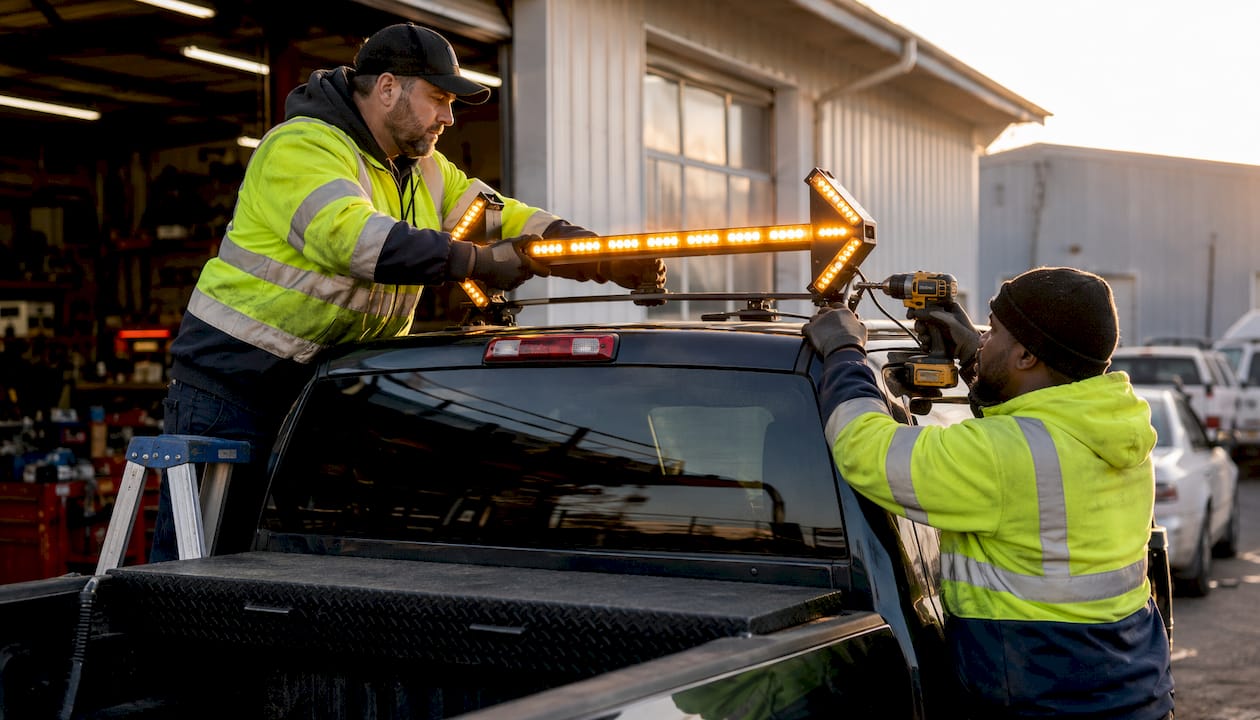
- Fixed mounts are required for vehicles whose primary operational role is highway maintenance or traffic control; magnetic or temporary mounts are generally restricted to personal or mileage use in most provinces, including BC.
- Place roof-mounted units on the vehicle centreline where possible. Off-centre placement can create photometric blind spots and may not satisfy the symmetry requirements referenced in provincial permit conditions.
- On service bodies with toolboxes or equipment racks, confirm the mounting surface is structurally sound and that the unit’s photometric output is not obstructed by body hardware at the intended installation angle.
- Trailer-mounted units need sealed, weatherproof connectors at the trailer coupling point to prevent corrosion-related failures on long hauls.
Electrical fitment checklist:
- Confirm system voltage (12V or 24V) before wiring.
- Check alternator output against total electrical load including the new lighting kit.
- Use a dedicated fused circuit sized to the kit’s rated current draw, not a shared accessory circuit.
- Install a relay when the kit’s current draw exceeds the capacity of the switch or controller output.
- Use sealed, OEM-style connectors at all exterior junction points to prevent water ingress and corrosion.
Common pitfalls to avoid:
- Positioning a strobe head directly in front of a mandatory tail lamp, clearance lamp, or turn signal. Federal guidance is explicit that supplemental warning lights must not obscure required lighting.
- Installing a unit at an angle that was not included in the photometric certification. Output at an uncertified angle may not meet the visibility distance requirements in your province’s permit conditions.
- Inadequate chassis grounding. A poor ground bond causes flickering, reduced output, and can introduce electrical noise into the vehicle’s CAN bus on newer trucks.
- Running the kit on an overloaded circuit without a relay, which leads to voltage drop, premature LED degradation, and nuisance fuse failures.
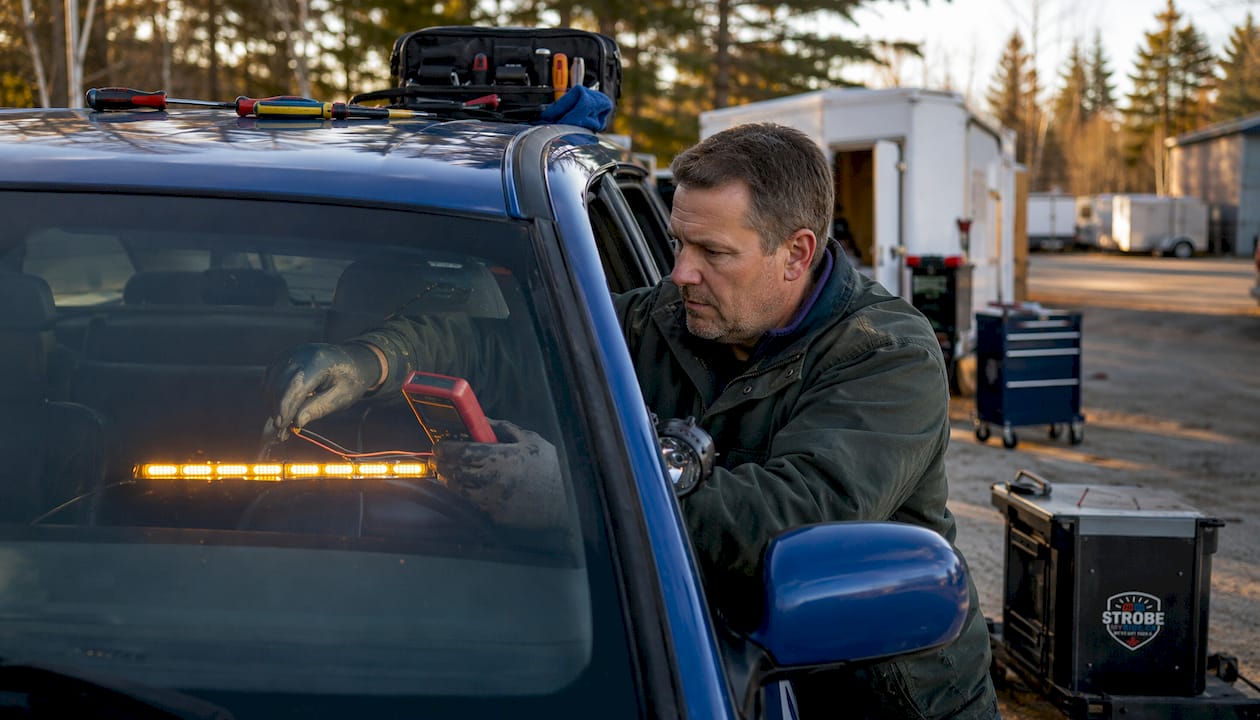
Pro Tip: Before permanent installation, bench-test the complete kit on the vehicle with all flash modes active. Confirm photometric angle, verify sync between heads, and document the installation with photos and the supplier’s spec sheet. That installation packet becomes your first line of defence at a permit inspection or enforcement stop.
For additional guidance on work vehicle visibility and how mounting position affects photometric performance, Strobe My Ride’s visibility guide covers the topic in practical terms.
Canada-specific compliance and provincial permit differences
Understanding the regulatory framework before you buy prevents the most common and expensive compliance mistakes.
Federal baseline: CMVSS 108
CMVSS 108 governs mandatory vehicle lighting across Canada. It does not regulate supplemental warning lights directly, but it does require that any added device not obstruct or conflict with mandatory lamps. Manufacturers and importers must maintain certification test records. When you purchase a warning light kit, request those records from your supplier. A US “DOT” label reflects compliance with FMVSS 108, not CMVSS 108 — the two standards are closely aligned but not identical, and Transport Canada holds Canadian importers to the Canadian version.
British Columbia
BC CVSE distinguishes between vehicles that are automatically permitted to use flashing amber lights (highway maintenance equipment, snow removal vehicles) and commercial trades vehicles that require a permit. The BC amber flashing lamp reference guide defines 360-degree devices and directional arrow boards separately and sets visibility distance expectations for traffic control vehicles. Fixed mounts are typically required for operational maintenance vehicles; magnetic mounts are generally limited to personal or mileage use. If your construction truck does not fall within the automatic exemption, apply for a CVSE permit and submit device specifications with your application.
Alberta
Alberta’s roadside worker safety rules include move-over and slow-down requirements with doubled fines when workers are present, with updates that broadened protections in September 2023. Higher-spec strobes with documented photometric output are defensible not just for visibility but as a liability mitigation measure. If an incident occurs and your vehicle’s warning lights cannot be shown to meet a reasonable visibility standard, the documentation gap becomes a legal exposure. Procuring kits with SAE J845-referenced specs and photometric records is the practical response to that risk.
Quebec
Quebec’s regulation defines an “amber beacon or strobe light” as a 360-degree rotating amber lamp that flashes at 60–90 flashes per minute with a lens not less than 10 cm high, or an equivalent light bar. A “flashing amber warning lamp” must have an effective projected luminous area, flash rate, and SAE class conforming to the specified Quebec regulatory standards. These requirements represent the regulatory minima for vehicles operating in Quebec. Confirm that any kit you purchase for Quebec operations meets both the flash-rate range and the lens-size requirement, and that the supplier can provide SAE test records to demonstrate conformance.
For amber-specific compliance across provinces, Strobe My Ride’s amber strobe guide covers colour rules and SAE class requirements in detail.
Nova Scotia
Nova Scotia’s Vehicle Warning Lights Regulations permit flashing yellow/amber lights on road-building and construction equipment and outline which vehicle classes are eligible. If you operate in Atlantic Canada, confirm your vehicle class appears on the permitted list before fitting supplemental amber warning lights.
Compliance checklist for procurement:
- Verify CMVSS 108 certification records are available from the supplier.
- Request photometric data showing output at the intended installation angle.
- Confirm provincial permit requirements for your vehicle class and operational duty.
- Check flash-rate range against Quebec’s 60–90 fpm rule if operating there.
- Confirm SAE J845 or J974 compliance for Quebec and any province that references those standards.
- Record installation details, photos, and spec sheets in each vehicle’s fleet file.
Pro Tip: Assemble an installation packet for each vehicle: supplier spec sheet, photometric report, invoice, installation photos, and a copy of the applicable provincial permit or exemption reference. Store it digitally linked to the vehicle’s fleet record. At a roadside inspection or permit renewal, having that packet ready saves hours.
If you operate in Ontario, Strobe My Ride’s guide on strobe lights on work trucks covers that province’s specific rules. For a broader look at commercial vehicle operation risks and how warning light compliance fits into fleet risk management, the linked fleet guide is a useful reference.
Key takeaways
The most effective approach to outfitting Canadian construction trucks with warning lights is to match the kit to the vehicle’s operational role, verify provincial compliance requirements before purchase, and demand supplier documentation that covers CMVSS certification, photometric output, and SAE test records.
| Point | Details |
|---|---|
| Match kit to vehicle role | Patrol Arrow for pilot/escort, Patrol SM Quad for service bodies and dump trucks, Patrol SM Mini Duo for pick-ups and compact trucks. |
| Verify CMVSS documentation | Request Canadian certification records from your supplier; a US “DOT” label does not satisfy CMVSS 108 requirements. |
| Check provincial rules before purchase | BC, Alberta, Quebec, and Nova Scotia each have distinct permit, flash-rate, and mounting requirements that affect which kit is compliant. |
| Photometric data at install angle | Federal guidance requires supplemental lights to be photometrically certified at their actual installation angle, not just in a forward-facing test position. |
| Strobe My Ride Patrol series | Strobe My Ride supplies all three Patrol-series kits with Canadian shipping, spec sheets, and compliance documentation for fleet procurement. |
Strobe My Ride has the kits and documentation your fleet needs
When you are outfitting a construction fleet in Canada, the difference between a compliant installation and a permit problem often comes down to paperwork, not the light itself. Strobe My Ride supplies the full Patrol series with Canadian shipping, technical support for fitment questions, and documentation packages that include spec sheets and photometric data.
Whether you need a single Patrol Arrow for a pilot truck or a multi-unit Patrol SM Quad order for a service body fleet, Strobe My Ride can support the procurement from product selection through to installation guidance. Fleet pricing is available on request, and the team can advise on which documentation applies to your province’s permit process. Visit the Strobe My Ride construction lighting page to review the full Patrol series, or contact Strobe My Ride directly to request a spec sheet and installation packet for your specific vehicle class and province.
Authoritative sources and where to verify rules
Use these primary sources to confirm regulations and product specifications for your province and vehicle class.
- Transport Canada — Safety Standards for Vehicles (CMVSS): Federal certification requirements and CMVSS 108 accountability for manufacturers and importers.
- Transport Canada — Federal Lighting Equipment Location Requirements: Guidance on supplemental light placement and photometric certification at installation angle.
- BC CVSE — Amber Flashing Lamp Permit and Device Information: BC permit process for commercial trades vehicles and automatic exemptions for maintenance equipment.
- BC CVSE — Amber Flashing Lamp Reference Guide: Device type definitions, visibility distance requirements, and maximum units per vehicle.
- Alberta — Roadside Worker Safety: Move-over and slow-down rules, doubled fines, and the compliance context for high-spec warning lights.
- Quebec — Regulation Respecting Emergency Vehicles and Vehicles Equipped with Flashing or Rotating Amber Lights: Flash-rate minima (60–90 fpm for amber beacons), lens-size requirements (10 cm minimum height), and SAE J845/J974 references.
- Nova Scotia — Vehicle Warning Lights Regulations: Permitted vehicle classes for flashing yellow/amber lights in Atlantic Canada.
- Strobe My Ride — Construction and Work Truck Lighting Canada: Product categories, compliance guidance, and spec sheet requests for Canadian fleets.
- Strobe My Ride — Construction Fleet Visibility Guide: Procurement checklist and fleet-focused guidance for warning light selection.
Recommendation: Save the applicable provincial permit page, the supplier’s photometric report, and the product spec sheet alongside each vehicle’s fleet record. At a permit renewal or roadside inspection, that file is your fastest path to resolution.