


For most Canadian fleet operators, the right warning beacon comes down to three variables: vehicle size, mounting constraints, and the operating environment. Strobe My Ride’s Patrol Series addresses all three with a focused shortlist. The Fleet Beacon HD-Duo is the strongest choice for large trucks, snow plows, and municipal equipment that need high-output amber coverage in harsh conditions. The Fleet Beacon Mini (Amber/White Duo) suits service vans, compact municipal units, and small trucks where a low-profile dual-colour device handles multiple tasks. The Fleet Beacon Equip is purpose-built for implements, trailers, and construction attachments that need equipment-grade sealing and flexible mounting.
All three are available with Canadian shipping and warranty support through Strobe My Ride. Device performance expectations are set by SAE J845 for optical warning devices, and national activation and photometric requirements fall under Transport Canada TSD 108.
- Fleet Beacon HD-Duo: large trucks, municipal fleets, snow plows — high output, rugged mount
- Fleet Beacon Mini (Amber/White Duo): vans, small trucks, compact municipal units — low profile, dual colour
- Fleet Beacon Equip: implements, trailers, construction equipment — equipment-grade sealing, flexible mount
Table of Contents
- How do the three Strobe My Ride beacons compare spec by spec?
- How to choose the right warning beacon for your fleet
- What are the main types of warning beacons and when should you use each?
- What installation and maintenance practices keep beacons reliable?
- What Canadian compliance rules apply to warning beacons?
- Key takeaways
- Strobe My Ride: Canadian-stocked beacons with fleet support
- Useful sources and primary references
How do the three Strobe My Ride beacons compare spec by spec?
| Feature | Fleet Beacon HD-Duo | Fleet Beacon Mini (Amber/White Duo) | Fleet Beacon Equip |
|---|---|---|---|
| Best for | Large trucks, municipal fleets, snow plows | Service vans, small trucks, compact municipal units | Implements, trailers, construction equipment |
| Lens colour / SAE class | Amber/dual colour | Amber/white duo | Amber |
| Mounting type | Permanent / rugged surface mount | Low-profile surface mount | Equipment / implement mount |
| IP / weather rating | Heavy-duty rated | Weather-rated | Equipment-grade sealed |
| Warranty & availability | Canadian warranty, ships from Canadian stock | Canadian warranty, ships from Canadian stock | Canadian warranty, ships from Canadian stock |
| Typical price band | $$ | $ | $ |
Specific voltage, current draw, and physical dimensions are listed on each product page; verify those figures before finalising a purchase order, particularly if you are matching the beacon to an existing flasher module or sync controller. Synchronisation capability across a mixed fleet is worth confirming directly with Strobe My Ride, since not all beacon models support multi-unit sync out of the box.
Pro Tip: When running multiple beacons on a single vehicle or across a fleet, synchronised flash patterns reduce visual confusion for other road users. Ask your supplier whether the beacons support a common sync wire or controller before ordering, and specify the same flash pattern across all units on a given vehicle class.
How to choose the right warning beacon for your fleet
The selection process is straightforward when you work through it in order. Start with the vehicle and its operating environment, then confirm electrical and mounting constraints before comparing models.
Core selection criteria
- Vehicle type and size: larger vehicles need higher-output devices; compact units suit vans and light trucks
- Coverage requirement: most fleet applications need 360° omnidirectional coverage; directional devices serve lane-control roles only
- SAE class / optical performance: confirm the class rating matches your provincial or municipal specification
- Flash pattern and synchronisation: choose a pattern that meets any applicable provincial traffic control manual requirements, and confirm sync capability if running multiple units
- Electrical compatibility: match beacon voltage to the vehicle system (12 V or 24 V); check current draw against circuit capacity and fusing
- Mounting constraints: permanent bolt-down, magnetic, or implement-mount; confirm the chosen location gives unobstructed 360° coverage
- IP rating and temperature range: Canadian winters demand a minimum IP67 rating for exposed roof or implement mounts
- Total cost of ownership: factor in purchase price, installation labour, periodic maintenance, and expected service life
Vendor questions to include in an RFQ
- Are spare parts (lenses, gaskets, mounting hardware) stocked in Canada?
- What are the warranty terms, and how is a claim processed?
- What is the lead time from Canadian stock versus import?
- Can you provide SAE J845 test records or documentation for the specific model?
- Does the beacon support synchronisation with other units, and what controller is required?
- Is the device activation designed to connect to a vehicle input (e.g., hazard switch), as required under TSD 108?
Pre-purchase sign-off checklist for fleet managers
- Confirm compatibility with existing flasher modules or plan for a replacement
- Verify whether a permit is required for traffic control vehicle use in your province
- Identify the exact mounting location on each vehicle and confirm no structural obstruction blocks the required coverage arc
- Document the installed device model, serial number, and installation date for fleet records
Pro Tip: For construction and work truck applications, check your provincial traffic control manual before specifying flash patterns. Some manuals prescribe specific patterns or minimum flash rates for vehicles operating in active work zones.
What are the main types of warning beacons and when should you use each?
A warning beacon is a highly visible flashing light signal designed to alert other road users to a potential hazard. The term covers several distinct device categories, each with different optical characteristics and appropriate applications.
- 360° LED beacons: the standard choice for general fleet conspicuity. They produce omnidirectional coverage from a single compact housing, draw low current, and have no moving parts. Suitable for tow trucks, snow plows, utility vehicles, and most municipal applications.
- Strobe modules: high-intensity single-flash devices often used as supplementary lighting or in hideaway configurations. Effective for high-visibility bursts but typically directional; not a substitute for a 360° device on its own.
- Rotators (legacy): mechanical rotating reflector units. Still found on older fleet vehicles but largely replaced by LED equivalents due to higher maintenance requirements and power draw.
- Directional arrow boards / sequential light bars: used for lane control and traffic direction. These are not interchangeable with 360° beacons; BC’s amber flashing lamp reference guide explicitly states that a flashing light bar is not a directional flashing optical warning device.
- Low-profile combo beacons (amber/white duo): dual-colour units that serve multiple roles on a single vehicle, such as the Fleet Beacon Mini. The white output can function as a work light; the amber output provides the warning signal.
- Whip / antenna-style beacons: tall flexible-mount devices used on off-road equipment, ATVs, and utility vehicles where height improves sightline visibility across uneven terrain. Also used on forklifts and warehouse equipment for pedestrian warning.
- V16-style roof beacons: roof-placed devices designed for roadside breakdown scenarios where a driver deploys the beacon without exiting the vehicle. Common in some European jurisdictions; less prevalent in Canadian fleet contexts but relevant for roadside assistance operators.
The practical rule: use a 360° LED beacon for general vehicle conspicuity, a directional device only where lane control is the specific task, and a combo unit where dual-function lighting reduces the total number of devices on the vehicle.
What installation and maintenance practices keep beacons reliable?
Mounting and coverage
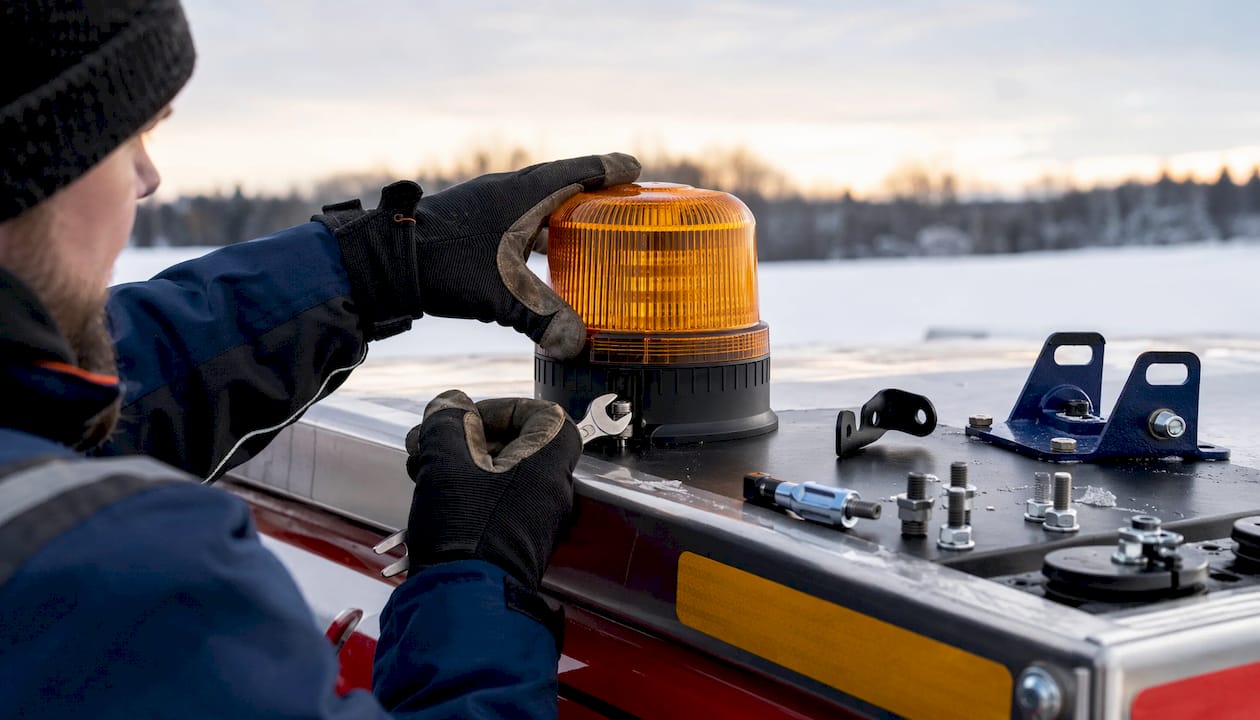
Position the beacon where it achieves unobstructed 360° visibility. On large vehicles, a single top-mounted unit is often insufficient because the cab or body blocks part of the coverage arc. Federal location requirements for trucks, buses, and multipurpose passenger vehicles set minimum lamp counts and placement guidance; if your vehicle structure obstructs coverage, install a secondary device to fill the gap. Follow the manufacturer’s torque specifications for fasteners, particularly on implement mounts exposed to vibration.
Electrical compatibility
Match the beacon’s rated voltage to the vehicle system (12 V for most light-duty trucks; 24 V for heavy equipment). Check the current draw against the circuit’s fuse rating and the capacity of any existing flasher module. If the beacon is wired to activate via the hazard switch, confirm that the circuit can carry the combined load. A dedicated fused circuit is the cleaner solution for permanent fleet installations. For troubleshooting wiring issues after installation, Strobe My Ride’s vehicle lighting troubleshooting guide covers common fault scenarios.
Routine maintenance schedule
- Clean lenses and housing monthly in high-dust or road-salt environments
- Inspect gaskets and IP seals at each seasonal service interval
- Check fastener torque after the first 500 km of operation and annually thereafter
- Verify LED module function and flash pattern at each preventive maintenance visit
- Replace any cracked or yellowed lenses promptly; degraded optics reduce effective range
Total cost of ownership framework
Purchase price is only part of the calculation. Budget for installation labour (typically one to two hours per unit for a permanent mount with dedicated wiring), annual maintenance time, and eventual lens or gasket replacement. LED beacons have no consumable bulbs, which reduces ongoing costs compared to legacy rotators. A well-maintained LED beacon on a fleet vehicle should deliver several years of reliable service under normal Canadian operating conditions.

Pro Tip: Stock at least one spare lens and gasket set per beacon model in your shop. When a seal fails in January on a plow truck, waiting for a parts order is not an option.
What Canadian compliance rules apply to warning beacons?
Transport Canada TSD 108
TSD 108 is the national technical standards document governing vehicle lighting, including hazard warning signals. It treats amber and yellow as equivalent for warning lighting purposes and sets activation requirements that connect device operation to specific vehicle inputs, such as the hazard switch. Buyers should ask vendors to document how their beacon’s activation logic maps to TSD 108 requirements, particularly for vehicles where the beacon is wired to a dedicated switch rather than the OEM hazard circuit.
TSD 108 specifies that hazard warning signal activation must be linked to vehicle inputs, and that amber and yellow are treated as equivalent colours for warning lighting purposes. Procurement teams should request vendor documentation confirming this mapping for any beacon intended for regulated vehicle use.
SAE J845 optical performance
SAE J845 provides the test procedures and performance requirements that vendors reference when claiming a class rating for omnidirectional and selective coverage optical warning devices. A generic “SAE-rated” claim is not sufficient for procurement purposes. Request the specific test records and confirm which edition of J845 was used.
BC amber flashing lamp distinctions
British Columbia’s amber flashing lamp reference guide draws a clear line between 360° warning devices and directional flashing optical devices. The guide states explicitly that a flashing light bar or sequential light bar is not a directional flashing optical warning device or arrow board. This distinction matters for any fleet operating traffic control vehicles in BC: deploying a light bar in place of a certified arrow board does not satisfy the provincial requirement.
Ontario tow and roadside assistance requirements
Ontario’s Highway Traffic Act sets specific requirements for tow trucks: at least one amber warning lamp must be permanently mounted on the top of the vehicle and clearly visible from all directions. Activation is restricted to specific operational conditions (attaching to a vehicle, towing, or assisting a stopped vehicle). If you operate tow trucks in Ontario, review the Ontario Book 7 warning light requirements for the full deployment context.
Practical compliance steps
- Record the make, model, and installation date of every beacon fitted to each vehicle
- Request SAE J845 test documentation from your supplier before finalising a purchase order
- Check the provincial traffic control manual for each province where the vehicle operates
- Confirm permit requirements for traffic control vehicle use in each jurisdiction
- Review the fleet lighting compliance guide for a consolidated Canadian checklist
Pro Tip: Fleets operating across multiple provinces face different deployment rules in each jurisdiction. BC’s amber lamp guide and Ontario’s Book 7 are not interchangeable. Build a province-by-province compliance matrix for your fleet before specifying beacon models and flash patterns.
This article provides general information for fleet procurement and technical teams. It is not legal advice. Verify current regulatory requirements with Transport Canada, the relevant provincial ministry, or a qualified compliance professional for your specific vehicles and operating jurisdictions.
Key takeaways
The right warning beacon for a Canadian fleet depends on vehicle size, mounting constraints, and provincial compliance requirements — verify all three before placing a purchase order.
| Point | Details |
|---|---|
| Match beacon to vehicle class | HD-Duo for large trucks and plows; Mini for vans and compact units; Equip for implements and attachments. |
| Confirm electrical compatibility | Check voltage (12 V or 24 V) and current draw against circuit capacity before wiring any permanent installation. |
| Request SAE J845 test records | A generic SAE-rated claim is not sufficient; ask for the specific test documentation and edition referenced. |
| Know the provincial rules | BC and Ontario have distinct amber lamp deployment requirements; a light bar does not substitute for an arrow board in traffic control. |
| Strobe My Ride Patrol Series | All three shortlisted beacons ship from Canadian stock with warranty support and technical guidance for fleet upfits. |
Strobe My Ride: Canadian-stocked beacons with fleet support
Fleet procurement teams working against tight lead times need a supplier that holds stock in Canada, not one routing orders through a US warehouse. Strobe My Ride carries the full Patrol Series beacon line with Canadian shipping, industry warranties, and direct technical support for fleet upfits — no waiting on customs clearance when a plow truck needs a replacement unit before the next storm.
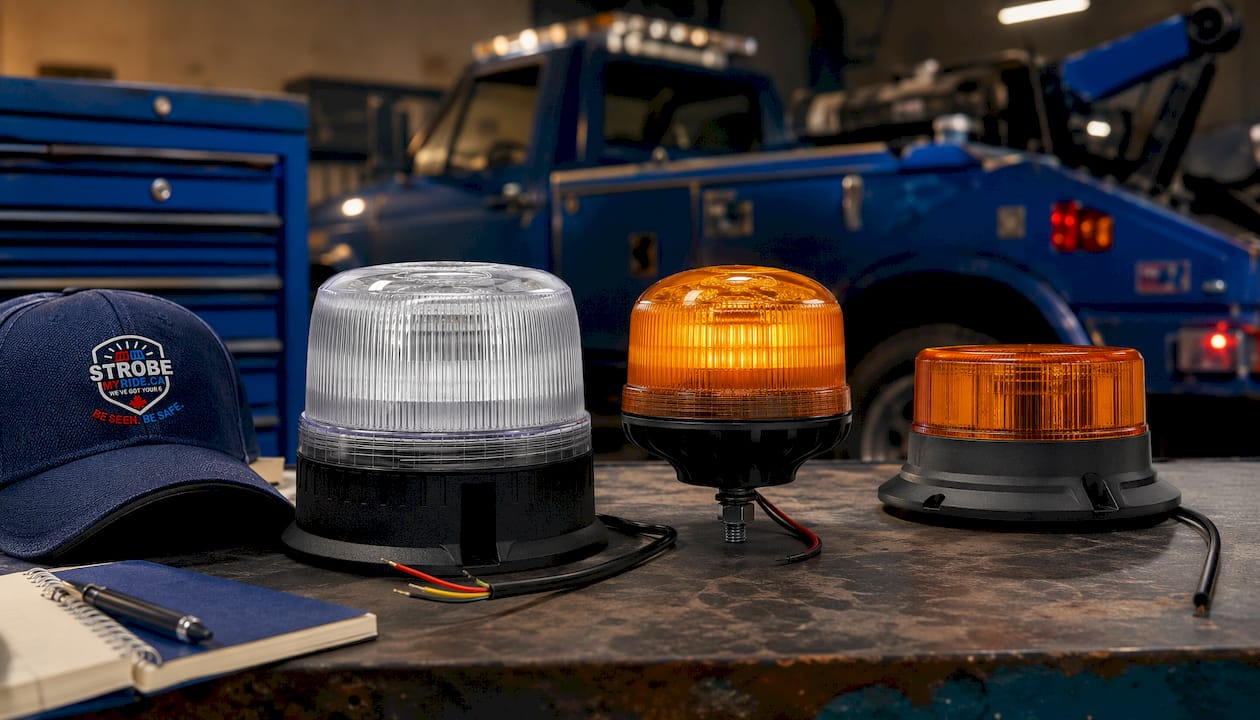
The three shortlisted models are available directly:
- Fleet Beacon HD-Duo – Heavy-Duty Beacon — for large trucks, municipal fleets, and snow plows
- Fleet Beacon Mini (Amber/White Duo) — for service vans, small trucks, and compact municipal units
- Fleet Beacon Equip – Amber LED Equipment Beacon — for implements, trailers, and construction equipment
Browse the full Patrol Series collection for specs and pricing, or contact Strobe My Ride directly for fleet pricing, volume orders, or installation advice on a specific vehicle application.
Useful sources and primary references
The documents below are the primary references cited in this article. Consult them directly to verify compliance claims or dig deeper into specific requirements.
- Transport Canada TSD 108 (Revision 8) — Start here for national vehicle lighting requirements, amber/yellow equivalence, and activation rules. The authoritative reference for any TSD 108 compliance claim.
- SAE J845_202108: Optical Warning Devices — Use this to evaluate vendor optical performance and class rating claims. Request test records that reference this specific edition.
- BC Amber Flashing Lamp Reference Guide — Essential for fleets operating in BC. Defines 360° devices, arrow boards, and what a light bar cannot substitute for.
- Transport Canada: Federal lighting location requirements for trucks, buses, and MPVs — Covers minimum lamp counts, placement, and colour requirements for larger vehicles.
- Ontario Highway Traffic Act, Bill 38 (Roadside Assistance Vehicles) — Governs amber lamp requirements and activation conditions for tow trucks and roadside assistance vehicles in Ontario.
- Strobe My Ride: Amber Warning Beacons Canada — Product and category information for SAE Class 1 LED beacons available through Strobe My Ride with Canadian purchasing details.
Pro Tip: For a consolidated plain-language summary of Ontario’s provincial requirements, the Strobe My Ride Ontario Traffic Manual Book 7 guide translates the technical manual into practical fleet guidance.
Recommended
- Fleet Warning Light Buying Guide for Canada | Strobe My Ride – Strobe My Ride
- Fleet Warning Lights Canada Buyers Need | Strobe My Ride – Strobe My Ride
- Fleet Lighting Trends That Matter in 2026 | Strobe My Ride – Strobe My Ride
- Fleet Lighting Compliance Guide for Canada | Strobe My Ride – Strobe My Ride


