


For Canadian service trucks, the right lighting package combines sealed LED work lights, an amber warning bar, and compartment strip lights purchased from a Canadian supplier with a domestic warranty. Three Strobe My Ride products cover the core of that package:
- Signal WL – Standard LED Work Light — sealed scene and task lighting for general worksite use
- Fleet WL Side Shooter – LED Work Light with Side Illumination — side-directed output for compartment access and service body illumination
- Signal WL Cube – LED Work Light (Pair) — compact cube format for tight mounting locations and even flood coverage
All three use sealed housings rated for Canadian road conditions, simplify wiring with matched connectors, and come with Canadian warranty support so provincial compliance checks are straightforward.
Table of Contents
- What types of service truck lights do you actually need?
- Where should you mount lights on a service truck?
- Which technical specifications matter when comparing spot and flood lights?
- How to wire and install service truck lights correctly
- Canada-specific compliance: what federal and provincial rules apply?
- Why sealed LED systems matter in Canada, and how to maintain them
- How to choose the right lights: a procurement checklist
- Strobe My Ride recommended products for Canadian service trucks
- Key takeaways
- Strobe My Ride: Canadian inventory, expert support, and fast shipping
- Authoritative sources and legal references to keep on file
What types of service truck lights do you actually need?
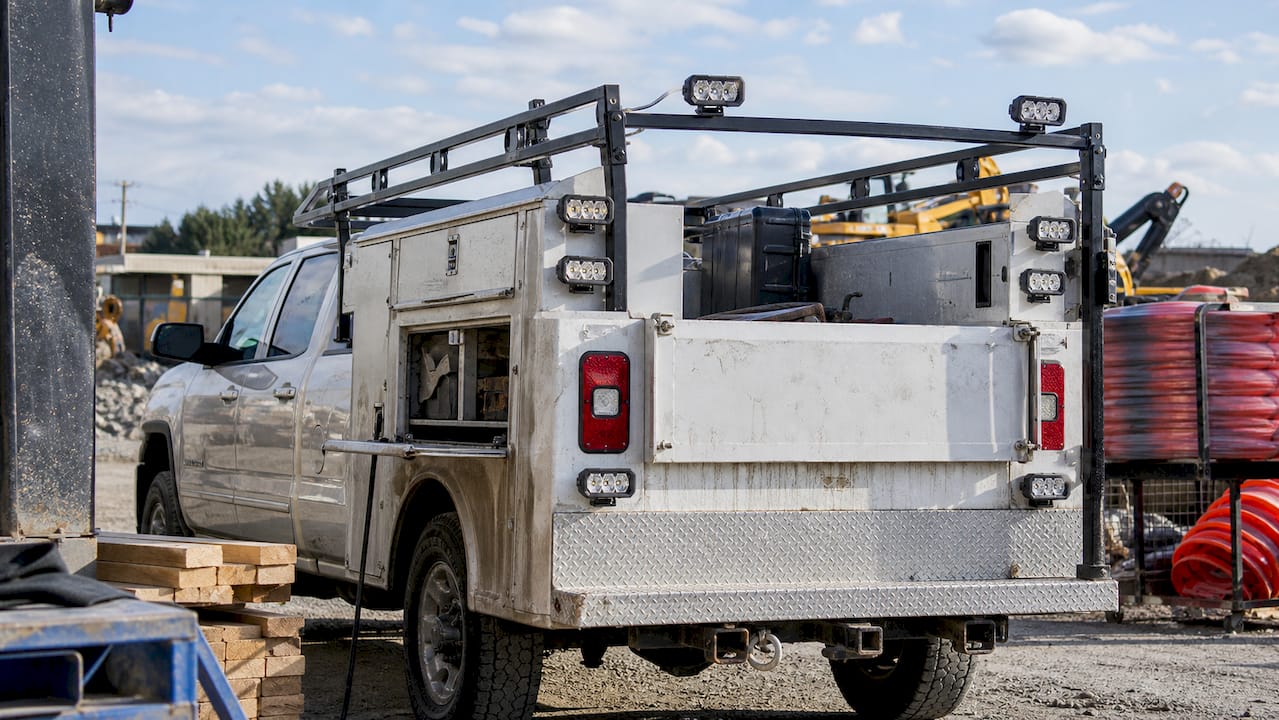
Service truck lighting falls into several distinct categories, and each one solves a different problem on the job.
Amber warning lightbars and beacons sit at the top of most service vehicles. They alert other drivers to a slow-moving or stationary vehicle on or near a roadway. Rectangular full-width bars and low-profile mini-bars are the two most common footprints.
Work and scene lights — spot and flood formats — illuminate the immediate work area. Spot optics throw a tight, long-range beam useful for boom-tip or overhead work; flood optics spread light across a wide area at close range for ground-level tasks.
Boom and crane-tip lights are a subset of work lights mounted at the end of a crane arm or aerial boom. They need vibration-resistant housings and, ideally, adjustable aiming.
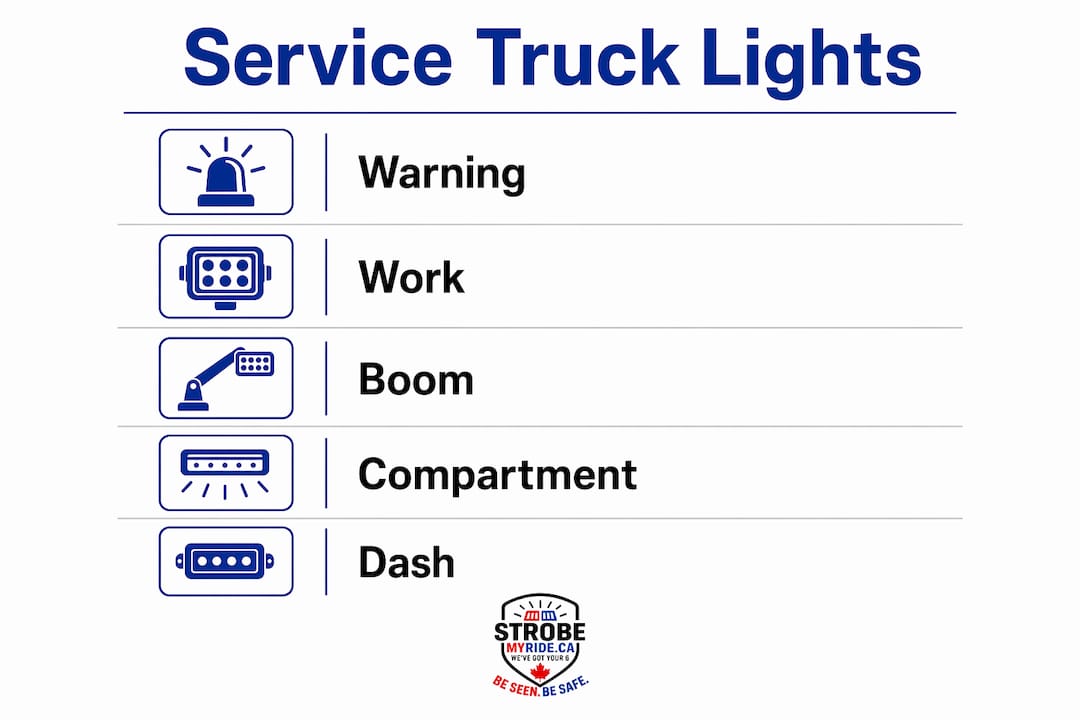
Compartment and interior strip lights are low-draw LED strips or puck lights installed inside toolboxes and service body compartments. They activate on door open and draw minimal current, which matters when a technician opens and closes compartments repeatedly throughout a shift.
Dash and hideaway lights provide secondary warning capability from inside the cab or behind grille panels without adding external hardware.
Backup-integrated S/T/T lamps combine stop, tail, and turn functions with a white backup element in one housing, reducing the total lamp count and the number of potential failure points.
Portable magnetic work lights round out the toolkit for situations where a fixed mount is impractical.
Where should you mount lights on a service truck?
Mounting location determines both visibility and compliance. Here is how experienced operators typically configure each zone:
- Roof: Full-width amber lightbars for maximum highway and worksite visibility; low-profile mini-bars where height clearance is limited (parking structures, overhead lines).
- Grille and bumper: Low-height warning lights and day-running flasher modules for forward visibility without obstructing required headlamp zones.
- Mirror and A-pillar mounts: Supplemental amber repeaters that extend side visibility on wide service bodies.
- Tailgate and bed rails: Rear-facing flood spots for worksite illumination and amber repeaters to signal presence from behind.
- Boom tip and crane arm: Vibration-rated floodlights with adjustable aiming brackets; confirm the fastening system is rated for dynamic loads.
- Compartments and toolboxes: LED strip or puck lights with a low amp draw. Door-activated switching reduces battery drain during repeated access.
For tow operators specifically, the tow truck safety lighting guide covers job-specific package builds in more detail.
Which technical specifications matter when comparing spot and flood lights?
Buying on price alone is the fastest way to end up with lights that fail mid-winter. These are the specs that actually separate a reliable work light from a liability.
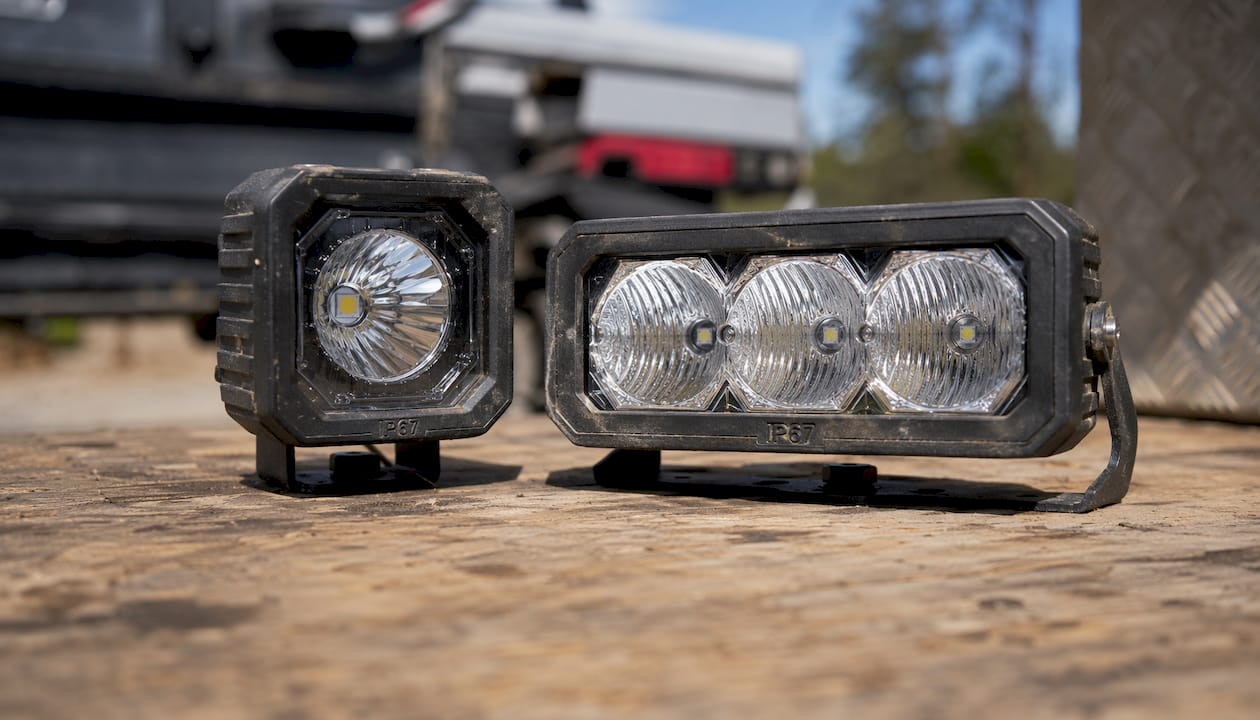
Ingress protection (IP rating) is the single most important durability spec for Canadian fleets. IP67 means the housing is dust-tight and can withstand temporary immersion; IP68 extends that to continuous immersion; IP69K adds resistance to high-pressure, high-temperature wash-down. If your trucks get pressure-washed or operate through deicing chemical spray, specify IP69K at minimum.
Optics: spot vs flood, lumens vs candela. Raw lumen output measures total light emitted. Candela measures intensity in a specific direction. For boom-tip or overhead work where you need throw, candela matters more. For close-range compartment or ground work, a wide flood beam and total lumens are the better metric.
Electrical compatibility. Most service trucks run 12V systems; heavy equipment and some larger vocational trucks use 24V. Confirm voltage compatibility before ordering. Amp draw at nominal voltage determines fuse sizing and relay requirements.
Mounting footprint and adjustability. Measure the available surface before specifying. Cube-format lights like the Signal WL Cube fit tight spaces; rectangular bars need a flat, unobstructed surface. Adjustable aiming brackets add flexibility for boom and tailgate mounts.
Material and corrosion resistance. Powder-coated aluminium housings resist road salt better than bare steel. Stainless hardware on mounting points prevents seized fasteners after a winter season.
Regulatory and photometric markings. SAE codes on the lens or housing indicate the photometric standard the lamp was tested to. TSD 108 specifies required lamp quantities, mounting heights, and photometric minimums for new vehicle construction. Auxiliary work lights are not covered by TSD 108 directly, but their placement must not obstruct any required lamp position.
Note for procurement teams: Two-in-one S/T/T lamps with an integrated white backup function reduce total lamp count and wiring complexity on service bodies. Fewer physical lamps means fewer failure points and a simpler inspection record.
How to wire and install service truck lights correctly
Electrical errors cause more early failures than product defects. A few fundamentals prevent most of them.
- Fuse sizing: Size the fuse to the circuit, not the load. Calculate total amp draw for all lights on a circuit, then select a fuse rated slightly above that draw. Never upsize a fuse to stop nuisance trips — find the fault instead.
- Relays for work lights: Work lights draw significantly more current than warning lights. A remotely mounted relay with an appropriate fuse at the battery reduces voltage drop and protects cab-mounted switches from high current. Include prewired relay blocks in your procurement specs for easier installer integration.
- Wire gauge and run length: Longer runs require heavier gauge wire to maintain voltage. A voltage drop above 0.5V at the lamp can reduce output and shorten LED driver life.
- Connector selection: Fully sealed Deutsch or Molex connectors resist moisture and salt far better than standard automotive connectors with a grommet. Specify sealed connectors on any exterior circuit.
- Grounding: A poor ground is the most common cause of intermittent lamp failure. Ground to clean, bare metal and protect the ground point with a corrosion inhibitor.
- Wire routing: Avoid sharp edges, secure with correct clips at regular intervals, and leave a service loop at each lamp. A harness pulled tight against a connector pin corrodes faster and fails under vibration.
Pro Tip: Specify a single-supplier harness and light system wherever possible. Mismatched pin sealing between a third-party harness and a different brand’s lamp housing is one of the most common sources of connector corrosion and early failure in Canadian fleet installs.
After installation, bench-test each circuit before the vehicle goes into service, then do a full photometric spot check to confirm aim and output.
Canada-specific compliance: what federal and provincial rules apply?
Understanding where federal rules end and provincial rules begin is critical for any fleet manager adding auxiliary lighting.
CMVSS/TSD 108 governs lamp locations, quantities, and photometric performance for new vehicle construction in Canada. It sets the baseline for required lamps — headlamps, tail lamps, stop lamps, turn signals, markers — and specifies mounting heights and lens area requirements. It does not directly regulate aftermarket auxiliary strobes, scene lights, or work lights added after the vehicle leaves the factory.
Once a vehicle is in service, provincial motor vehicle acts take over for auxiliary lighting. Rules vary by province and operators must check the specific act for their jurisdiction.
The federal lighting location requirements for trucks, buses, and MPVs also caution that no part of the vehicle — including aftermarket auxiliary lights — may obstruct any required lamp from meeting its prescribed photometric requirements.
For a practical summary of how these layers interact, the fleet lighting compliance guide covers CMVSS/TSD 108 implications and provincial differences in one place.
Procurement checklist for compliance:
- Retain datasheets and SAE photometric codes for every lamp installed
- Confirm permitted colours with your provincial ministry before public road use (amber is broadly accepted for slow-moving/warning use; other colours are restricted)
- Verify that auxiliary lights do not obstruct required lamp positions per TSD 108 location tables
- Keep vendor confirmation of electrical and photometric specs with vehicle records for roadside inspection
Why sealed LED systems matter in Canada, and how to maintain them
Lighting issues are the leading category for CSA Vehicle Maintenance infractions. In Canadian conditions, the primary failure drivers are moisture and road salt ingress, connector corrosion, and mechanical vibration from rough roads and equipment operation.
Sealed LED systems with integrated housings and matched harnesses address all three. An IP69K-rated housing survives pressure washing and deicing chemical exposure; a sealed Deutsch connector at the harness entry point prevents the salt-laden moisture that corrodes standard connectors within a single winter season.
Maintenance checklist (run pre-winter and post-salt season):
- Visual lens check: cracks, fogging, or discolouration indicate housing failure
- Connector corrosion check: pull each connector, inspect pins, apply dielectric grease if needed
- Ground integrity: verify resistance at each ground point
- Amp draw test: compare measured draw against spec; a significant drop can indicate a failing LED driver
- Photometric spot check: confirm aim has not shifted from vibration
Pro Tip: Schedule lamp-and-connector inspections alongside your seasonal maintenance intervals. Catching a corroded connector in October costs minutes; finding a failed work light during a night call in January costs far more.
For a deeper look at why LED outperforms halogen in these conditions, the LED vs halogen comparison covers longevity and performance data directly.
How to choose the right lights: a procurement checklist
Specify these items in every purchase order or bid document for service truck lighting:
- IP rating (IP67 minimum; IP69K for pressure-washed vehicles)
- SAE/TSD photometric codes confirming the lamp type and test standard
- Voltage compatibility (12V or 24V)
- Amp draw at nominal voltage (for fuse and relay sizing)
- Mounting footprint dimensions and aiming adjustability
- Harness type and connector standard (sealed Deutsch or equivalent)
- Warranty terms and Canadian support/shipping availability
- Spare parts availability and recommended installation kit
Typical price ranges for Canadian fleets (approximate, subject to change):
- Entry-level spot or flood work light: $40–$120 CAD per unit
- Mid-range sealed LED work light (IP67+, matched harness): $120–$300 CAD per unit
- Full amber roof warning bar with controller: $350–$900 CAD depending on length and flash-pattern options
Procurement timeline: Stock SKUs from a Canadian supplier typically ship within 1–3 business days. Built-to-order harness kits or custom configurations may require 1–2 weeks. Allow a pilot install window of at least one week before fleet-wide rollout to catch any fitment or wiring issues specific to your vehicle body.
Questions to ask your vendor:
- Can you provide the IP rating test data and SAE photometric sheet for this lamp?
- What are your Canadian warranty terms and how are warranty claims processed?
- Do you stock replacement harnesses and connectors for this product?
- Is an installation kit (relay block, fuse holder, connectors) available for this SKU?
Strobe My Ride recommended products for Canadian service trucks
| Product | Best for | Voltage | IP rating | Regulatory notes | Warranty / support |
|---|---|---|---|---|---|
| Signal WL – Standard LED Work Light | Scene and close-range task lighting; roof, tailgate, bumper mounts | 12V / 24V | Sealed housing | Auxiliary work light; confirm provincial rules for on-road use | Canadian warranty; Strobe My Ride support |
| Fleet WL Side Shooter | Side illumination of compartments and service body access zones | 12V / 24V | Sealed housing | Auxiliary work light; side-directed output | Canadian warranty; Strobe My Ride support |
| Signal WL Cube (Pair) | Tight mounting locations; even flood coverage in pairs | 12V / 24V | Sealed housing | Compact auxiliary work light | Canadian warranty; Strobe My Ride support |
Basic service truck package: Signal WL Standard (×2, rear-facing) + Signal WL Cube Pair (compartment or bumper) + amber warning bar. Covers scene lighting, compartment access, and highway warning in one order.
Heavy-duty worksite package: Fleet WL Side Shooter (×2, service body sides) + Signal WL Standard (×2, tailgate) + Signal WL Cube Pair (boom or grille) + full-width amber lightbar with traffic advisor. Suited to utility, construction, or crane trucks operating at night or in low-visibility conditions.
For construction and work truck lighting configurations specific to vocational fleets, Strobe My Ride’s dedicated page covers additional package options.
Key takeaways
Sealed LED work lights paired with a Canadian-sourced amber warning bar and matched harness system give service truck fleets the best combination of durability, compliance readiness, and long-term reliability in Canadian conditions.
| Point | Details |
|---|---|
| Specify IP69K for pressure-washed trucks | IP69K-rated housings withstand high-pressure wash-down and deicing chemical exposure that IP67 housings may not survive long-term. |
| Lighting leads CSA maintenance violations | Moisture and connector corrosion are the primary failure causes; sealed integrated systems reduce both risks. |
| Provincial rules govern aftermarket lights | CMVSS/TSD 108 covers new vehicle construction; provincial motor vehicle acts control auxiliary lighting in service — check your province before operating on public roads. |
| Run seasonal maintenance inspections | Pre-winter and post-salt-season connector and lens checks catch failures before they become roadside violations. |
| Strobe My Ride covers the core package | The Signal WL Standard, Fleet WL Side Shooter, and Signal WL Cube Pair are available with Canadian warranty and support for direct fleet procurement. |
Strobe My Ride: Canadian inventory, expert support, and fast shipping
If you need sealed, work-truck-grade LED lighting shipped quickly with a Canadian warranty behind it, Strobe My Ride stocks the products and the expertise to get your fleet upfitted correctly.
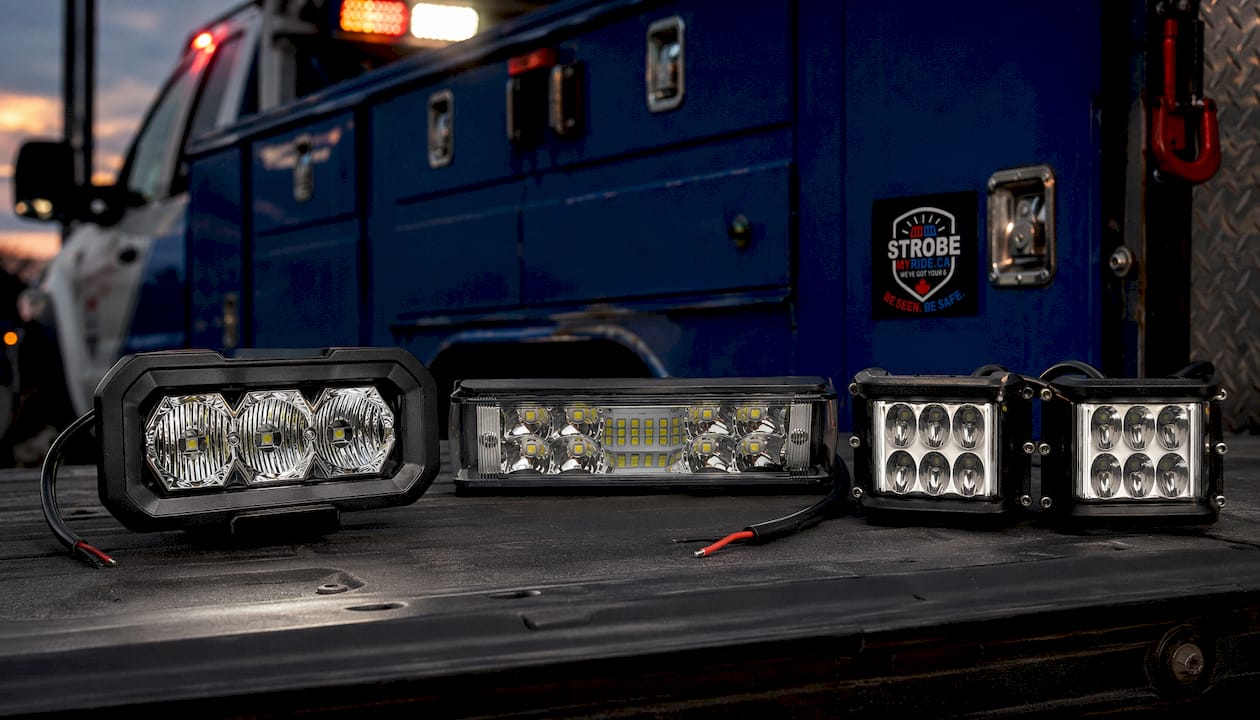
Strobe My Ride carries Canadian inventory of the Signal WL Standard, Fleet WL Side Shooter, and Signal WL Cube Pair, along with wiring kits, relay blocks, and installation accessories. Every order comes with access to technical support by phone or email — not a chatbot — so you can confirm fitment, fuse sizing, and connector compatibility before the truck goes into the shop. Warranty claims are handled domestically, with spare parts available for the products you buy.
Browse the full Strobe My Ride work light collection or go directly to the product pages above to check current stock and place your order.
Authoritative sources and legal references to keep on file
Use these primary documents when verifying compliance, preparing inspection records, or responding to enforcement queries.
Federal documents:
- Transport Canada — Commercial Vehicle Safety (CMVSS/TSD 108 context): explains where federal standards apply and their scope for new vehicle construction
- TSD 108 Revision 8 (full text): required lamp quantities, mounting heights, photometric minimums — the document to reference when locating required lamps and ensuring auxiliary lights do not obstruct them
- Federal lighting location requirements — Trucks, Buses, MPVs: location tables for required devices by vehicle type
Provincial documents (example):
- BC Motor Vehicle Act Regulations, Division 4 — Lamps: BC-specific lamp authorisation rules, docking lamp exception, and operational hour requirements
What to request from your supplier:
- SAE photometric code sheet for each lamp (confirms the test standard and lamp type)
- IP rating test data or certification reference
- Wiring diagram and connector specification for the harness
- Written Canadian warranty terms
These documents belong in the vehicle file alongside registration and inspection records. If a lamp is questioned at a roadside inspection or provincial audit, having the datasheet on hand demonstrates that the installation was specified to a known standard.
Recommended
- Fleet Lighting Compliance Guide for Canada | Strobe My Ride – Strobe My Ride
- Municipal Vehicle Lighting Guide for Fleets | Strobe My Ride – Strobe My Ride
- Vehicle Emergency Lights: Canada Compliance and Install Guide | Strobe My Ride – Strobe My Ride
- Service Truck Warning Packages That Work | Strobe My Ride – Strobe My Ride


