


Individually tinned copper conductors, paired with a chemically resistant jacket and sealed terminations, remain the most reliable specification for wiring exposed to salt, moisture, or industrial atmospheres. The tinning premium runs roughly 8 to 12 percent over bare copper, yet it can stretch service life from 2 to 5 years to 15 to 25 years or more in marine duty. Connector selection and keeping dissimilar metals apart at every joint matter just as much as the conductor itself.
TL;DR:
- Tinned copper conductors provide the best long-term corrosion resistance, especially in marine or salt-exposed environments, extending service life significantly.
- Proper cable jacket materials like HMWPE, XLPE, or fluoropolymers offer enhanced chemical, UV, and abrasion resistance suited to specific exposure conditions.
- Installing protective measures such as adhesive-lined heat-shrink, dielectric grease, and barrier coatings at transitions greatly reduces moisture ingress and galvanic corrosion risks.
- Avoid direct copper-to-aluminum contacts without proper isolation, as galvanic corrosion rapidly damages connections and reduces conductor lifespan.
- Regular inspection, testing, and timely maintenance are crucial for early detection and prevention of corrosion-related failures in harsh environments.
Materials and coatings that resist corrosion
Tinning works because the tin layer blocks direct contact between copper and chloride ions, halting the electrochemical reaction that would otherwise pit and blacken bare strands. Specifications for long-term marine service should reference MIL-T-10727 Grade A, which sets minimum tin thickness for individually coated strands rather than a single tinned bundle.
Jacket material determines how the cable survives chemical splash, UV exposure, and abrasion once the conductor itself is protected. Consider these common options:
- HMWPE (high molecular weight polyethylene): strong abrasion and moisture resistance, common in direct-burial and underground runs.
- XLPE (cross-linked polyethylene): better thermal stability than standard PE, holds up under repeated flexing.
- TPU (thermoplastic polyurethane): flexible in cold weather, good resistance to oils and fuels.
- Halar/Kynar (fluoropolymers): the strongest chemical and UV resistance of the group, typically reserved for chemical-plant and offshore applications where budget allows.
Armouring and finish choices follow a similar logic. Stainless steel armour resists the widest range of chemistry but costs more; galvanized steel is a reasonable mid-tier choice for general outdoor use; zinc-aluminium coatings split the difference on cost and salt resistance. Aluminium conductors deserve a caution here: they are lighter and cheaper than copper, but they oxidize quickly when exposed and pair poorly with copper terminals unless isolated, a point covered in the next section.
Where corrosion happens and what it looks like
Environment dictates failure mode, and matching the wiring spec to the actual exposure prevents most premature failures. The dominant scenarios technicians encounter are:
- Salt-spray and marine exposure — chloride ions accelerate pitting on bare copper and unprotected terminals within months, not years.
- Underground and direct-burial runs — constant soil moisture and shifting pH drive slow, steady jacket degradation and metallic shield corrosion.
- Chemical and industrial atmospheres — acidic or caustic vapours attack both conductor and jacket, often faster than salt spray alone.
- UV and abrasion in exposed outdoor runs — jacket embrittlement lets moisture in even where salt exposure is minimal.
Galvanic corrosion shows up wherever two dissimilar metals touch in the presence of an electrolyte, such as a copper lug bolted directly to an aluminum bracket. One metal sacrifices itself to protect the other, and in vehicle and marine wiring that sacrificial metal is usually whichever conductor or fastener sits lower on the galvanic series. Left unmanaged, this produces what technicians often call “black wire disease,” where insulation appears intact but corrosion wicks along the strands underneath it, invisible until the connection fails. Modelling of aluminium conductors in acidic industrial electrolytes shows how galvanic attack combined with elevated operating temperature can measurably shrink conductor cross-section and reduce ampacity over a period of years, well before an installer notices any visible fault.
Protective measures during installation
Corrosion protection is largely won or lost at the transition points, wherever a jacket meets a connector, a splice, or a termination. That is where moisture finds its way in, and it is where the National Research Council of Canada’s work on coating adhesion is most relevant: a barrier coating only works if it stays bonded to the surface it protects.
Practical steps that hold up in the field:
- Specify individually tinned strands rather than bare copper for any run exposed to moisture or salt air.
- Install adhesive-lined heat-shrink at every cable-to-connector transition rather than relying on plain shrink tubing.
- Use overmoulded assemblies for permanent connections where the cable and connector will never be serviced separately.
- Apply dielectric grease at mating faces on connectors that will be unmated periodically, and reapply it during scheduled maintenance.
- Choose barrier coatings for general protection and sacrificial coatings (like zinc) only where you want the coating to corrode instead of the base metal.
- Install isolation bushings anywhere dissimilar metals must physically touch.
- Route cable away from standing water and add abrasion guards anywhere it crosses a frame edge or moving component.
The math on that tinning premium is straightforward: an 8 to 12 percent higher material cost on the front end is trivial compared to replacing a harness that fails after two seasons of coastal exposure. ServiceWire’s cost and lifespan data backs that up directly.
Pro Tip: Rubber gaskets and some wire jackets outgas sulphur compounds as they age, which can corrode nearby contacts even in a sealed enclosure. If you’re seeing unexplained terminal corrosion in a supposedly weatherproof housing, check the gasket material before you blame the wiring.
Choosing connectors and terminations that won’t fail first
A corrosion-resistant cable connected through a poor terminal is still a corrosion problem, just relocated. Contact hardware needs the same scrutiny as the conductor itself.
- Favour stainless steel shells, nickel-plated brass, or gold-plated contacts on low-voltage connectors where contact resistance has to stay low over years of exposure.
- Never bolt copper directly to aluminum. Use dielectric isolation, compatible platings, or a bimetallic lug rated for the transition.
- Seal every termination with heat-shrink, sealant, or overmoulding; a poorly sealed termination will fail faster than an unprotected splice out in the open, because trapped moisture has nowhere to evaporate.
- Test terminals both visually and electrically. Rockwell Automation’s guidance on terminal corrosion resistance notes that gastight connections can look corroded on the surface while performing fine electrically, and the reverse is also true.
Stainless steel generally offers the broadest resistance across chemistries, but it isn’t a universal fix. Zinc and chromate treatments still have a place where cost matters more than absolute longevity, provided the application doesn’t expose them to aggressive chemicals.
Inspection and maintenance that catches problems early
Corrosion rarely announces itself before it costs money. A short, disciplined inspection routine catches most problems while they’re still cheap to fix.
- Look for verdigris (greenish copper corrosion), insulation cracking, or a connector that runs unusually warm; these are the three most common visual cues technicians miss on a rushed walkaround.
- Run insulation resistance and contact resistance tests on a schedule, and document the threshold values that trigger a repair rather than relying on memory or gut feel.
- Reseal or reapply dielectric grease at any connection showing early corrosion, and replace degraded heat-shrink or overmoulded interfaces rather than patching them.
- Replace, rather than repair, any cable or connector where corrosion has reached the conductor strands themselves; a repaired splice on a compromised conductor is a temporary fix at best.
Fleets managing inspection equipment on a broader scale may find the environmental-exposure factors outlined in this guide to industrial inspection equipment lifespan useful context for how mechanical wear compounds corrosion risk over time.
Standards and tests worth requesting from suppliers
Salt-spray testing under ASTM B117 or ISO 9227 remains the industry baseline for validating corrosion resistance, with marine-rated products typically tested to a minimum of 168 hours and offshore or defence applications often pushed well beyond that. Salt spray alone correlates poorly with real-world field performance, so pair it with UV exposure, thermal cycling, and vibration testing before trusting a supplier’s claims.
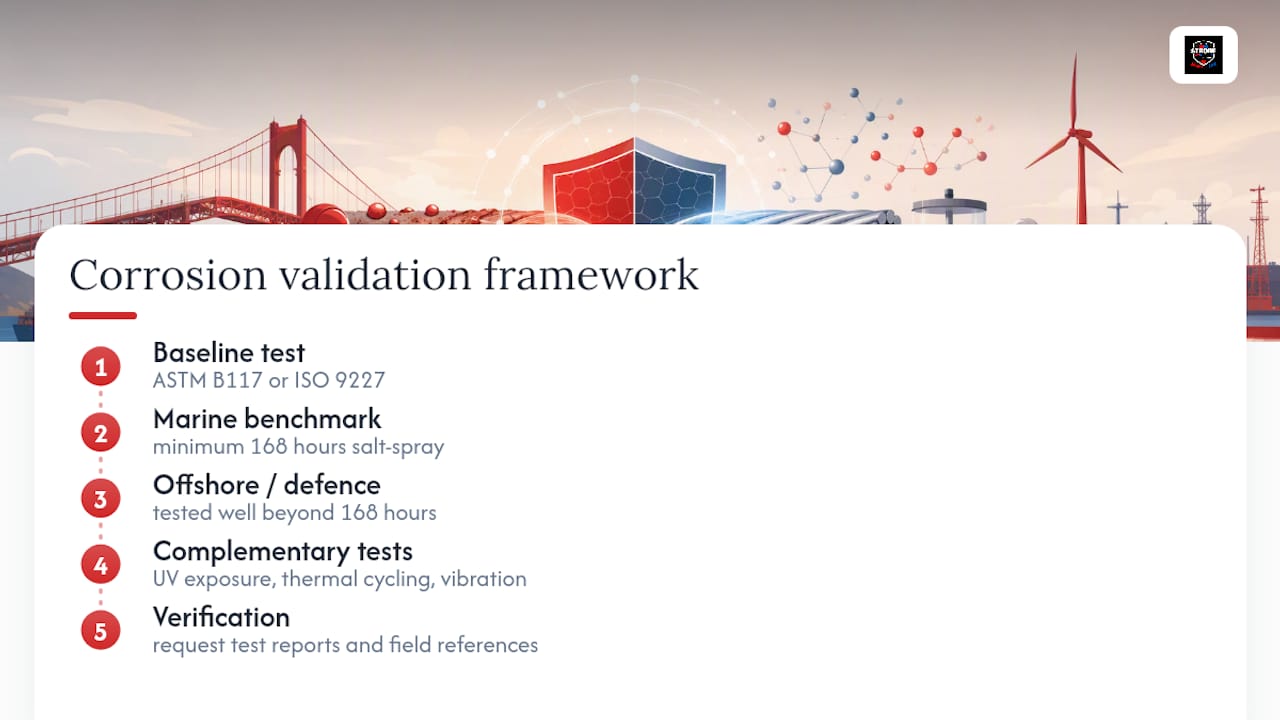
For underground and direct-burial cable systems, IEEE guidance on metallic shield and concentric neutral corrosion is a useful reference point. Ask suppliers for actual test reports rather than a marketing summary, and where possible, ask for field references from installations with similar exposure to yours.
How Strobe My Ride’s resources support corrosion-aware installs
Strobe My Ride is a Canadian supplier of LED warning lights, work lights, and vehicle-lighting accessories, and its site includes practical installation references built for exactly this kind of wiring decision.
- The switch panel wiring guide covers layout and routing considerations relevant to connector transitions and heat-shrink placement.
- Patrol line installation instructions walk through practical wiring detail for specific product lines.
- Product collections such as mini light bars and beacons list compatible mounting hardware and accessories on their individual product pages.
For SKU-specific questions about certifications, ratings, or compatibility, consult the product page directly or contact Strobe My Ride’s technical support rather than assuming a specification applies across the catalogue.
Where to find compatible fixtures and get technical support
Once the wiring specification is locked in, the fixtures themselves need to survive the same environment. Strobe My Ride stocks several categories built for exposed, harsh-environment vehicle use, including surface mounts, full-size and mini light bars, beacons, and work lights.
| Product category | What it covers |
|---|---|
| Surface mounts | Compact warning lights such as the Signal Vector Surface Mount and Fleet SM Stealth Smoked Lens |
| Full-size light bars | Units like the Patrol Bar Quad 50 Slim w/STT and Patrol Bar Quad 60 w/STT |
| Mini light bars | The Patrol Bar Quad 24 mini bar in amber/white/blue/green configurations |
| Off-road lightbars | The Patrol Beam Dual Force Quad for off-road applications |
| Work and scene lights | The Signal Wash work light for area illumination |
| Equipment beacons | The Fleet Beacon Equip amber LED beacon |
Every listed product is available directly through Strobe My Ride, and specification, colour, and vehicle-compatibility details live on each individual product page rather than in a general catalogue summary. If you’re upfitting a fleet vehicle and need help matching a fixture to your existing wiring and connector setup, reach out through the technical support contact on the Strobe My Ride site, where staff can walk through SKU-specific compatibility before you order.
Sources
- ServiceWire — Tinned copper Q&A
- Galvanic corrosion and thermal modelling of ACSR/TW conductor in acidic industrial electrolyte (2025)
- National Research Council Canada publications — causes and control of corrosion
FAQ
What do you put on electrical wires to prevent corrosion?
Adhesive-lined heat-shrink, dielectric grease at mating connector faces, and overmoulding at permanent transitions are the three most effective field measures, alongside specifying tinned conductors from the start.
What kind of wire is rust-proof?
No copper wire is entirely immune to corrosion, but individually tinned copper conductors resist salt and chemical attack far longer than bare copper, extending service life from 2 to 5 years up toward 15 to 25 years or more in marine conditions.
Can corroded wires be fixed?
Light surface corrosion at a terminal can often be cleaned, resealed, and returned to service, but once corrosion has wicked into the conductor strands themselves, the affected section should be replaced rather than repaired.
Will oxidized copper wire still work?
It depends on how far the oxidation has progressed. Light oxidation raises contact resistance without stopping current flow, but progressive corrosion increases resistance further and can eventually reduce ampacity to the point of failure, particularly under sustained heat, as thermal modelling of corroded conductors demonstrates.


