


LED strobe amperage is not one number. Manufacturers report it three ways: peak (the instantaneous draw during a flash pulse), average (draw adjusted for duty cycle over time), and continuous (steady-state draw if the LED stayed on). For installation planning, the figure that matters most is average current, calculated from expected duty cycle, with margin added for inrush and voltage drop.
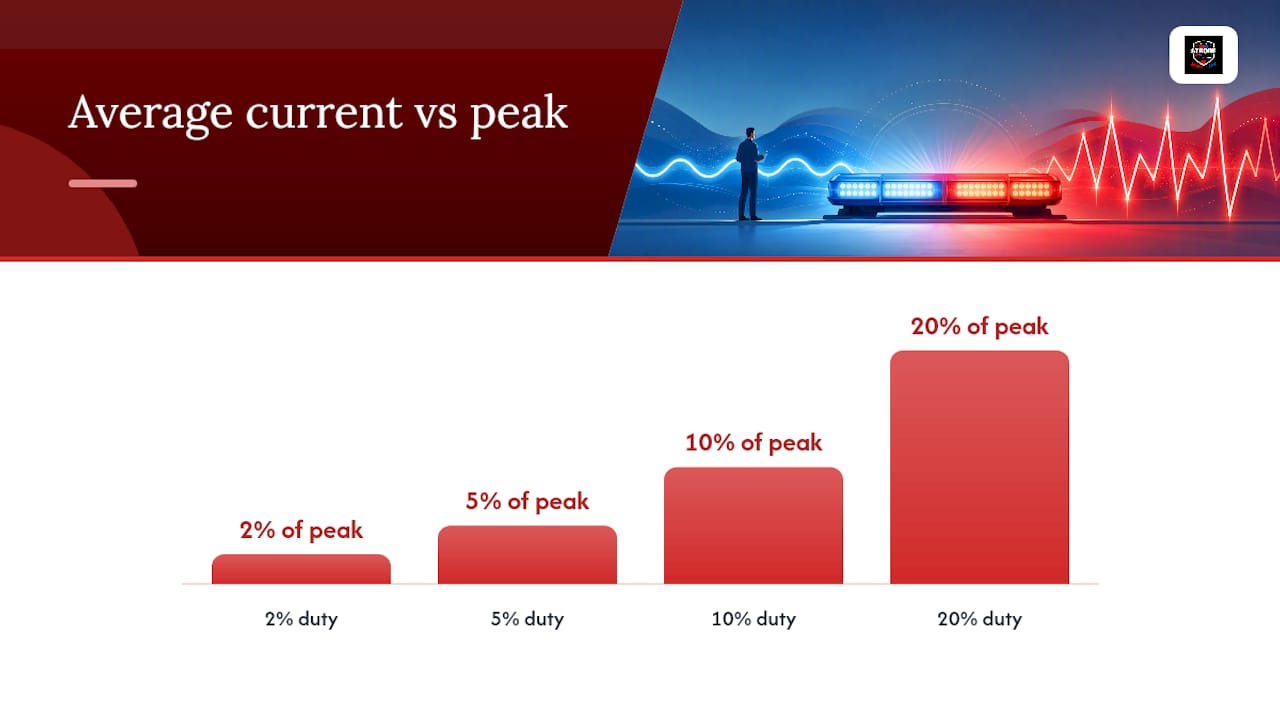
Most performance strobes run a duty cycle between 2% and 20%, meaning the LED is only actually lit for a small fraction of each cycle, according to guidance on LED stage strobe efficiency. The U.S. Department of Energy has documented similar efficiency gaps between rated peak output and real-world consumption in LED lighting generally, which is why datasheets that list only peak wattage tell you less than they seem to.
Before wiring anything, run this checklist:
- Pull the datasheet and confirm rated voltage, peak watts, and duty cycle.
- Calculate average current: I = P ÷ V, then multiply by duty cycle.
- Add margin for inrush current and voltage drop across the wiring run.
- If any of those figures are missing, contact the vendor, such as Strobe My Ride’s technical support, before committing to a circuit.
Key Takeaways
Accurate LED strobe amperage planning depends on converting peak wattage into average current using duty cycle, then adding margin for inrush and voltage drop.
| Point | Details |
|---|---|
| Use average, not peak | Calculate Avg I = (Peak W × duty cycle) ÷ Voltage rather than sizing circuits off peak wattage alone. |
| Duty cycle drives real load | Performance strobes typically run 2 to 20% duty cycle, meaning average draw is far below peak. |
| Voltage changes the math | The same wattage draws roughly half the current on a 24 V system compared to 12 V. |
| Measure, don’t assume | Clamp meters miss fast pulses; use an oscilloscope or power logger for duty-cycle accuracy. |
| Check Strobe My Ride specs | Product pages for the Patrol Flash Light, Signal WL N Strobe, and Fleet Beam 120 show rated voltage and wattage, with technical support available for average current questions. |
What manufacturers mean by “amps”: peak, steady, and average
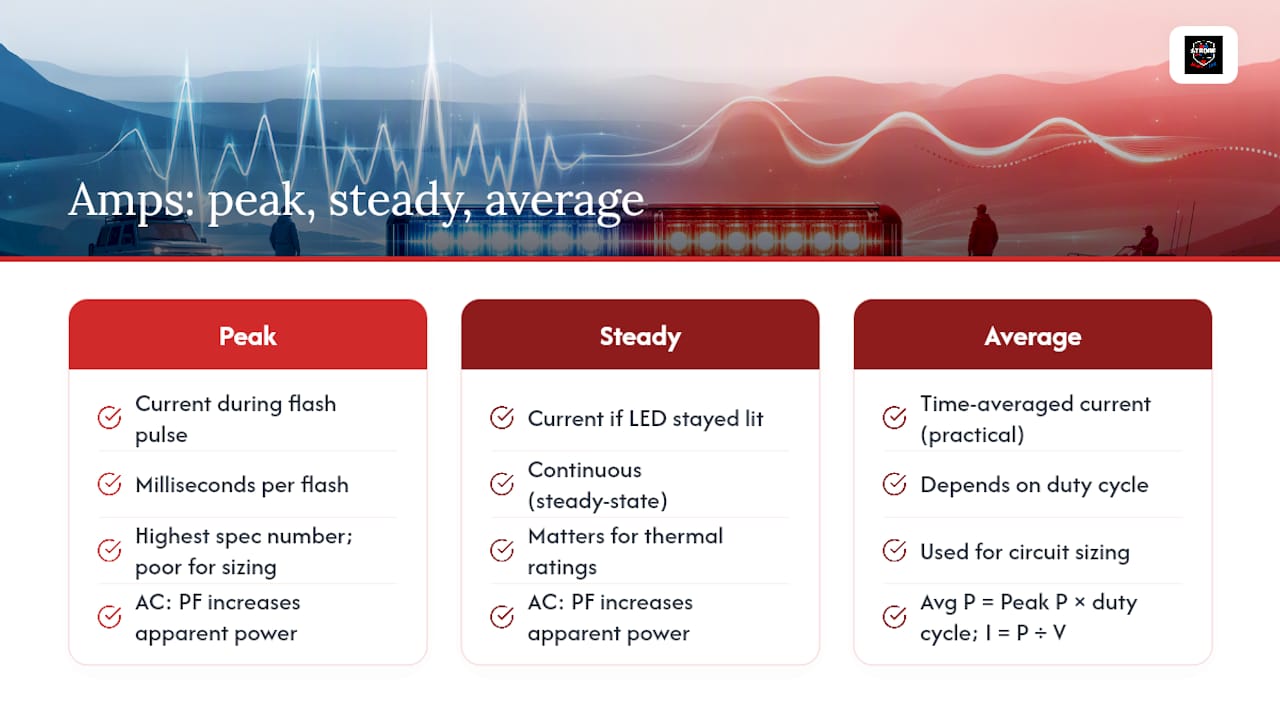
A strobe’s peak current is what it draws during the actual flash pulse, the split-second the LED fires at full brightness. It is the highest number on the spec sheet, and it is also the least useful one for sizing a circuit, because the fixture only hits it for milliseconds at a time. Continuous or steady-state current describes what the fixture would draw if the LED stayed lit indefinitely. That number matters for thermal ratings but rarely reflects how a strobe actually operates.
Average current is the practical figure. It comes from a simple relationship: Avg power = Peak power × duty cycle, and once you have average watts, you convert to amps with I = P ÷ V. A 200 W peak strobe running a low duty cycle typically averages significantly less power than the peak rating suggests, per the LED stage strobe efficiency guide.
On AC-fed systems, power factor complicates things further. Poor power factor increases apparent power draw relative to real power, which matters when sizing distribution panels, as noted in analysis of LED strobe energy efficiency. Vehicle 12 V or 24 V DC installations sidestep most of that complexity since you are working with real current, not apparent current.
Pro Tip: If a spec sheet lists only peak wattage with no duty cycle or average current figure, treat that as an incomplete datasheet. Ask the manufacturer directly for average current at a representative duty cycle before you size a breaker or fuse block around it.
Why does duty cycle change real current draw?
Duty cycle is the percentage of each flash cycle that the LED is actually illuminated. Performance strobes typically fall somewhere in that 2% to 20% band, and that range alone can produce a tenfold difference in average draw between two fixtures with the same peak wattage rating, per LED stage strobe efficiency data.
The formula stays consistent: Avg I = (Peak W × duty cycle) ÷ Voltage. A 200 W peak strobe on a 12 V system at a typical duty cycle averages a fraction of the peak current, a figure worlds apart from what a peak-only spec sheet implies.
A few things to watch beyond the single-fixture math:
- Multiple strobes firing synchronously can spike apparent peak demand well above what any one fixture’s average current suggests.
- Staggered or sequenced firing patterns reduce simultaneous peak draw even when total average load stays the same.
- Published peak wattage without duty-cycle context routinely overstates real load, sometimes by an order of magnitude, so always request average figures or measured traces before planning circuit capacity.
Estimating total current for one unit and multiple units
Here is the step-by-step math for sizing a system, from a single strobe to a full light bar array:
- Convert peak watts to peak amps: Ipeak ≈ Ppeak ÷ V.
- Apply duty cycle to get average amps: Iavg ≈ Ipeak × duty cycle.
- Multiply the per-unit average by the number of fixtures for total average load.
- Add a 20 to 30% safety margin to cover inrush spikes and unknown power-factor effects.
Scale that to four units and you get about 6.7 A average, though simultaneous firing could momentarily approach the combined peak of 66.7 A for a fraction of a second. Stagger the firing sequence across eight or twelve units in a control profile and that instantaneous peak drops considerably, even though total average current climbs proportionally with fixture count.
Voltage matters here too. A 300 W bar draws roughly 25 A on a 12 V system, but the same wattage on a 24 V system, common on heavier trucks and plow rigs, draws closer to half that current, according to figures from Aurora Lightings on LED light bar amperage. That distinction shapes how you budget circuit capacity across a fleet built on mixed voltage platforms.
How to read manufacturer datasheets and what to ask vendors
Not every spec sheet gives you what you need. Look specifically for rated voltage, peak watts, recommended duty cycle for strobe mode, average watts or typical current at a stated duty cycle, inrush current, power factor (on AC-fed units), L70 lifetime, and thermal limits. A sheet missing average current or duty cycle context is incomplete for planning purposes, a gap flagged in guidance on choosing energy-efficient LED strobe lights.
Strobe My Ride’s own product pages illustrate what a usable listing looks like. The Patrol Flash Light page lists rated voltage and operating specs for a handheld unit. The Signal WL N Strobe work light shows how an integrated work light and strobe combination lists its wattage and duty-cycle behaviour. The Fleet Beam 120 combo beam demonstrates how a work light paired with strobe function documents its electrical specs. These pages are examples of where to find that data, not a substitute for reading each SKU’s own listing.
Pro Tip: When contacting a vendor’s technical support team, ask specifically for measured power traces at representative flash profiles, and request photometric files (.ies or .ldt format) if you’re doing camera-based or scene-lighting testing.
Measuring current in service: tools and what results mean
A clamp meter is the simplest way to check in-service average current draw on a DC circuit, but fast pulses can slip past its sampling rate, meaning it may under-read a strobe’s actual peak. A true-RMS handheld multimeter works for spot checks on steady loads but has the same blind spot with rapid pulses. An oscilloscope or a dedicated power logger captures the full pulse trace, which is the only reliable way to see both peak and duty-cycle behaviour together.
A steady reading that matches the datasheet’s average current is a good sign. A reading that drifts or spikes unpredictably suggests either a firing pattern different than expected or a supply issue worth investigating further.
- Clamp meter: quick average current checks, may miss fast pulses.
- True-RMS multimeter: good for steady loads, same pulse limitation.
- Oscilloscope or power logger: captures peak and duty-cycle detail accurately.
If measured values differ meaningfully from datasheet expectations, contact the vendor or a qualified technician rather than guessing at the cause. These readings tell you what the circuit is doing, not how to wire or fuse it, so treat them as diagnostic information and bring specific product questions to Strobe My Ride’s support team.
Thermal and power-supply factors that affect current and lifetime
Heat correlates with average power, not peak power.
Inrush current is a separate concern from thermal load. Supply capacity, alternator output, and how fixtures are distributed across breakers all affect whether a rig can absorb multiple simultaneous inrush events without nuisance trips, a planning point echoed in guidance on LED stage strobe efficiency. Build circuits with margin, and where a warning light controller allows scene programming, stagger firing rather than triggering every fixture at once.
Pro Tip: Capping simultaneous strobes and limiting duty cycle within a control scene reduces peak electrical demand without noticeably reducing the strobe’s visual effect on the road.
Voltage drop across long wire runs is a less obvious failure point. As distance from the power source increases, wire resistance drops available voltage at the fixture, which shows up as flicker or dimming rather than an outright failure. Always calculate using the round-trip distance, feed and return combined, when consulting a voltage-drop reference.
What to check when measured current doesn’t match expectations
A handful of issues account for most surprises when measured draw doesn’t line up with the datasheet:
- Missing duty-cycle context on the datasheet. Verify with a power logger rather than assuming the peak figure applies continuously.
- Unaccounted inrush current. Look for nuisance breaker trips coinciding with multiple fixtures firing together.
- Simultaneous firing of many fixtures. Review the control scene programming for staggering options.
- Voltage drop from long wire runs. Watch for flicker or dimming that worsens toward the end of a run.
- A clamp meter that can’t capture fast pulses. Cross-check with an oscilloscope or logger before concluding the fixture is drawing more than expected.
Pro Tip: Before calling technical support, gather the product page URL, your measured trace or clamp readings, and a description of the control scene profile in use. That trio of information gets you a faster, more accurate answer.
Strobe My Ride’s product pages and technical support remain the primary source for product-specific electrical traces and duty-cycle guidance when your own measurements raise questions a general datasheet can’t answer.
Get the right lighting for your fleet from Strobe My Ride
Sizing a strobe installation correctly starts with knowing which fixtures you’re working with, and Strobe My Ride stocks the exact product lines referenced throughout this piece: the Patrol Flash Light, the Signal WL N Strobe work light, and the Fleet Beam 120 combo beam, all shipped from Ottawa across Canada. Tow operators running fleets in Alberta will also find amber and blue surface mount options built for tow truck applications in that province.
What sets Strobe My Ride apart for operators doing this kind of amperage planning is direct access to Canadian technical support. Rather than guessing at duty-cycle figures from a generic overseas listing, you can ask a real person for the average current data your circuit design actually needs. Browse the full LED warning light lineup to compare rated voltage and wattage across fixtures, and reach out to the support team before you finalize a fleet-wide install so your breaker sizing accounts for real duty-cycle behaviour rather than peak numbers alone.
Frequently asked questions
What is the difference between peak and average LED strobe amperage? Peak amperage is the instantaneous current during a flash pulse. Average amperage adjusts that figure for duty cycle, the percentage of time the LED is actually lit, and is the number relevant to circuit sizing.
How do I calculate LED strobe amperage from watts? Use I = P ÷ V for a basic conversion, then multiply by duty cycle to get realistic average current rather than a peak-only figure that overstates continuous load.
Why does duty cycle matter for vehicle strobe wiring?
Does voltage affect strobe amperage on 12 V versus 24 V trucks? Yes. The same wattage fixture draws roughly half the current on a 24 V system compared to 12 V, which matters when planning circuits on heavier trucks and plow rigs.
What should I ask Strobe My Ride if a datasheet doesn’t list average current? Ask for average current at a representative duty cycle, along with any available measured power traces, so you can plan circuit capacity accurately instead of relying on peak wattage alone.
Sources
- How far away can I wire my siren, strobe etc from the power supply?


