


Pilot cars in Canada must display amber warning lights and, once specified width or length thresholds are exceeded, a regulated dimensional sign. Common triggers appear at several defined load width thresholds, though every province sets its own numeric thresholds and lamp specifications. Skip to the provincial breakdown below to find the exact numbers, lamp sizes, and pre-move checklist that apply to your route.
TL;DR:
- Width is the most common trigger for escalating lighting requirements, with thresholds varying by province from around 2.60 m to 3.85 m.
- Amber warning lamps must provide 360-degree visibility and typically need to be flashing; stationary lights are generally not compliant.
- The full set of mandatory equipment includes warning flags, dimensional signs, and a kit of safety gear, with specific lamp sizes and mounting heights specified regionally.
- Lamps are required to stay illuminated for the entire escort duration, regardless of visibility conditions, to ensure clear warning signals.
- Province-specific regulations and permit conditions take precedence, and non-compliance can lead to fines, load delays, or escort suspensions.
What pilot car lighting requirements have in common across Canada
Every province regulates escort vehicle lighting a little differently, but the underlying logic is the same everywhere. A load crosses a dimensional threshold, and that threshold triggers a specific piece of equipment: a flag, a light, a sign, or an entire escort vehicle. Understanding that chain helps operators anticipate what a permit officer or provincial handbook will ask for, even before checking the province-specific numbers.
Width is the most common trigger. As a load gets wider than the standard highway lane allowance, provinces layer on requirements in stages rather than all at once. A load that is moderately over width might only need warning flags during daylight. Add another few centimetres and the requirement escalates to warning lights after dark, then to a dimensional sign, then to a full escort vehicle with roof-mounted lighting. Length and overhang can trigger similar escalation, particularly for rear escorts on long combinations.
Lamp colour and visibility expectations are also consistent from coast to coast, even where exact figures differ. Amber is the standard colour for pilot car warning lamps in every province referenced in this guide, and every jurisdiction expects those lamps to be visible through a full 360 degrees, not just from directly behind or ahead. That means roof-mounted placement, unobstructed lenses, and no mounting position that leaves a blind arc where an approaching driver would miss the signal.
Flash behaviour matters too. Provincial handbooks generally expect warning lamps to flash rather than burn steady, since a flashing amber light reads as a warning signal to other drivers in a way a steady light does not. Some provinces specify a lamp classification standard, such as SAE J845 or SAE J595, to make sure the flash pattern and intensity meet a recognized benchmark rather than a manufacturer’s own claim.
None of this happens in a vacuum. The permit that authorizes an oversize or overweight move is often the document that finalizes what equipment a specific trip actually needs. A central permit office can tighten or, in some cases, relax standard equipment requirements based on route, time of year, or load characteristics, so the permit conditions issued for a specific move always take precedence over the general handbook language.
A few points hold across most of the country:
- Amber is the standard warning lamp colour for pilot and escort vehicles in every province referenced here.
- Lamps must generally provide 360 degrees of visibility, which almost always means roof mounting rather than bumper or dash mounting.
- Width thresholds escalate in stages: flags, then lights, then dimensional signs, then a full pilot vehicle.
- Permit conditions issued for a specific move can add to or modify the standard equipment list.
- Escort vehicle operators are expected to carry a defined kit of safety equipment in addition to lighting, not lighting alone.
The province-by-province section below fills in the actual numbers behind each of these general rules.
Province-by-province pilot car light laws: BC, Alberta, Saskatchewan, Ontario, Manitoba
Regulatory language varies enough between provinces that operators running multi-province routes need to check each jurisdiction separately rather than assume one province’s rule applies everywhere. Here is what each of the five provinces most relevant to Canadian escort operations actually specifies.
British Columbia
British Columbia’s Commercial Vehicle Safety and Enforcement branch sets out pilot car lighting requirements in its compliance circulars and in Appendix G of the Traffic Management Manual. For loads exceeding 3.2 m in width or 27.5 m in length, the towing unit must carry one or two amber rotating or strobe lights. Rotating lamps need a minimum 15 cm diameter, strobe lamps need a minimum 11 cm diameter, and both must sit at a minimum height of 12 cm. Whichever lamp type is used, it has to deliver 360-degree visibility.
BC’s commercial transportation manual also settles a question that trips up a lot of newer escort operators: required lamps must stay illuminated for the entire duration of the escort trip, regardless of whether the move happens in daylight or after dark. This is a common misread of the rule. Operators sometimes assume lighting is only mandatory once visibility drops, but BC’s guidance is explicit that mandatory lamps run continuously once the escort begins.
BC’s Technical Circular T01-17 also references mandatory equipment beyond lighting, including illuminated paddles and channelizing devices for certain moves, along with colour and display standards for signage.
Alberta
Alberta runs one of the more granular threshold systems in the country. The Escort Vehicle Operators Handbook sets tiered width triggers that escalate in clearly defined steps:
- Over 2.60 m: warning flags are required during daylight; warning lights are required at night.
- Over 3.05 m: dimensional signs added to the requirement.
- Over 3.35 m: one or more flashing amber lamps become mandatory.
- Over 3.85 m: full pilot or trail vehicle rules apply, along with additional movement restrictions.
Alberta threshold snapshot: a load at 2.6 m needs only flags and lights. Add 25 cm to reach 2.85 m and the requirement is unchanged. Cross 3.05 m and a dimensional sign is now mandatory. Cross 3.35 m and flashing lamps join the sign. Cross 3.85 m and the load needs a full pilot vehicle plus movement-timing restrictions.
That escalation matters because it means a marginal width increase, sometimes as small as a few centimetres, can shift a load from “flags only” to “full pilot vehicle with dimensional sign and flashing lamp,” with real cost and scheduling consequences for the carrier. Alberta’s handbook also recommends a final pre-move check confirming that signage, communication equipment, and every light, including roof-mounted dimension-sign lights, is functioning before the escort departs.
Saskatchewan
Saskatchewan’s escort vehicle requirements call for two 175 mm flashing amber outboard lights that meet the SAE J595 standard once a load crosses the province’s width, length, or overhang triggers for a mandatory escort. The 175 mm figure is a specific, checkable dimension, not a general size guideline, so procurement staff sourcing lamps for Saskatchewan routes should confirm that figure against the SKU they intend to buy rather than assuming any amber beacon qualifies.
Ontario
Ontario’s Commercial Vehicle Dimension and Weight Regulation, along with the Division 8 excerpts referenced in R.R.O. 1990, Regulation 615, requires amber roof lighting visible through the full 360-degree arc. The regulation specifies Class 1 warning lights meeting the SAE J845 standard, along with sign and display rules governing how dimensional signage must be presented on the escort vehicle. Operators moving loads through Ontario should treat the J845 classification as a hard specification rather than a suggestion, since it is written directly into the dimension and weight regulation rather than left to a supplementary handbook.
Manitoba
Manitoba manages much of its escort vehicle lighting and placement through permit conditions rather than a single standalone handbook. Manitoba’s overlength permit guidance identifies when a rear pilot vehicle is required and ties overhang and clearance rules to the standard conditions attached to each permit. Because Manitoba leans more heavily on permit-specific conditions, operators running routes there should treat the permit document itself, not a general provincial table, as the authoritative source for lighting and escort placement on any given move.
Dimensional sign specifications for pilot and escort vehicles
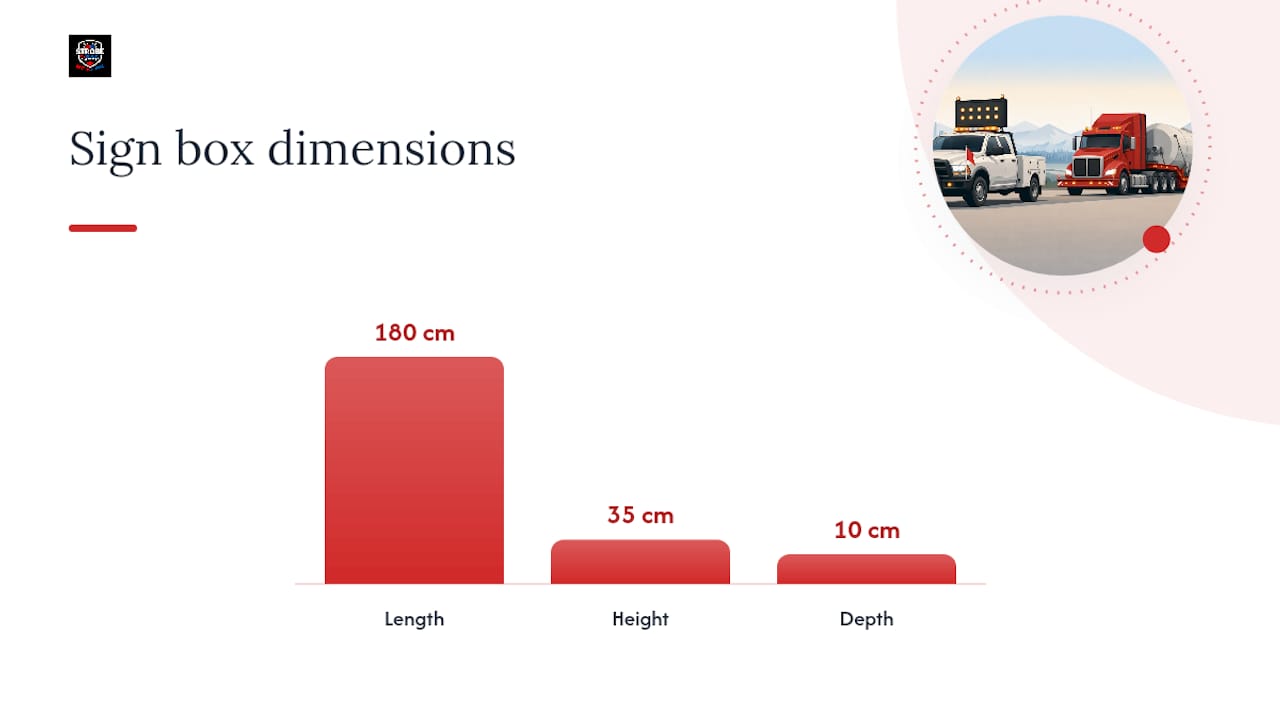
Dimensional signs are the physical placards that announce “oversize load” or similar wording to approaching traffic, and provincial handbooks are specific about their construction, not just their wording. Regulatory examples cite sign box dimensions in the neighbourhood of 180 cm by 35 cm by 10 cm, with an internal lamp layout designed to illuminate the sign face evenly rather than leaving dark patches that reduce legibility at night or in poor weather.
The lamp count inside the sign box is not arbitrary. Handbooks describe wiring and mounting expectations that assume multiple lamps distributed across the sign face, so a single centred bulb does not meet the intent of the requirement even if it technically illuminates the sign. Mounting has to be secure enough to survive highway vibration and wind loading without shifting the sign’s angle relative to approaching traffic.
Operators handling dimensional signs should work through a short sequence before every escort:
- Confirm the sign box is intact and securely mounted. A shifted or loose sign is both a compliance problem and a legibility problem for oncoming drivers.
- Test the internal lamps for even illumination. Dead or dim sections of the lamp layout defeat the purpose of a lit sign after dark.
- Check wiring connections at the sign box and along the mounting bracket. Vibration loosens connectors over time, and a sign that looks fine parked can go dark on the highway.
- Cover, fold, or remove the sign when it is not actively in use for an escort. Alberta’s handbook specifically recommends this to keep signage clean, legible, and to avoid drawing unnecessary enforcement attention when the vehicle is not escorting a load.
- Clean the sign face and lenses regularly. Road grime reduces reflectivity and readability faster than most operators expect, particularly through a Canadian winter.
That fifth point deserves its own emphasis. Legibility is not just an aesthetic concern. A dimensional sign covered in salt film or winter grime can fail a roadside inspection even if every lamp inside it works perfectly, because the regulatory intent is that approaching drivers can actually read the sign, not just see that it is illuminated.
Lamp specifications and mounting placement for escort vehicles
Regulatory lamp specifications tend to focus on three things: minimum size, mounting height, and visibility arc. BC’s guidance is the most numerically specific example available: rotating lamps need a minimum 15 cm diameter, strobe lamps need a minimum 11 cm diameter, and both need a minimum mounting height of 12 cm, with 360-degree visibility required regardless of which lamp type is chosen.
Quick reference: BC sets a 15 cm minimum diameter for rotating lamps, an 11 cm minimum for strobes, and a 12 cm minimum mounting height, all tied to a 360-degree visibility requirement once a load exceeds 3.2 m in width or 27.5 m in length.
Roof mounting is the default placement assumption behind almost every provincial lamp rule, because a bumper-mounted or dash-mounted lamp cannot deliver a genuine 360-degree signal. Traffic approaching from the side, or merging from an angle, needs to pick up the warning lamp just as clearly as traffic approaching head-on. That is also why dimensional sign lighting and roof-mounted warning lamps are treated as two separate but complementary systems in most handbooks rather than one interchangeable requirement.
Flash rate and lamp classification get referenced differently depending on the province. Ontario ties its requirement to the SAE J845 Class 1 standard. Saskatchewan cites SAE J595 for its 175 mm outboard lights. Not every province publishes an explicit flash-rate figure, which is exactly why operators should not rely on a manufacturer’s marketing copy to confirm compliance. A few habits keep procurement on solid ground:
- Check the specific provincial handbook or circular for the route the load will travel, not just the province where the vehicle is based.
- Confirm minimum diameter and mounting height figures against the regulation text rather than a supplier’s general product description.
- Where a province cites an SAE standard, confirm the specific SKU carries documentation referencing that standard.
- Treat government specification sheets and circulars as the authoritative source, and use manufacturer literature only to confirm which SKU meets that specification.
That last point is worth repeating in plain terms: a government circular tells you what the law requires; a supplier tells you which product meets it. Confusing the two, or skipping the first step entirely, is one of the more common gaps we see when fleets are sourcing pilot car lighting under time pressure.
When pilot car lights must be on, and how to use outboard versus inboard lamps
BC’s commercial transportation manual settles the single most common operational question outright: required lamps must be illuminated for the full duration of the escort trip, in daylight and in darkness alike, whenever they are listed as mandatory equipment for that load. That is a stricter standard than many operators expect. It is not a “turn them on when visibility drops” rule; it is a “turn them on for the entire trip” rule.
Outboard and inboard lamp use follows a more situational logic. Alberta’s handbook describes outboard lights as the normal operating configuration for an escort vehicle in transit, while inboard lights are reserved for specific circumstances such as adverse weather, turning manoeuvres, active flagging, or a breakdown on the shoulder. Switching to inboard lighting outside those situations can actually reduce the clarity of the warning signal you are trying to send to approaching traffic.
Pro Tip: When your escort personnel step outside the vehicle to flag traffic or manage a stopped load, keep parking lights on rather than full headlights facing oncoming drivers. Headlights aimed at approaching traffic at night can wash out your amber warning lamps and make it harder, not easier, for other drivers to read the situation.
A short list of operational habits keeps most escort assignments compliant and safe:
- Illuminate all mandatory lamps for the entire escort trip, not just during low-visibility stretches.
- Default to outboard lighting during normal transit; switch to inboard lighting only for adverse conditions, turning, flagging, or breakdown situations.
- Use parking lights rather than headlights when personnel are outside the vehicle near oncoming traffic.
- Confirm permit-based movement timing restrictions before departure, since some wide-load permits limit travel to specific daylight windows or restrict travel on weekends and holidays.
Permit-based timing restrictions deserve a mention on their own. A load that clears every lighting and signage requirement can still be non-compliant if it moves outside the window the permit actually authorizes, so timing conditions belong on the same pre-departure checklist as the equipment itself.
Pre-move inspection checklist for pilot car equipment
A pre-move inspection is where most preventable compliance failures get caught, and Alberta’s handbook frames it as a short but prescriptive process that combines equipment checks with administrative checks in one final pass before dispatch.
Run through the equipment side of the check in this order:
- Test every roof-mounted and sign-mounted lamp for function. Confirm they light, and confirm the flash pattern is working, not just a steady glow.
- Walk around the vehicle to verify 360-degree visibility. Check for mounting angles, obstructions, or dirt that could create a blind arc.
- Clean lenses and sign faces. Road grime reduces both brightness and legibility.
- Confirm the dimensional sign is securely mounted and undamaged. A cracked or loose sign box is a common roadside failure point.
- Test communication radios on the assigned channel for the move. A working light system does not help if the escort vehicle cannot coordinate with the load or with other escorts.
Mandatory equipment goes beyond lighting. Handbooks consistently list a defined kit that escort vehicles are expected to carry regardless of the specific load:
- Three warning triangles for roadside breakdowns
- Warning flags for daylight escort duties
- CSA Class 3 reflective vests for personnel outside the vehicle
- A first aid kit
- A fire extinguisher
- Spare fuses, bulbs, or lamp parts appropriate to the vehicle’s lighting system
Document each inspection with the date, the operator’s name, and any faults found, along with the corrective action taken. That record does two things at once: it demonstrates due diligence if a roadside inspection raises a question, and it gives your fleet a running history of which vehicles or lamp systems fail repeatedly, which is often the first sign a unit needs a hardware upgrade rather than another repair. The semi-truck inspection checklist from our roadside safety partner is a useful companion reference for building out the vehicle-condition side of a pre-move check, alongside the lighting-specific steps above.
Keeping pilot car lights and signs road-ready between escorts
Lighting and signage that pass inspection on installation day do not stay compliant on their own. Salt, road grime, vibration, and winter temperature swings all degrade lens clarity and wiring connections over a season, which is why routine maintenance matters as much as the initial spec sheet.
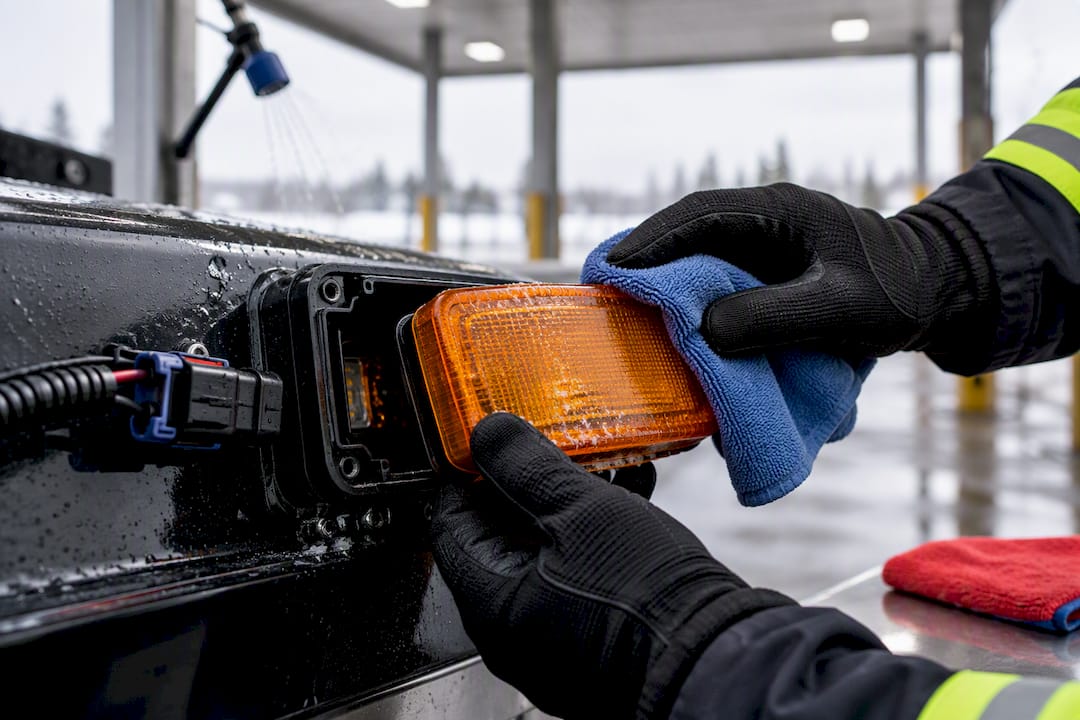
Set a cleaning and function-check schedule for lenses and dimensional signs rather than waiting for a visible problem to show up. Vibration-loosened wiring connectors are a common failure point on rotating and strobe lamps, and they rarely announce themselves until a lamp goes dark mid-route. Carrying spare bulbs, fuses, and connectors on the vehicle turns a potential roadside failure into a five-minute fix.
An inspection log does not need to be complicated to be useful. At minimum, track:
- The date of the inspection
- The operator who performed it
- Which items were checked (lamps, sign, radios, mounting hardware)
- Any faults found
- The corrective action taken and when it was completed
Retain any certification documentation your supplier provides for specific lamp models, along with permit-specific equipment conditions issued for individual moves. If a roadside officer or permit auditor asks whether a particular lamp meets the standard cited in your provincial handbook, a supplier certification sheet on file settles the question far faster than trying to source it after the fact.
How Strobe My Ride supports compliant pilot car lighting in Canada
There are suppliers stocking LED warning lights in Canada that ship across the country, which matters for escort operators who need replacement lamps or full kits on a timeline that matches a permit window rather than an overseas shipping schedule.
Different equipment roles call for different product categories. A mini lightbar suits sign-box or lower-profile roof mounting where space is limited. An exterior plug-and-play kit fills the roof-mounted warning role most provincial handbooks describe as the primary escort signal. An interior kit handles in-cab signalling and control, giving the driver a straightforward way to switch between outboard and inboard configurations without aftermarket wiring.
A few habits keep procurement aligned with regulatory expectations:
- Request SKU-level certification and specification documentation from Strobe My Ride before finalizing a purchase, since certifications and permitted colours vary by individual SKU and by province.
- Review the Patrol Line installation instructions before mounting or wiring any new lamp kit.
- Confirm the exact provincial requirement first, then match the product category to that requirement rather than the reverse.
Strobe My Ride does not set the regulatory thresholds. Those come from the provincial handbooks and circulars cited throughout this guide. What Strobe My Ride can do is help you source the SKU that fits the role your compliance checklist calls for.
Penalties for non-compliant pilot car lighting
Non-compliant escort lighting is enforced the same way as any other commercial vehicle equipment violation: through roadside inspection, permit condition checks, and, in serious cases, holding a load until the equipment is corrected. Escort vehicles operating with missing, malfunctioning, or undersized lamps risk fines tied to the applicable provincial commercial vehicle or highway traffic regulation, and a permit officer who identifies non-compliant equipment during a pre-move or roadside check can delay the move entirely until the deficiency is fixed.
The practical cost of non-compliance usually outweighs the fine itself. A wide-load move that gets held at the roadside for a dark dimensional sign or an undersized lamp does not just cost the escort vehicle time. It stalls the entire convoy, potentially pushes the move outside its permitted travel window, and can force a costly rescheduling of the whole route. Repeat equipment violations can also affect a carrier’s standing with the permit office issuing future authorizations, since permit offices track compliance history when reviewing applications for oversize or overweight moves.
Because fine amounts and enforcement mechanisms are set by each province’s own highway traffic or commercial vehicle legislation, and because they can change, operators should treat provincial regulation text and permit conditions as the definitive source for penalty amounts rather than a general estimate. The safer, and cheaper, approach is always the pre-move inspection checklist covered earlier in this guide: a five-minute lamp and sign check costs far less than a delayed convoy.
Lighting requirements for oversized length and height, not just width
Width thresholds get most of the attention in provincial handbooks, but length and height can trigger their own equipment requirements, particularly for rear escort placement and overhang situations. Manitoba’s permit guidance ties rear pilot vehicle requirements directly to overhang and clearance conditions rather than to width alone, which means a load that is standard width but has significant rear overhang can still require a trailing escort with its own lighting package.
Long combinations often need a rear escort specifically because the hazard they present, an overhang that extends well past the last set of wheels, is not something a lead escort ahead of the load can warn other drivers about. That rear escort typically carries the same amber warning lamp and dimensional sign requirements as a lead escort, oriented to warn traffic approaching from behind rather than ahead.
Height is less frequently the direct trigger for escort lighting compared to width and length, since height restrictions more often affect route planning around overpasses and structures than equipment on the escort vehicle itself. Where height does interact with escort requirements, it is usually alongside a width or length trigger on the same load, rather than as an independent standalone trigger. Operators moving unusually tall loads should still confirm rear and lead escort lighting requirements against the same provincial thresholds covered for width, since a load that is both overheight and overwidth is governed by whichever provincial trigger it crosses first.
Get compliant pilot car lighting from Strobe My Ride
Sourcing the right lamp for the right role is most of the compliance battle once you know your provincial thresholds. The Patrol Bar Quad 24 mini lightbar suits lower-profile roof or sign-adjacent mounting where a full-size bar will not fit. The Patrol Link Plug & Play 4 exterior kit covers the primary roof-mounted warning role that most provincial handbooks describe as the escort vehicle’s core signal. The Patrol Link Plug & Play 4 interior kit gives the driver in-cab control to switch between lighting configurations without custom wiring work.
Some suppliers stock products domestically and ship across Canada, which can help fleet managers working against a permit window avoid long waits for cross-border freight to get a replacement lamp on the road. Before you order, confirm three things: the minimum lamp size your provincial handbook specifies, the 360-degree visibility requirement for your mounting position, and whether the SKU comes with certification documentation you can keep on file for a roadside or permit check. Reach out to Strobe My Ride directly for SKU-specific certification sheets or for bulk pricing if you are outfitting more than one escort vehicle, and browse the full SMR Patrol Line and related collections to compare mounting options side by side before you commit to a purchase.
Where to find the official regulations
The provincial handbooks and circulars cited throughout this guide are the authoritative source for exact figures, and they get updated periodically, so bookmark the originals rather than relying solely on a secondary summary.
- BC: CVSE Compliance Circular 04-21 for lamp size figures, and the commercial transportation manual, chapter 8 for illumination timing rules.
- Alberta: the Escort Vehicle Operators Handbook for width thresholds, and the companion handbook edition for the pre-move checklist and mandatory kit list.
- Saskatchewan: provincial escort vehicle requirement summaries for the 175 mm outboard lamp specification.
- Ontario: R.R.O. 1990, Regulation 615 for Division 8 sign and lamp classification rules.
- Manitoba: the overlength permits page for permit-based rear pilot and overhang conditions.
Sources
- Changes to Pilot Car Requirements and Travel Times for … (CVSE compliance circular)
- Escort drivers’ handbook (Alberta TEG054)
- Escort vehicle operators handbook (Alberta)
- BC commercial transportation manual — chapter 8
- Ontario regulation R.R.O. 1990, Commercial Vehicle Dimension and Weight Regulation (Division 8 excerpts)
FAQ
What are the requirements for pilot cars in Canada?
Requirements vary by province, but the common pattern is amber warning lamps with 360-degree visibility, a dimensional sign once a load exceeds a set width, and a defined equipment kit including triangles, flags, and reflective vests. Exact thresholds and lamp sizes are set individually by BC, Alberta, and each other province.
At what width do you need a pilot car in Alberta?
Alberta’s escalation starts at 2.60 m, where warning flags and lights become mandatory, and reaches full pilot or trail vehicle requirements once a load exceeds 3.85 m in width. Dimensional signs join the requirement at 3.05 m, and flashing lamps at 3.35 m.
Do pilot car warning lights need to stay on the entire trip?
Yes, at least in BC, where guidance confirms that mandatory lamps must be illuminated for the entire duration of the escort, whether the move happens in daylight or darkness. Other provinces expect similar continuous use once a lamp is listed as mandatory equipment for the load.
Are headlights mandatory to be turned on for escort vehicles?
Provincial escort handbooks focus on amber warning lamps rather than standard headlights as the mandatory equipment, though headlights remain subject to each province’s general vehicle lighting rules. When personnel are outside the vehicle near traffic, using parking lights instead of full headlights helps keep amber warning lamps visible rather than washed out.
What lamp size does British Columbia require for pilot cars?
BC sets a minimum 15 cm diameter for rotating lamps and 11 cm for strobe lamps, with a minimum mounting height of 12 cm and full 360-degree visibility once a load exceeds 3.2 m in width or 27.5 m in length.
Where can I buy compliant pilot car warning lights in Canada?
Strobe My Ride stocks LED warning lighting in Ottawa and ships across Canada, including mini lightbars and plug-and-play exterior and interior kits suited to escort vehicle roles. Current pricing for each product is listed directly on the Strobe My Ride product pages.


