


For modern fleet warning lights and LED arrays, choose a solid‑state, LED‑rated flasher module. Reserve mechanical bimetal cans for legacy incandescent circuits where low cost and tolerance for electrical abuse matter more than clean cadence. If your lightbar carries several lamps or you’re wiring a multi‑zone warning package, insist on an OEM plug‑and‑play solid‑state module rather than a generic can.
TL;DR:
- LED-rated solid-state flashers maintain a consistent flash rate regardless of load and are essential for multi-lamp warning systems to ensure reliability.
- Traditional bimetal relays are suitable only for simple incandescent circuits and are incompatible with low-current LED loads due to their thermal operation.
- Hybrid relays offer more stability than bimetal but still suffer from contact wear and are less durable than solid-state modules.
- Proper thermal management and verifying load ratings are critical when selecting solid-state flashers to prevent overheating and ensure compatibility with high-current LED arrays.
- When retrofitting, ensure modules are explicitly rated for LED loads and check wiring, ground integrity, and terminal orientation to avoid common flashing issues.
Relay vs solid state: how each flasher actually works
The relay vs solid state question comes down to how each device times and switches the circuit. Understanding the mechanics explains why one fails on LEDs and the other doesn’t.
A bimetal flasher relay is a thermal device. Current flowing through the unit heats a bimetal strip, which bends until it opens the circuit, cools, and closes again. That cycle produces the flash. Because the heating depends on current draw, bimetal flashers are load sensitive and temperature dependent, and they slow down or stop flashing altogether in cold weather or when the load is too low.
Hybrid units split the difference. They use an electronic timing circuit to trigger an internal electromechanical switch, which improves timing stability and extends temperature range compared with pure bimetal designs, while keeping lamp‑out sensing. The tradeoff is that the switching contact is still a mechanical relay, so it still wears.
Solid‑state flashers replace the moving parts entirely. Electronic timing drives a MOSFET or transistor switch, which gives longer life because there’s nothing to wear out mechanically — but higher currents demand heatsinking to manage the heat the switch generates.
Where each type tends to hold up:
- Bimetal cans: fine on single incandescent circuits with steady, predictable current.
- Hybrid units: reasonable where shock, vibration, or dirty power make pure electronics riskier.
- Solid‑state modules: the standard for LED arrays and multi‑lamp lightbars, where heavy‑duty signaling applications have pushed designers toward solid‑state switching for reliability at high loads.
Relay advantages and disadvantages vs solid state benefits
Procurement decisions come down to a short list of tradeoffs. Here’s the practical breakdown fleets use at purchasing review:
Bimetal (mechanical) relay
- Pros: low unit cost, tolerant of voltage spikes and rough electrical environments.
- Cons: poor LED compatibility, sensitive to temperature, generally shorter service life than solid‑state alternatives.
Hybrid relay
- Pros: more stable timing than bimetal, retains lamp‑out sensing with electromechanical switching.
- Cons: still subject to relay contact wear over time.
Solid‑state module
- Pros: works reliably with LED loads, holds a steady flash cadence regardless of load size, supports diagnostics, and tends to outlast mechanical designs.
- Cons: higher upfront cost, and high‑current installations need proper heatsinking and mounting clearance.
Pro Tip: If your fleet mixes incandescent work lights with LED warning lights on the same circuit, don’t assume one flasher type covers both. Check the module’s rated load range before wiring it into a mixed‑lamp harness.
Why relay vs solid state matters for LED compatibility
This is where most fleet lighting complaints originate. Thermal flasher cans need enough current flowing through them to heat the bimetal strip. LEDs draw a fraction of the current an incandescent bulb does, so thermal flashers generally fail to flash correctly with LED lamps — either the strip never heats enough to open (no flash at all), or if lamp‑out sensing is built in, the low current reads as a burned‑out bulb and triggers hyperflash.
Solid‑state flashers solve this because their timing is electronic, not thermal. It doesn’t depend on load current, so an LED‑rated solid‑state module flashes at the correct rate whether it’s driving one LED or a dozen, and it can still offer lamp‑out detection tuned for low‑current loads.
A few wiring checks matter regardless of flasher type:
- Confirm feed (X) versus load (L) terminal orientation. Many LED‑rated flasher cans are directional, unlike some older nondirectional units.
- Verify ground integrity at the flasher and at each lamp housing.
- Confirm the module is explicitly listed as LED‑rated or “no‑load” capable, not just a generic replacement can. Strobe My Ride’s rundown of LED flasher alternatives covers the common options fleets run into during retrofits.
Buying guide: what to ask before you specify a flasher
Work through these points before ordering hardware for an upfit or a fleet‑wide retrofit:
- Calculate total lamp current. Add up steady‑state draw for every lamp on the circuit, then estimate peak draw at startup, and compare both against the flasher’s continuous and pulse current ratings.
- Confirm LED compatibility explicitly. Ask the supplier whether the module is rated for “no‑load” or LED circuits, and how lamp‑out sensing behaves once the load drops below incandescent levels.
- Check thermal management requirements. Solid‑state modules handling higher currents may need heatsinking or specific mounting clearance to dissipate heat properly; heavy‑duty solid‑state flashers are typically packaged with this in mind for multi‑lamp applications.
- Request SKU‑level compatibility notes. Certification sheets and fitment notes should confirm whether an OEM module is a genuine plug‑and‑play fit for your vehicle’s harness, not just a universal adapter.
- Evaluate serviceability and support. Ask what spare parts are stocked and how quickly a supplier can answer a compatibility question if something doesn’t behave as expected after installation.
Fleets running multiple lightbars or auxiliary lamp circuits often find that a properly sized solid‑state module costs less over the vehicle’s service life than repeatedly replacing relays, even though the sticker price is higher. Strobe My Ride’s plug‑and‑play flasher guide walks through when that upfront cost is worth paying.
Troubleshooting common flasher problems in the field
Matching the symptom to the likely cause saves diagnostic time on a vehicle that’s due back on the road:
- No flash at all: wrong flasher type for the load (bimetal on an LED circuit), or a stuck bimetal strip.
- Hyperflash: lamp‑out sensing reading low LED current as a burned‑out bulb — swap for an LED‑rated module.
- Intermittent flash: loose connectors, a failing ground, or a worn relay contact in a hybrid unit.
- Overheating: thermal stress on a solid‑state module that’s undersized for the load or mounted without adequate heat dissipation.
Start with the basics: listen for the mechanical click on relay‑based units, check fuses, and inspect connectors and grounds before assuming the flasher itself has failed. Where practical, measure actual load current rather than guessing. If a known‑good LED‑rated module doesn’t fix a hyperflash complaint, the issue is usually wiring, not the flasher. Persistent overheating on a solid‑state module is a sign to move up to a heatsinked unit or an OEM plug‑and‑play module rated for the actual lamp count. When a fix isn’t obvious after these checks, contact your supplier with the SKU in hand rather than swapping parts at random. For guidance on how environment affects lighting hardware more broadly, Strobe My Ride’s weatherproofing notes cover related failure points worth ruling out.
Strobe My Ride’s LED‑compatible lighting and flash modules
Once you’ve settled the relay vs solid state question for your fleet, the next step is matching hardware to the job. Strobe My Ride stocks OEM flash modules and warning lights built around that decision, shipped from Ottawa across Canada.
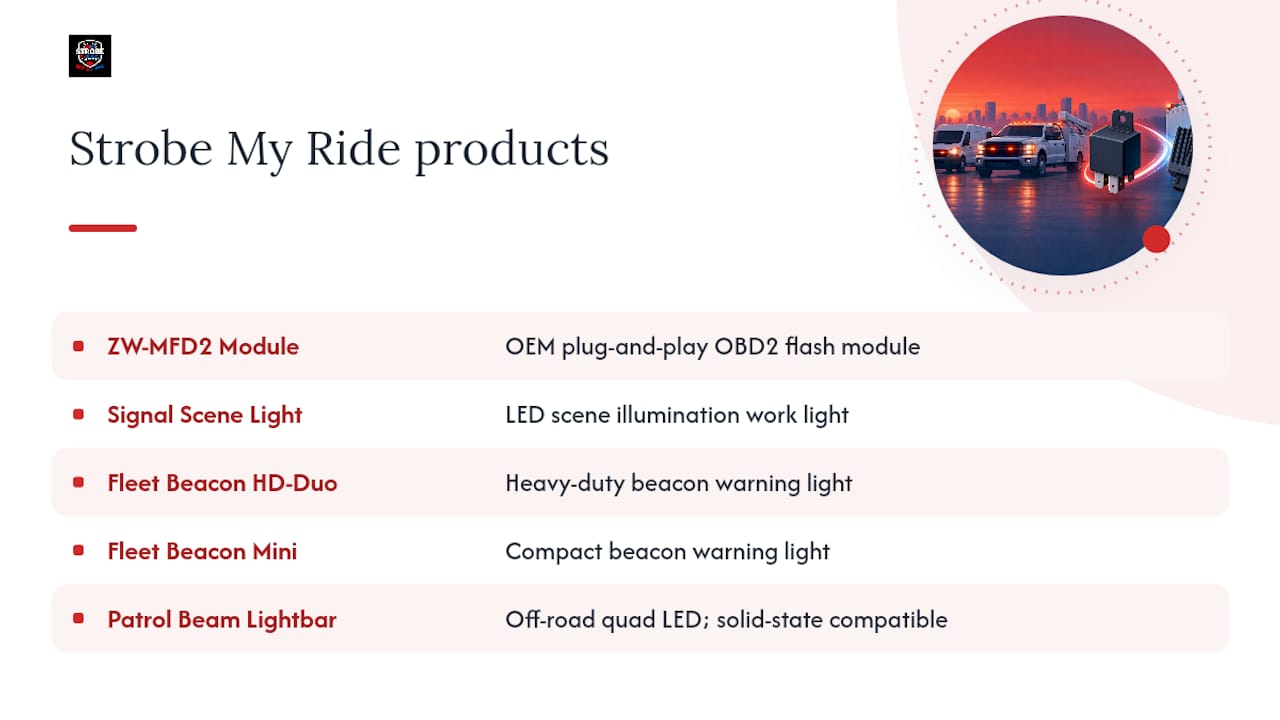
For OEM‑style plug‑and‑play switching, the ZW‑MFD2 OBD2 Flash Module is built for direct fitment on supported vehicles without splicing into the factory harness. On the lighting side, the Signal Scene LED Scene Work Light covers scene illumination, the Fleet Beacon HD‑Duo and Fleet Beacon Mini handle beacon‑style warning in heavy‑duty and compact formats respectively, and the Fleet Beacon Equip is built for amber equipment warning. If you’re retrofitting surface‑mount positions, the Signal Vector Surface Mount and the smoked‑lens Fleet SM Stealth cover discreet and standard finishes. For off‑road visibility, the Patrol Beam Dual Force Quad LED Off Road Lightbar is built for multi‑lamp arrays where solid‑state flasher compatibility matters most.
SKU‑level specs, compatibility notes, and certification details are listed on each product page and in Strobe My Ride’s technical blog. Where a spec isn’t published, don’t assume it. Contact Strobe My Ride directly for a compatibility check or bulk and fleet pricing before you commit hardware to a build.
Sources
- 13C3310a flasher relays technical note
- Use of solid‑state flashers in heavy‑duty signaling applications (SAE paper)
- Light show — picking the right turn signal flasher for LEDs
FAQ
Do LED warning lights need a special flasher relay?
Yes. Thermal bimetal flashers rely on lamp current to heat a strip, and LEDs typically draw too little current to trigger that mechanism, causing no‑flash or hyperflash. An LED‑rated solid‑state module avoids the problem because its timing doesn’t depend on load current.
What causes hyperflash on LED circuits?
Hyperflash happens when a flasher’s lamp‑out sensing reads the LED’s low current draw as a burned‑out incandescent bulb. Switching to a flasher explicitly rated for LED or “no‑load” circuits resolves it in most cases.
Can a solid‑state flasher overheat?
Yes, if it’s undersized for the connected load or installed without adequate heatsinking. Solid‑state units switch with MOSFETs and need attention to thermal dissipation at higher currents, so matching the module’s rating to actual lamp count matters.
Where can I buy an OEM plug‑and‑play flash module?
Strobe My Ride stocks the ZW‑MFD2 OBD2 Flash Module for direct OEM‑style fitment, along with a range of LED‑compatible warning lights. Current prices are available on the product page, and SKU-level compatibility should be confirmed before ordering.
Is a mechanical relay ever the better choice?
A bimetal relay can still make sense on legacy incandescent circuits where low cost and tolerance for electrical abuse outweigh flash‑rate precision. For any circuit carrying LED lamps or multiple lamps in a lightbar, a solid‑state module is the more reliable option.


