


A tow truck light bar is a multi-LED warning light system mounted on the roof or rear of a towing vehicle to alert approaching traffic and protect operators working on or near active roadways. In Canada, these systems are not optional equipment. Provincial legislation and Transport Canada guidelines require tow trucks to display approved warning lights whenever they are stopped on or adjacent to a roadway. 60% of Ontario towing fleets now use LED light bars as their primary visibility tool. That figure reflects how quickly the industry has moved away from older halogen and rotating beacon systems toward purpose-built LED arrays that deliver greater output, longer service life, and broader compliance coverage.
What colours and flash patterns are legal for tow truck light bars in Canada?
Amber is the nationally recognised caution colour for tow trucks and roadside service vehicles across every Canadian province and territory. No province currently permits tow trucks to run red or blue as a primary warning colour, since those are reserved for police, fire, and ambulance services. Amber signals caution rather than emergency authority, which is exactly the message a tow truck operator needs to send to approaching drivers.
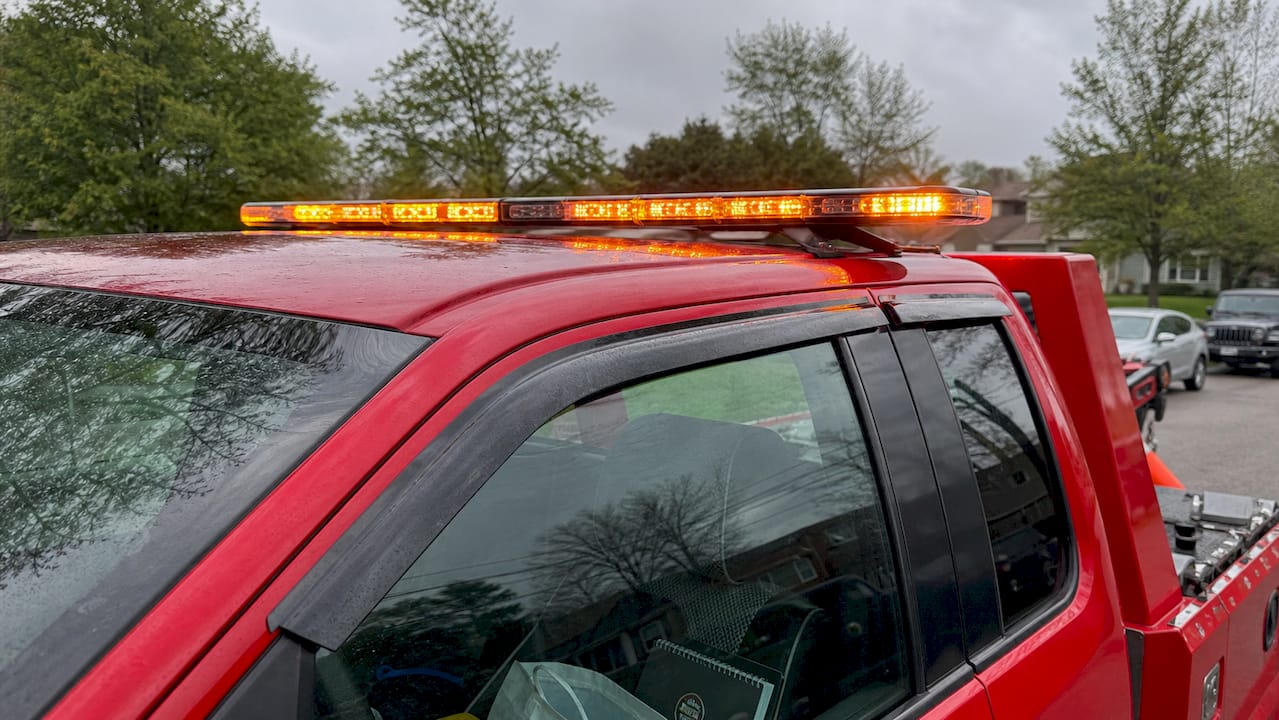
Flash patterns matter as much as colour. A steady amber light is far less effective at capturing driver attention than a split-second strobe or alternating flash sequence. Most provincial regulations specify that warning lights must be visible from a minimum distance, and high-frequency flash patterns consistently outperform steady burns in daylight and adverse weather. Operators should confirm the specific flash pattern requirements with their provincial ministry of transportation, since enforcement interpretations vary.
Alberta’s amber-blue pilot programme
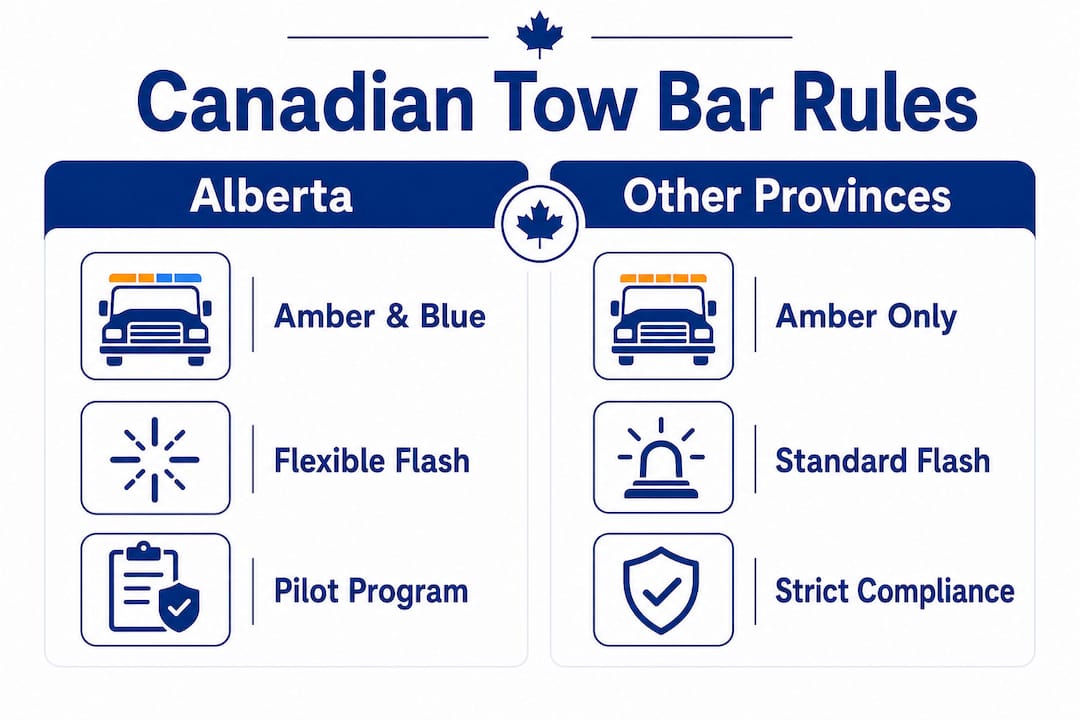
Alberta has taken the most progressive position on tow truck lighting in Canada. Alberta permits tow trucks to use a combination of blue and amber lighting under a five-year pilot programme, with blue directed rearward to increase urgency signals for approaching drivers. Blue must supplement amber, not replace it. The intent is to produce a two-colour signal that drivers associate with both caution and authority, which research into driver reaction times supports. If you operate in Alberta, review the specific provincial regulation before adding blue lights, since the pilot terms include directional and mounting restrictions.
More jurisdictions across Canada are evaluating expanded colour options, including amber combined with green for certain roadside service categories. This trend reflects a broader recognition that amber alone may not generate sufficient urgency on high-speed highways. For detailed guidance on what is currently permitted in Alberta and Saskatchewan, Strobe My Ride maintains a dedicated resource on amber and blue warning lights for tow trucks.
Provincial colour and flash pattern comparison
| Province | Primary colour | Secondary colour | Flash pattern requirement |
|---|---|---|---|
| Alberta | Amber | Blue (pilot, rearward) | Flashing or strobing required |
| Ontario | Amber | None currently authorised | Flashing required; steady burn insufficient |
| British Columbia | Amber | None currently authorised | Flashing required |
| Quebec | Amber | None currently authorised | Flashing required |
Note: Confirm current requirements with your provincial ministry of transportation before purchasing or installing any warning light system. Regulations change and enforcement practices vary by jurisdiction.
Pro Tip: Running non-compliant colours or flash patterns does not just risk a fine. It can also void your commercial vehicle insurance coverage if an incident occurs while your lighting is out of spec. Verify compliance before every season.
How to select the best light bar for towing
The best light bar for towing combines high lumen output, durable construction, and full compliance with the colour and flash pattern rules of your operating province. Operators who focus only on brightness and ignore mounting options or power draw often end up with a unit that works well in the parking lot but fails on a winter highway at 2:00 AM.
Key selection criteria
Start with these five factors before comparing any specific product:
- Lumen output and beam angle. A light bar needs to be visible from a significant distance in direct sunlight, rain, and snow. Higher lumen output combined with a wide beam angle covers more of the roadway behind and beside the truck.
- Colour compliance. Confirm the unit ships in the correct colour for your province. Amber is the baseline. If you operate in Alberta, verify whether the unit supports a rear-facing blue channel under the pilot programme terms.
- Flash pattern count. More flash patterns give you flexibility to match the pattern to the situation, whether you are on a rural road or a divided highway. Look for units with at least 15 programmable patterns.
- Weather and vibration resistance. Tow trucks require vibration-resistant, weatherproof LED light bars built to maintain performance in harsh roadside conditions. An IP67 or IP68 rating indicates the unit can handle full water immersion, which matters during Canadian winters.
- Mounting versatility. Roof-mount, magnetic-mount, and permanent-mount options each suit different truck configurations. Fleet managers running mixed fleets benefit from units that transfer between vehicles without requiring new hardware.
Wireless and remote control features
Wireless LED light bars reduce cabling complexity and allow operators to control flash patterns remotely without reaching across the cab. This is a practical safety benefit, not just a convenience feature. Fewer cables mean fewer failure points, and remote pattern switching lets the operator adapt the signal to changing road conditions without stopping work. For fleet managers, wireless units also simplify vehicle changeovers since there is no hardwired harness to disconnect and reconnect.
Pro Tip: Always ask your supplier for the SAE classification of any light bar you are considering. SAE Class 1 is the highest output rating and is the appropriate standard for tow trucks operating on highways. Class 2 and Class 3 units are rated for lower-speed environments and may not meet provincial requirements for highway towing. Strobe My Ride’s tow truck light bar page outlines SAE Class 1 certification requirements in detail.
Installation and maintenance best practices
Proper installation determines whether a light bar performs as rated or becomes a liability. A unit mounted at the wrong height, wired through an undersized circuit, or secured with inadequate hardware will degrade faster and may not meet the visibility distance requirements set by provincial regulation.
Installation steps for consistent performance
Follow this sequence for a reliable, compliant installation:
- Confirm mounting position. The light bar should be mounted at the highest practical point on the cab roof to maximise the visible arc. Rear-facing units must be positioned so they are not obstructed by the boom or any loaded vehicle.
- Size the wiring correctly. Use wire gauge rated for the total amperage draw of the light bar plus a safety margin. Undersized wiring causes voltage drop, which reduces light output and generates heat that shortens LED lifespan.
- Use a dedicated fused circuit. Connect the light bar to its own fused circuit rather than tapping into an existing accessory circuit. This prevents interference with other vehicle systems and makes troubleshooting straightforward.
- Seal all penetrations. Any hole drilled through the cab roof or body panel for wiring must be sealed with a weatherproof grommet and sealant. Water intrusion at wiring penetrations is the leading cause of premature light bar failure in Canadian climates.
- Test all flash patterns before road use. Cycle through every programmed pattern and confirm the unit responds correctly. Document the patterns available so operators know which setting to use in different situations.
- Verify mounting hardware torque. Loose mounting bolts vibrate free on rough roads. Use thread-locking compound on all fasteners and re-check torque after the first 500 kilometres of operation.
Routine maintenance of tow truck light bars includes lens cleaning, wiring connection checks, and flash pattern testing. These tasks take less than 15 minutes per vehicle per month and prevent the majority of in-service failures.
Ongoing maintenance checklist
Run this inspection monthly and after any collision or heavy off-road recovery:
- Clean lenses with a non-abrasive cloth and mild soap. Road film and salt accumulation reduce light output measurably over a Canadian winter.
- Inspect all wiring connections for corrosion, chafing, or looseness. Pay particular attention to connections near the cab roof where temperature cycling is most severe.
- Test every flash pattern. A pattern that has stopped working indicates a failed LED module or a controller fault, both of which require immediate attention.
- Check mounting hardware for looseness or corrosion.
- Inspect the weatherproof seals around any wiring penetrations.
If you notice dimming output that is not explained by a dirty lens, the most likely cause is voltage drop from a loose or corroded ground connection. Clean the ground terminal and retest before assuming the LED module has failed.
How do tow truck light bars support Move Over law compliance?
Move Over laws require drivers approaching a stopped tow truck displaying flashing warning lights to slow down and, where safe, change lanes away from the vehicle. These laws exist in every Canadian province, and the penalties for non-compliance are significant. In Alberta, failing to slow down and move over for a tow truck with flashing lights results in a $243 fine and 3 demerit points. That penalty falls on the passing driver, not the tow truck operator. However, the operator’s light bar must be functioning and displaying an approved pattern for the law to apply.
The connection between light bar performance and legal protection is direct. A tow truck operator whose warning lights are dim, non-functional, or displaying a non-compliant colour cannot rely on Move Over legislation to establish that approaching drivers had adequate warning. Maintaining a bright, compliant, and fully operational light bar is not just a safety measure. It is the legal foundation for the protection the law is designed to provide.
The Alberta Motor Association has documented dozens of near-misses and serious incidents involving tow truck operators struck or almost struck by passing traffic. These incidents consistently involve situations where driver awareness of the stopped vehicle was delayed. High-visibility warning lighting is the primary tool operators have to reduce that delay and give approaching drivers the reaction time they need.
High-visibility tow truck warning lights are especially critical in adverse conditions. Rain, snow, fog, and low-angle winter sun all reduce the distance at which a driver can detect a stopped vehicle. A properly specified LED light bar with a high-frequency flash pattern cuts through these conditions far more effectively than a steady amber beacon or a low-output halogen unit. The amber-blue combination now being piloted in Alberta is specifically designed to increase urgency perception at greater distances, giving drivers more time to react.
Fleet managers should treat light bar specification as a risk management decision, not just a compliance checkbox. A fleet running underpowered or non-compliant lighting exposes operators to physical risk and the company to liability if an incident occurs. Reviewing your fleet’s tow truck lighting solutions against current provincial standards is a straightforward step that directly reduces both risks.
Key takeaways
A compliant, high-output tow truck light bar is the single most effective tool an operator has to trigger Move Over law protections and reduce the risk of being struck by passing traffic.
| Point | Details |
|---|---|
| Amber is the baseline colour | Every Canadian province requires amber as the primary warning colour for tow trucks on public roads. |
| Alberta permits amber-blue combinations | Alberta’s five-year pilot allows rear-facing blue lights to supplement amber, increasing urgency signals for approaching drivers. |
| SAE Class 1 is the highway standard | Tow trucks operating on highways should use SAE Class 1 rated light bars to meet provincial visibility distance requirements. |
| Installation quality determines performance | Correct wiring gauge, sealed penetrations, and torqued mounting hardware prevent the majority of in-service light bar failures. |
| Move Over law protection requires a working light bar | A non-functional or non-compliant light bar removes the legal basis for Move Over law protection in the event of an incident. |
Strobe My Ride’s Patrol Bar Quad 60 for tow truck operators
Strobe My Ride supplies the Patrol Bar Quad 60 as a full-size LED light bar built for tow truck and emergency service applications. It delivers multiple programmable flash patterns, a weatherproof housing rated for Canadian road conditions, and a quad-head LED configuration that produces the output levels required for highway visibility.
The Patrol Bar Quad 60 is available in amber and in configurations that support the amber-blue combination for operators in Alberta. Strobe My Ride backs its products with industry-leading warranties and provides expert support to help fleet managers confirm compliance with provincial regulations before purchase. Fast Canadian shipping means your fleet does not sit idle waiting for lighting upgrades. If you are evaluating tow truck safety lights for a new build or a fleet refresh, the Patrol Bar Quad 60 is worth a close look.
FAQ
What colour lights are legal on a tow truck in Canada?
Amber is the legally required warning colour for tow trucks across all Canadian provinces. Alberta additionally permits a rear-facing blue light to supplement amber under a five-year pilot programme, but blue cannot replace amber as the primary colour.
What does SAE Class 1 mean for a tow truck light bar?
SAE Class 1 is the highest output classification under the Society of Automotive Engineers warning light standard. It indicates the light bar meets the brightness and flash pattern requirements for high-speed highway use, which is the appropriate rating for most tow truck applications.
How much is the fine for not moving over for a tow truck in Alberta?
Failing to slow down and move over for a tow truck displaying flashing lights in Alberta results in a $243 fine and 3 demerit points. The fine applies to the passing driver, provided the tow truck’s warning lights are functioning and compliant.
How often should a tow truck light bar be inspected?
Monthly inspections covering lens cleaning, wiring connections, flash pattern testing, and mounting hardware checks are the standard maintenance interval. Operators should also inspect the unit after any collision or heavy recovery operation.
Can I install a tow truck light bar myself?
DIY installation is possible for operators with electrical experience, but professional installation is recommended for permanent roof-mount units. Incorrect wiring gauge or unsealed penetrations are the most common causes of premature failure and can create safety hazards in service.


