


Green courtesy lights are the standard choice for volunteer firefighters across most of Canada, and the rules governing them vary significantly by province. Before you purchase or install any emergency lighting on your personal vehicle, you need to know exactly what your provincial legislation permits, what technical standards apply, and what authorization you must carry. Getting this wrong is not just a compliance issue; it can result in fines, programme revocation, and real risk to public trust in volunteer fire services.
Here is what Canadian volunteer firefighters need to know at a glance:
- Green flashing lights are the designated courtesy light for volunteer firefighters in provinces like Ontario and Québec. They signal to other drivers that a firefighter is responding to an emergency, but they do not grant emergency vehicle status.
- Provincial legislation governs everything. Ontario Regulation 484/07 and Québec’s Flashing Green Light Regulation are the two most detailed frameworks in the country. Other provinces have their own rules or lack specific green light provisions entirely.
- Authorization is mandatory in provinces with formal programmes. You must carry your certificate every time the light is activated.
- SAE standards matter. Québec requires lights that meet SAE Standard J845 (February 2019 or later) or SAE Standard J595 (August 2021 or later). Other jurisdictions reference similar benchmarks.
- Strobe My Ride is Canada’s leading supplier of green volunteer fire lights, offering SAE-compliant dash lights, beacons, and surface mount LEDs built specifically for this application.
What do the provincial laws say about volunteer firefighter lights?
Provincial rules differ enough that a light legal in Québec may not be authorized in British Columbia. The table below summarizes the current regulatory landscape by province. Every legislative claim in this table requires manual verification against current primary sources before acting on it.
| Province | Permitted colour | Authorization required | Key legislation / notes |
|---|---|---|---|
| Ontario | Green (flashing) | Yes, for authorized volunteer medical responders; firefighter use governed separately under the Highway Traffic Act | O. Reg. 484/07; photo ID of membership must be carried |
| Québec | Green (flashing) | Yes; municipal authority resolution plus ENPQ training and SAAQ certificate required | Flashing Green Light Regulation (in force since 2021); SAE J845 or J595 compliant LED, 1–4 Hz flash rate, inside windshield only |
| British Columbia | Red (flashing) for non-privately owned emergency vehicles | Permit from CVSE required; applies to organizations, not individuals | BC Motor Vehicle Act Regulations s.4.28; no specific green light provision identified |
| Nova Scotia | Amber/yellow (flashing or revolving) for most non-emergency vehicles | Governed by Vehicle Warning Lights Regulations under the Motor Vehicle Act; specific volunteer firefighter green light provision not confirmed | Verify with NS Registry of Motor Vehicles |
| Alberta | Verify with Alberta Transportation | Not confirmed in primary sources | Alberta Traffic Safety Act governs; consult local fire authority |
| Manitoba | Verify with Manitoba Infrastructure | Not confirmed in primary sources | Highway Traffic Act governs; consult local fire authority |
| Saskatchewan | Verify with SGI | Not confirmed in primary sources | Traffic Safety Act governs; consult local fire authority |
| New Brunswick | Verify with NB Department of Justice | Not confirmed in primary sources | Motor Vehicle Act governs; consult local fire authority |
| PEI | Verify with PEI Transportation | Not confirmed in primary sources | Highway Traffic Act governs; consult local fire authority |
| Newfoundland & Labrador | Verify with Service NL | Not confirmed in primary sources | Highway Traffic Act governs; consult local fire authority |
Important: This table is a starting point, not legal advice. Contact your provincial motor vehicle authority and your Fire Chief before purchasing or installing any emergency lighting on a personal vehicle.
In Québec, the regulatory framework is the most detailed in Canada. Under section 226.2 of the Highway Safety Code, only authorized firefighters and tow truck operators may use flashing green lights on non-emergency vehicles. The light must be installed inside the windshield, within the wiper sweep area, and outside any tinted zone that transmits less than 70% of light. A single light is permitted; grille-mounted or exterior installations are not allowed under this regulation.
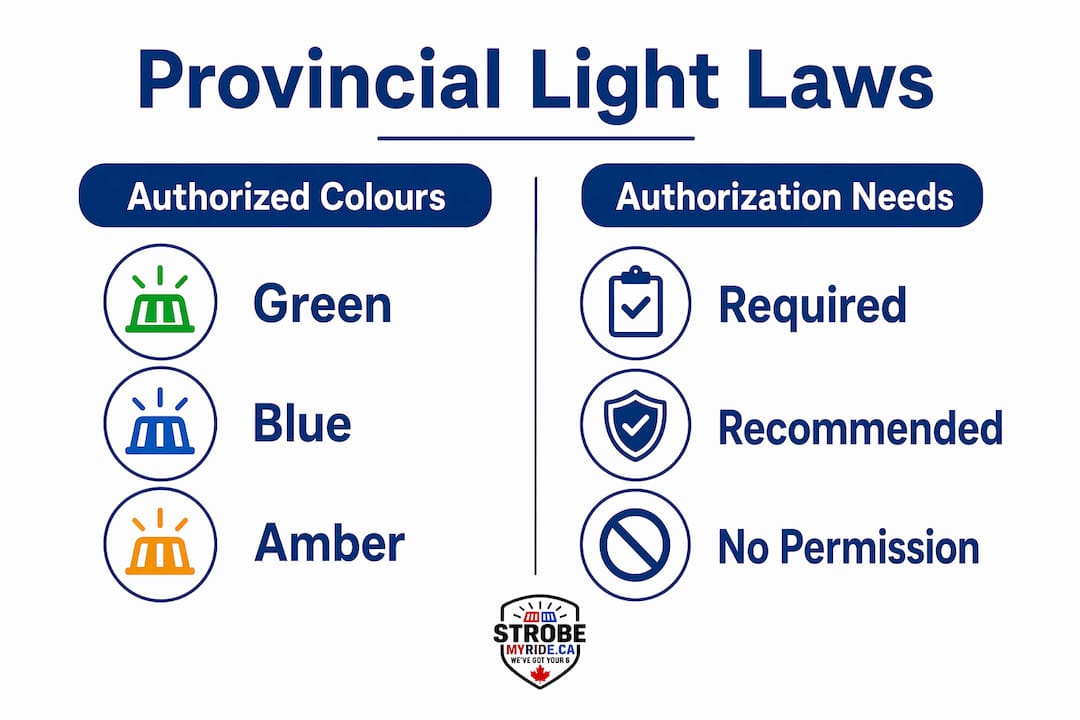
Ontario’s approach under O. Reg. 484/07 specifically addresses volunteer medical responders, including members of Hatzoloh Toronto and St. John Ambulance, authorizing green lights during active emergency response. Firefighter use in Ontario is governed under the Highway Traffic Act itself; consult your Fire Chief and the Ministry of Transportation for current guidance.
What types of emergency lights work for volunteer firefighters?
Not every emergency light on the market is appropriate for a volunteer firefighter’s personal vehicle. The right choice depends on your province’s rules, your vehicle, and how the light will be mounted and activated.
Common light categories for volunteer firefighter use:
- Dash lights: Mounted inside the vehicle on the dashboard or windshield. In Québec, the inside-windshield dash mount is the only legally permitted location for the green courtesy light. Products like the Fire Dash Mini Responder from Strobe My Ride are purpose-built for this application, with green LED output and a compact profile that fits within the wiper sweep area.
- Dual-function dash lights: The Fire Dash dual LED dash warning light offers two independent LED zones, allowing a firefighter to run green courtesy output while keeping the unit within the vehicle’s windshield area. This is particularly useful where provincial rules restrict exterior mounting.
- Surface mount LEDs: Low-profile lights that attach to the exterior of a vehicle. These are common on department-owned apparatus but may not be permitted on personal vehicles in provinces with strict inside-windshield requirements.
- Beacons: Rotating or flashing dome lights, typically used on department vehicles. Amber beacons are widely authorized for roadside and construction use; green beacons for personal firefighter vehicles are subject to provincial restrictions.
- Hideaway LEDs and grille strobes: Built into existing vehicle lighting housings. Again, check provincial rules before installing these on a personal vehicle, as exterior mounting of green lights is restricted in Québec.
- Portable magnetic lights: Temporary units that attach via magnet to the vehicle roof or hood. Useful for flexibility, but verify that portable mounting satisfies your province’s installation requirements.
LED technology is the right choice across all these categories. LED modules draw less current than halogen or incandescent alternatives, produce higher light output, and last far longer under the thermal cycling that comes with intermittent emergency use. Québec’s regulation specifically requires LED modules; other provinces that reference SAE J845 or J595 effectively require LED-grade performance as well.
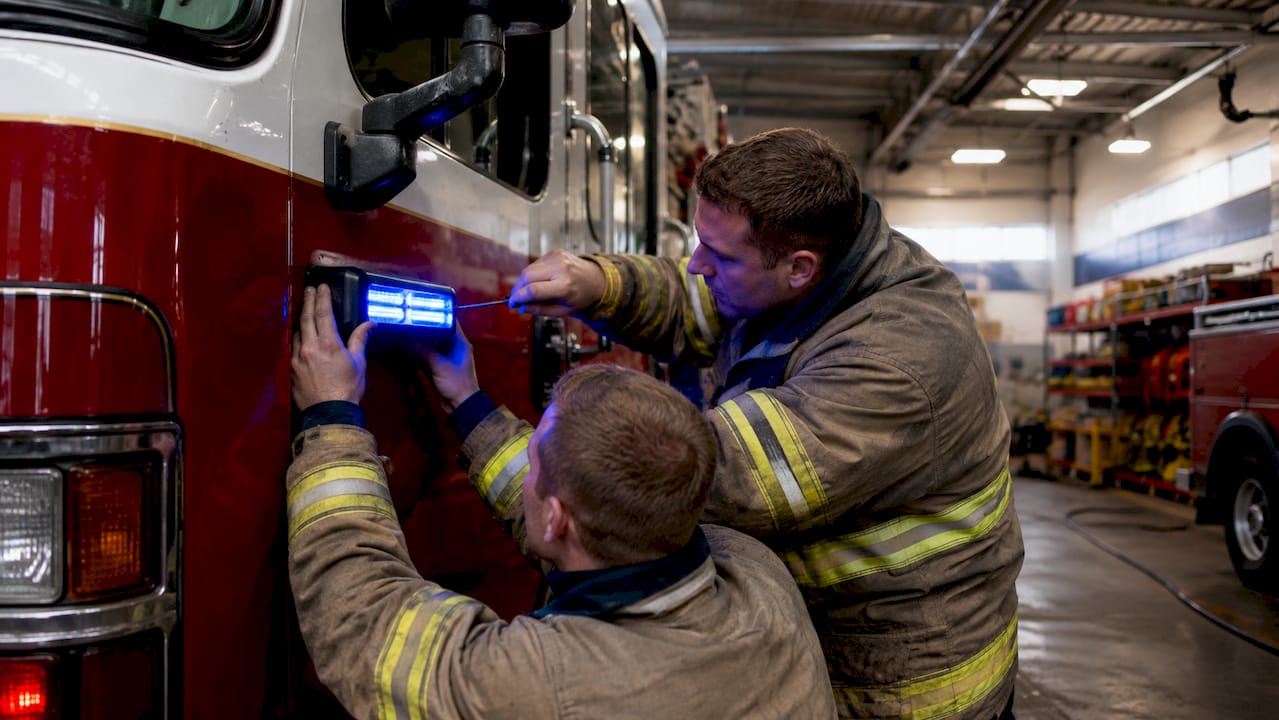
Pro Tip: Before ordering any light, confirm with your Fire Chief that the specific product meets your municipality’s technical standards for flash rate, mounting position, and colour output. A non-conforming light cannot be legally activated, regardless of how it is marketed.
How do you use emergency lights safely and legally?
Owning the right light is only half the equation. How you use it determines whether you stay on the right side of the law and whether the green light programme in your community keeps its credibility.
Key practices for legal and safe use:
- Carry your authorization certificate every time. In Québec, the certificate issued by the municipal authority must be with you whenever the light is activated. The same principle applies in Ontario for authorized volunteer medical responders, who must carry photo ID of membership. A light activated without the certificate present is an unauthorized use.
- Activate only during active emergency response. The green light is for travelling to the fire station or the scene of an emergency when called by a fire safety service. It must not be used for routine driving, personal errands, or any non-emergency purpose.
- Obey all traffic laws. The SAAQ is explicit: a flashing green light does not exempt firefighters from the Highway Safety Code. Speed limits, traffic signals, and right-of-way rules all apply. The light requests courtesy from other drivers; it does not grant the legal privileges of an emergency vehicle.
- Mount the light correctly. In Québec, the light must be inside the windshield, within the wiper sweep area, outside the tinted zone, and positioned so it does not obstruct the driver’s view or interfere with airbag deployment. Incorrect mounting is a violation even if the light itself is compliant.
- Deactivate when not responding. The light must not be activated outside of emergency response. In Québec, the light may remain installed in the vehicle when not in use, but it must not be connected to any power supply when a non-authorized person is driving.
- Inspect the light regularly. Check the mounting, wiring, and lens condition before each response season. A light that fails during an active response is a safety problem; one that activates unexpectedly is a legal one.
Pro Tip: Coordinate directly with your Fire Chief and your municipal authority before purchasing any lighting equipment. Technical standards for brightness, flash pattern, and mounting vary by jurisdiction, and your department may have specific approved product lists.
Why do Canadian provinces use green courtesy lights for volunteer firefighters?
The green light programme exists because volunteer firefighters typically respond from home or work in their personal vehicles, not from a fire station in a marked apparatus. Without any visual signal, other drivers have no way to identify a firefighter who is urgently trying to reach a scene or station.
The green light solves this by giving firefighters a recognized, legally defined signal that asks other road users for courtesy. The key word is “courtesy.” A vehicle displaying a green flashing light is not an emergency vehicle under Canadian law. It cannot legally run red lights or exceed speed limits. What it can do, in provinces with formal programmes, is travel on the shoulder and stop in any location when safe to do so, provided the firefighter acts in a way that does not endanger others.
Why green specifically? Red and blue are reserved for police, fire apparatus, and ambulances. Amber is used for roadside, construction, and tow vehicles. Green was chosen for volunteer firefighter courtesy lights precisely because it is distinct from all of these, reducing the risk of confusion about a vehicle’s legal status and authority.
The programme’s credibility depends entirely on strict compliance. Municipal fire authorities consistently emphasize that misuse, whether activating the light outside of emergency response or driving aggressively while it is on, directly undermines public trust and can lead to programme revocation at the municipal level. Québec’s authorization process reflects this: training at the École nationale des pompiers du Québec is mandatory, and certificates are subject to renewal with ongoing compliance checks.
For volunteer fire department lighting in Canada, Strobe My Ride carries the widest selection of green courtesy lights built to meet provincial technical standards, including SAE J845 and J595 compliant options. Whether you need a compact inside-windshield unit or a dual-zone dash light, the product range is designed around the specific constraints Canadian firefighters actually face.
Battery and power considerations for emergency lighting systems
Power draw is a practical concern that many volunteer firefighters overlook until they are sitting in a parking lot with a dead battery after a long response. LED emergency lights draw far less current than older halogen or incandescent units, but the way you wire and manage the system still matters.
A dedicated switched circuit, separate from your vehicle’s ignition and accessory circuits, is the cleanest way to power a dash light. This prevents accidental activation and makes it straightforward to cut power when the light is not in use, which is a legal requirement in some provinces. Québec’s regulation specifically states that the light must not be connected to any power supply when a non-authorized person is driving the vehicle.
Hardwired installations should use an appropriately rated fuse and wiring gauge for the light’s current draw. Most LED dash lights draw well under 5 amps, but always verify the specification for the specific product you are installing. Plug-in lighter socket adapters are convenient for portable units, but they rely on the socket remaining live when the ignition is off, which varies by vehicle. For a permanent installation, a direct-to-battery wired connection with an inline fuse and a dedicated switch is the most reliable approach.
If your vehicle’s electrical system is already supporting accessories like a phone mount, radio, and heated seats, consider the total load before adding emergency lighting. Most modern vehicles handle this without issue, but older vehicles with smaller alternators may benefit from a quick load assessment.
How do you integrate emergency lights with other emergency equipment?
A volunteer firefighter’s personal vehicle often carries more than just a warning light. Radios, pagers, phone mounts, and sometimes portable gear all share the same electrical system and physical space. Getting the integration right from the start saves headaches later.
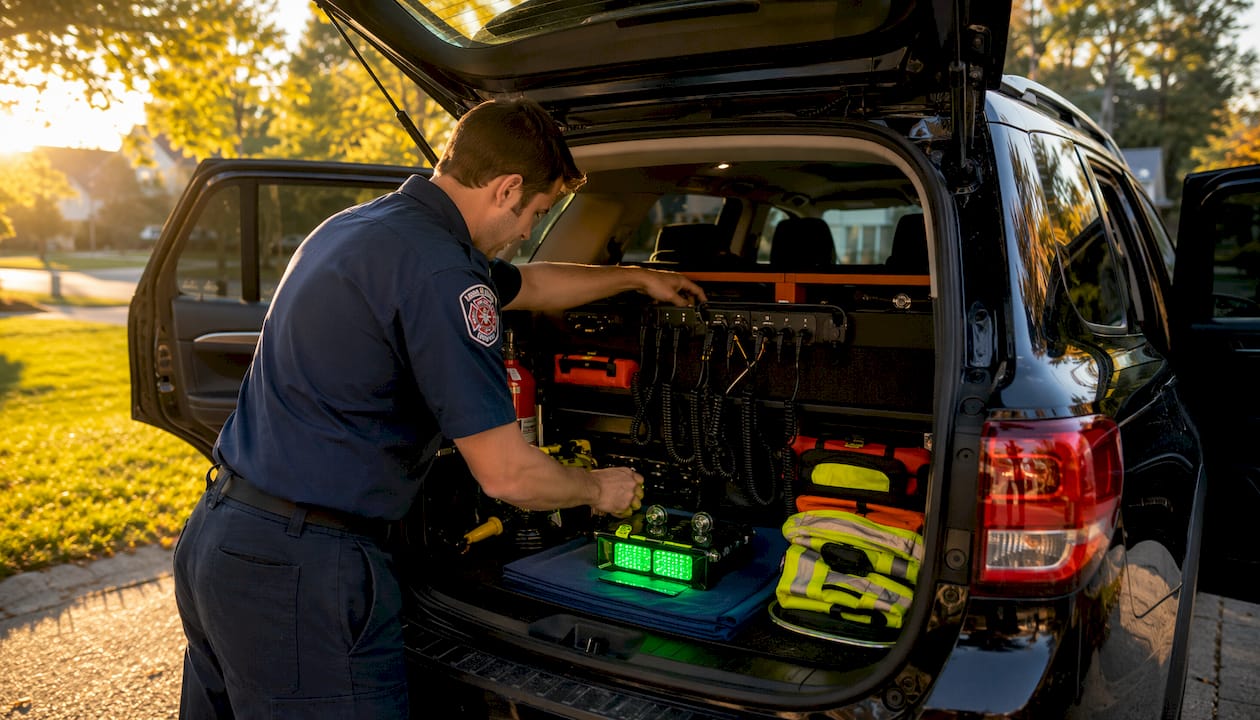
The most common integration challenge is switch placement. Your green courtesy light needs a switch that is easy to reach while driving but impossible to activate accidentally. A dedicated rocker switch mounted on the dash or centre console, clearly labelled, is the standard approach. Avoid placing it adjacent to your radio or phone controls where a fumble in the dark could trigger the wrong device.
For firefighters who also carry portable radios or pagers, cable management matters. Routing power and signal cables cleanly through the vehicle prevents interference and keeps the cabin clear for safe driving. Many firefighters use a small wiring harness or cable tray to bundle accessory cables together, which also makes it easier to inspect connections during regular maintenance checks.
If your department issues a portable radio with a vehicle charger, that charger draws continuous current when the vehicle is running. Add the light’s draw on top, and you have a predictable, manageable load. The issue arises when multiple accessories are all drawing from the same fused circuit. Map your vehicle’s accessory circuits before adding any new equipment, and consult a licensed auto electrician if you are unsure about load capacity.
Finally, consider how your lighting system interacts with your vehicle’s existing lighting. Some LED warning lights can cause interference with CAN-bus electrical systems in newer vehicles, triggering false error codes. Products designed specifically for modern vehicle integration, like those in the Strobe My Ride green light range, are built with this in mind. When in doubt, ask the supplier directly about compatibility with your vehicle’s make, model, and year before purchasing.
Get the right light from Canada’s green light specialists
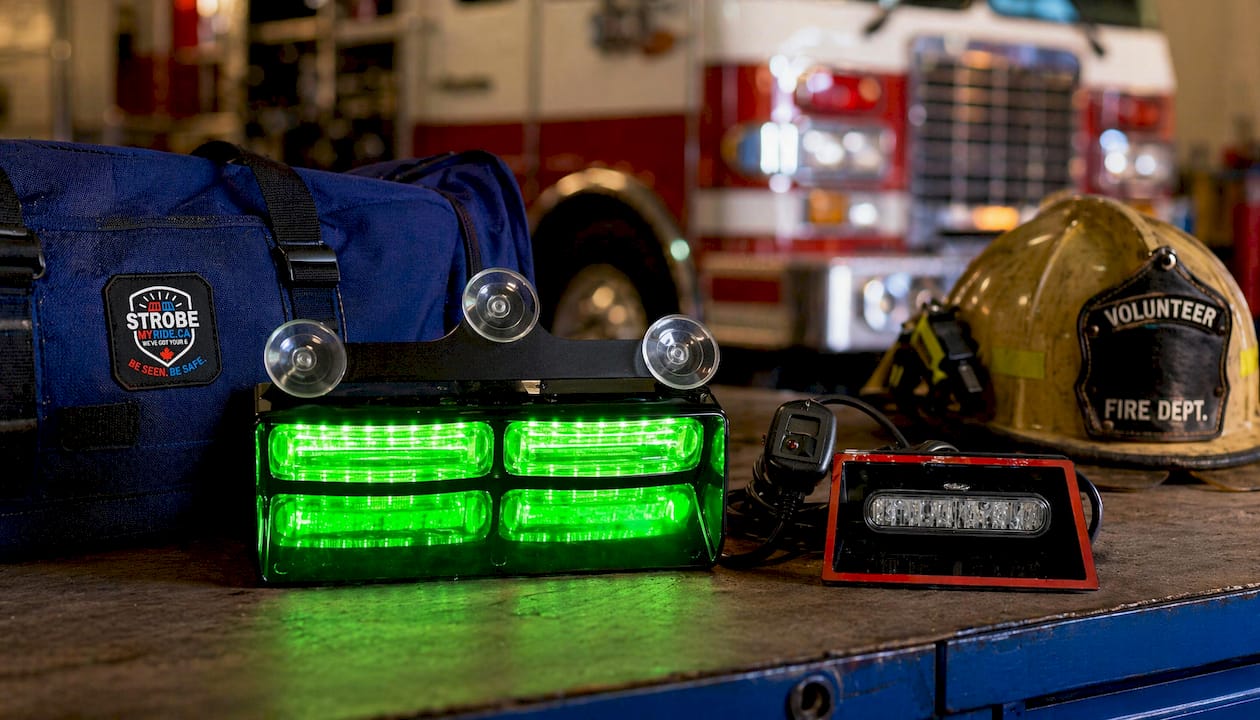
Strobe My Ride is Canada’s go-to source for green volunteer fire lights, with a product range built specifically around the legal and technical requirements Canadian firefighters face. The Fire Dash Mini Responder is a compact, purpose-built green dash light designed for inside-windshield mounting, making it a natural fit for Québec’s regulatory requirements and similar provincial standards. For firefighters who want dual-zone output, the Fire Dash dual LED dash light delivers two independent LED zones in a single low-profile unit.
Every product ships fast from Canada, comes backed by industry-leading warranty coverage, and is supported by a team that understands the specific compliance questions volunteer firefighters deal with. If you are not sure which light fits your province’s rules or your vehicle, contact Strobe My Ride directly before you buy.
Key takeaways
Canadian volunteer firefighters must choose green courtesy lights that comply with their province’s specific legislation, carry proper authorization, and use lights only during active emergency response.
| Point | Details |
|---|---|
| Green lights are courtesy signals | They request driver courtesy but do not grant emergency vehicle status or exempt firefighters from traffic laws. |
| Provincial laws vary significantly | Québec and Ontario have detailed frameworks; other provinces require direct verification with local authorities before purchase. |
| Québec requires SAE J845 or J595 compliance | The light must be LED and be installed inside the windshield within the wiper sweep area. |
| Authorization certificates must be carried | Firefighters must have their certificate with them every time the green light is activated, regardless of which vehicle they are driving. |
| Strobe My Ride supplies compliant options | Products like the Fire Dash Mini Responder are designed for the inside-windshield application Canadian regulations require. |
Recommended
- Volunteer Firefighter Green Lights Canada | Laws, Mounting & Lights – Strobe My Ride
- Green Lights for Volunteer Firefighters | Canada – Strobe My Ride
- Volunteer Firefighter Green Lights Canada | Strobe My Ride – Strobe My Ride
- Volunteer Fire Fighter Green Lights Explained | Strobe My Ride – Strobe My Ride


