


Yes, vehicle strobes and warning lights can drain a battery when they run without adequate charging support or when the install itself creates a parasitic draw. If you suspect a drain right now, switch off every nonessential light and, if you still need visibility, connect an auxiliary power source or a battery maintainer while you sort out the cause.
TL;DR:
- Using multiple lights on a single circuit can overload fuses, cause dimming, or soften wiring insulation due to sustained overcurrent.
- Connecting relay triggers to constant 12V instead of ignition-switched power results in continuous battery drain even with the vehicle off.
- Cold temperatures significantly reduce battery capacity, cutting run-time by nearly half at −30°C compared to room temperature conditions.
- Proper installation includes dedicated fused circuits, switched trigger wiring, and vehicle-aware controllers to prevent parasitic battery drain.
- Testing for drain requires waiting 30 to 60 minutes after shutdown to allow onboard modules to enter sleep mode and avoid false high readings.
What causes battery drain from strobes
The LED itself is rarely the real problem. A single strobe head typically draws a modest current, but the components wrapped around it, drivers, remote controllers, and relay coils, add load that never shows up on the spec sheet.
Peak current matters as much as average current. LED strobes flash in bursts, and each flash pulls a short spike well above the resting draw. Wiring and alternator capacity are sized for sustained loads, so a wiring run that looks fine on paper can still heat up or trip a fuse under repeated peaks, especially when several lights share one circuit.
Standby draw is the quieter threat. A poorly designed controller can leave its internal logic energized even after you flip the switch off, and that phantom load keeps pulling from the battery around the clock. According to research from Battery Tender, aftermarket LED installs can prevent vehicle modules from entering sleep mode, producing a drain larger than the light’s rated current would suggest.
Three things determine how much current a strobe setup actually pulls from your battery:
- The number and type of LED heads wired into the circuit
- Whether the controller or module fully powers down when switched off
- How the relay coil and trigger wire are sourced (switched versus constant 12V)
Understanding peak versus average draw helps explain why two lights with similar advertised current ratings can behave very differently once installed.
Typical strobe power consumption and run-time math
Amp draws vary a lot by light type, and the numbers below are illustrative examples for run-time planning, not specifications for any particular product. A small beacon might draw somewhere in the range of half an amp to a couple of amps. A mini light bar often lands higher, and a full-size bar with multiple modules can pull several amps under load, particularly during full-pattern flash sequences.
Quick math: a 50Ah battery powering a 2A continuous draw could theoretically supply that load for roughly 25 hours if the battery were drained to zero, which you should never actually do. A 60Ah battery under the same 2A draw stretches that to about 30 hours.
- 50Ah battery, 2A draw: approximately 25 hours to full discharge, roughly half that to a safe 50% limit
- 60Ah battery, 2A draw: approximately 30 hours to full discharge, roughly half that to a safe 50% limit
- Higher draws (4 to 6A) cut those windows to a fraction of the above
Cold weather shrinks that math further. Battery capacity drops by roughly 20% at 0°C and by about 50% at −30°C, according to DiscoverBattery’s technical research. That means a run-time calculation done at room temperature can be cut nearly in half on a cold prairie or northern jobsite, which matters enormously for anyone relying on lighting during an overnight roadside stop. Our guide to winter lighting selection covers how cold affects both battery behaviour and LED output.
Common installation mistakes that cause battery drain
Most drain complaints trace back to one of a handful of wiring habits, not a defective light. Here’s what to check first, roughly in order of how often we see them:
- Daisy-chaining multiple lights on one circuit. Running several heads off a single tapped wire overloads that circuit’s fuse rating and creates uneven voltage across the string. Symptoms include a fuse that trips repeatedly, visible dimming when other accessories switch on, or in worse cases, insulation that softens or melts from sustained overcurrent.
- Wiring a relay trigger to constant 12V instead of an ignition-switched source. This is a quiet mistake because everything works fine while you’re driving. The relay coil, however, stays energized even with the key out, pulling a small but continuous current that adds up over a parked weekend.
- Skipping a dedicated fused circuit. Piggybacking off an existing interior circuit means your lighting load now shares protection designed for something else entirely, masking the true draw until the accessory it was meant for also fails.
If you’re testing for a suspected parasitic draw after any of these fixes, Battery Tender’s diagnostic guidance recommends waiting 30 to 60 minutes after shutting off the ignition. Modern vehicle modules take time to fall asleep, and testing too soon gives you a falsely high reading that points you at the wrong wire.
Preventing battery drain from strobe lighting
The fix for most drain problems is decided at install time, not afterward. A few deliberate choices up front save hours of diagnostic work later.
- Run a dedicated fused circuit sized for the actual load of your lighting setup, separate from interior accessory circuits.
- Trigger relays from an ignition-switched (ACC or IGN) source rather than a constant 12V tap, or use an Add-a-Circuit fuse tap wired correctly to a switched position.
- Choose vehicle-aware or CAN-bus controllers where your fleet’s electrical architecture supports them, since these are less prone to leaving a phantom load behind.
- Fit a low-voltage disconnect or battery maintainer on vehicles that sit for extended periods, particularly seasonal equipment or spare fleet units.
- Schedule routine battery and charging-system checks, and consider an auxiliary battery or alternator upgrade for vehicles running lighting for extended stationary periods.
Planned load calculations and dedicated circuits are consistently the difference between a fleet that never sees a dead battery and one that calls a tow truck every winter, according to OCM Upfitting’s failure-prevention research.
Pro Tip: If your fleet parks vehicles for more than a few days at a stretch, a maintainer costs far less than a service call, and it keeps the battery at full capacity so cold-weather run-time math actually holds up.
For vehicles that need backup power independent of the main battery, it’s worth reviewing how to choose the right backup power source before committing to a single-battery setup.
Troubleshooting steps for suspected strobe drain
Work through this in order rather than jumping to conclusions about which component is at fault:
- Triage first. Turn off every light and accessory, then try to start the vehicle. If it’s dead, jump it and get the engine running before doing anything else.
- Check resting voltage after the vehicle has sat undisturbed for at least 12 hours. A healthy resting battery typically sits well above 12V; a reading noticeably lower points to a drain worth chasing.
- Pull the lighting circuit’s fuse and see if the drain stops. This single step isolates whether the lighting harness is the culprit or whether the issue lives elsewhere in the vehicle’s electronics.
- Run a proper parasitic draw test with a multimeter, but only after waiting 30 to 60 minutes for onboard modules to enter sleep. Testing too early, as UTI’s automotive program notes, gives a falsely high reading and sends you chasing the wrong wire. Inspect grounds and the relay trigger connection while you’re in there.
Continuous standby draws of tens of milliamps from a controller can quietly drain a battery over several days, while larger phantom loads from vehicle modules can deplete a battery in less than a couple of days.
Strobe My Ride’s technical resources for Canadian installers
Strobe My Ride is a Canadian-owned supplier of LED warning lights, work lights, and vehicle-lighting accessories, stocked in Ottawa and shipped to fleets across the country. Beyond product selection, we maintain technical resources built specifically for the wiring and load questions this article covers, including a practical strobe wiring guide, a breakdown of peak versus average amperage, and winter lighting selection guidance for fleets operating in cold climates. These guides go deeper into the specific wiring diagrams and controller setups referenced above.

Ready to run lighting without the drain worries
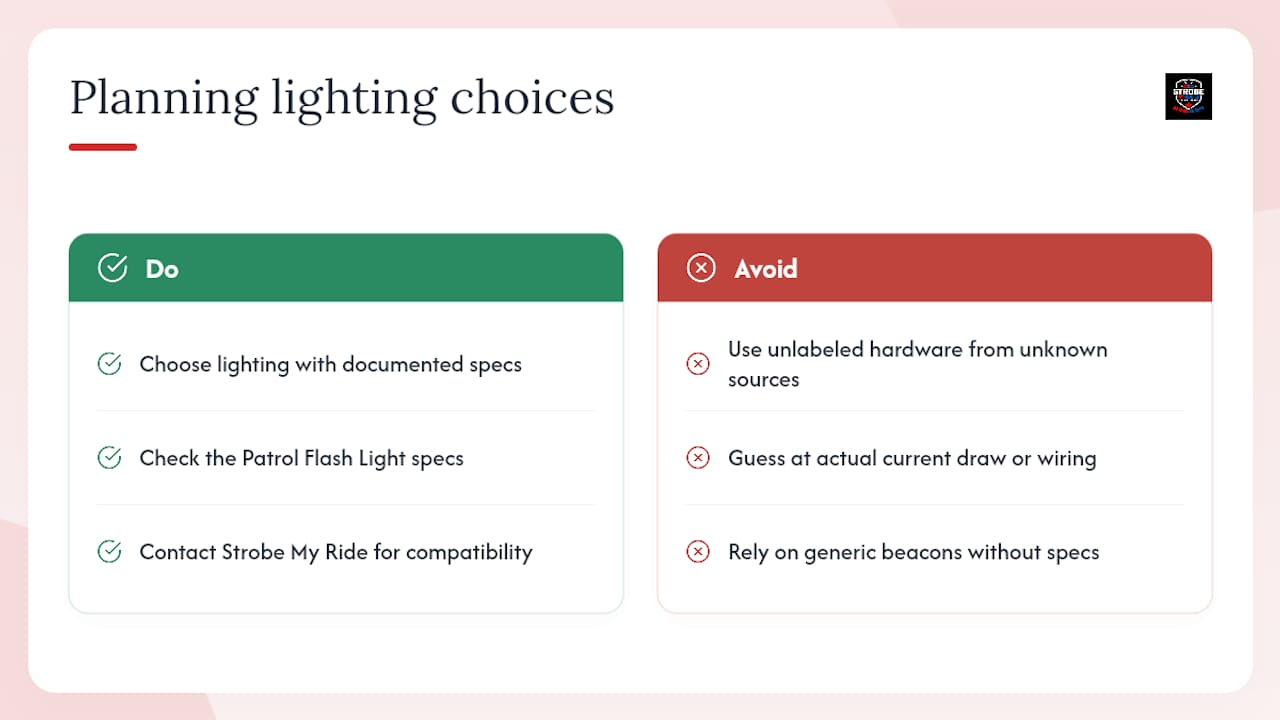
There are other ways to add visibility to a vehicle, from generic hardware-store beacons to whatever a local shop happens to have wired in already, but neither route gives you a clear answer on actual current draw or how a light behaves once winter hits. Strobe My Ride sells lighting with documented specifications you can actually plan a circuit around, which is the single biggest advantage over guessing at an unlabelled unit from an unknown source. If you need a dependable handheld option for roadside signalling or scene work, check the Patrol Flash Light product page for its full specifications. For fleet-specific questions, including how a proposed lighting setup fits your vehicle’s existing electrical plan, contact Strobe My Ride directly and we’ll work through the compatibility questions with you before you commit to a wiring layout.


