


For close task lighting on a tow rig or plow truck, look at lights in a moderate lumen range with a flood or combo beam. For broader worksite or roadside scenes, choose higher output lights with a wide flood pattern. Beam pattern and mounting position decide how much of that output actually reaches the ground, so treat lumens as a starting filter, not the final answer. You can consult with the supplier to review SKU-level specs once you know which band fits your task.
TL;DR:
- Lumen ranges correspond to different task requirements, from low to moderate lumens for close work to tens of thousands for large scene lighting.
- Beam patterns—spot, flood, and combo—significantly impact how much useful light reaches your worksite, regardless of lumen ratings.
- Mounting position and angle influence the effectiveness of the light, especially for flood beams, to reduce glare and maximize ground illumination.
- Comparing lux at a set distance and viewing beam pattern charts offers a more accurate picture of actual scene illumination than lumen counts alone.
- Higher lumen fixtures demand more electrical power and require careful aim to avoid glare and overspending on unnecessary output.
What work light lumens actually measure
Lumens measure total light output from a fixture, in every direction the optics allow. They tell you nothing about where that light lands, how far it throws, or how evenly it spreads across a work area. That distinction matters more than most spec sheets let on, because two lights rated at the same lumen figure can produce very different results on the ground depending on their reflectors, lenses, and beam angle.
This is also where the terminology gets muddy. “Work light” and “scene light” get used interchangeably in a lot of marketing copy, but they describe different jobs.
- Work lights illuminate a small, defined area, typically a few hundred square feet or less, for someone performing a task close to the vehicle, such as hooking up a tow chain or checking a hitch.
- Scene lights are built to flood a much larger area, often measured in the thousands of square feet, for tasks like a multi-lane recovery or a construction site perimeter, according to Ventry Solutions.
A widely used rule of thumb puts the boundary at a certain lumen level: fixtures below that tend to behave like task or work lights, while fixtures above it start to function as true scene lighting, per the same Ventry Solutions explainer. That threshold is not a hard rule. A narrow spot beam at 8,000 lumens can throw farther and brighter at a single point than a wide flood rated at 12,000 lumens, because beam angle concentrates or spreads that output differently. Lumens set the ceiling on total output. Optics decide how much of it you actually see where you need it.
For a fleet buyer, that means starting with the job (hookup work, perimeter lighting, search and recovery) before you start comparing lumen numbers between products. Strobe My Ride’s guide on utility truck lighting covers how output requirements shift across common vocational applications if you want a broader starting point.
How beam pattern and mounting change what lumens deliver
Three beam types cover most vehicle-mounted applications, and each one converts raw lumens into usable light differently.
- Spot beams concentrate light into a narrow, focused cone. They throw farther and stay brighter at distance, which suits search operations, long approach lanes, or lighting a specific point well away from the vehicle.
- Flood beams spread light across a wide horizontal and vertical angle. They cover more ground close to the vehicle but lose intensity faster with distance, making them the right call for near-field task work and site perimeters.
- Combo beams blend both patterns into one fixture, often by splitting the lens or reflector into near-field and far-field zones. Buyer guidance consistently points to combo configurations as the most versatile option for vehicles that need both close-area coverage and some throw, according to gtr lighting’s buyer’s guide.
Mounting location adds another variable. A brow-mounted light aims down and out, useful for illuminating the ground directly around a cab. Side-mounted units light the flank of the vehicle where crews actually stand. Pole and surface mounts on scene lights raise the fixture higher for wider ground coverage, which is part of why some high-output scene lights are engineered with multiple mount options built into the same product line, per Firehouse’s coverage of apparatus lighting.
Pro Tip: Angle any flood-pattern light so the brightest part of the beam lands on the work surface, not at eye level for oncoming traffic or crew members. A light aimed too flat throws glare back at your own operators long before it improves visibility.
Lumen bands that map to real fleet tasks
Once you know the job, the lumen band gets a lot easier to pick. These ranges reflect common fixture categories, not a certification standard, so treat them as a starting filter for your product search.
- Lower to moderate lumen flood or combo beam lights are suited for close task lighting such as hookups, hitch work, tire changes, and cab-adjacent tasks.
- Mid-range lumen combo beams work well for mixed work and drive-adjacent lighting like plow routes, utility calls, and roadside jobs needing near-field visibility and some throw.
- Higher lumen wide flood lights provide broad scene lighting for construction perimeters, multi-vehicle recovery scenes, or municipal worksites where several crew members need coverage.
- Very high-output scene lighting fixtures can reach outputs such as tens of thousands of lumens with wide horizontal and vertical spreads, designed for multiple mounting configurations, according to Firehouse.
A few trade-offs belong on your procurement checklist before you commit to a band. Higher lumen output draws more current, which matters on vehicles already carrying warning lights, radios, and other accessories on the same electrical system. Wider floods at high output also increase glare risk for oncoming traffic and nearby crew, so mounting height and aim angle need to scale with output, not stay fixed across your fleet. And a fixture rated at the top of a lumen band still needs a beam pattern that matches the task. Buying more lumens than your mounting position can usefully direct is a common way fleets overspend without gaining real illumination.
Reading a spec sheet: lumens, lux, and candela explained
Lumens, lux, and candela measure three different things, and mixing them up leads to bad comparisons between products.
- Lumens measure total light output from the fixture in every direction.
- Candela measures light intensity in a specific direction, which is what determines how far a beam throws before it fades.
- Lux measures illuminance, the amount of light actually landing on a surface at a given distance, measured in lumens per square metre.
Lumens tell you how much light a fixture produces. Lux tells you how much of it lands where you’re standing. Raw lumen counts on their own are not a reliable measure of usable light, and lux-at-distance figures paired with beam pattern charts predict what you’ll actually see on scene far better than a single lumen number, according to gtr lighting’s buyer’s guide.
Spec-sheet variability: Two fixtures with identical lumen ratings can produce meaningfully different lux at 10 metres depending on optics and beam angle, which is exactly why manufacturers that publish lux-at-distance figures give procurement teams a far more useful comparison than lumen-only listings, per the same buyer’s guide.
When you’re comparing spec sheets, look for:
- A lux figure at a stated distance (commonly 10 m or 50 m), not just a lumen total.
- A beam pattern chart or plot showing spread and intensity, not just a beam angle in degrees.
- IP rating, operating voltage, and mounting options, since these affect whether the fixture fits your vehicle and duty cycle.
Strobe My Ride breaks down how candela and lumens differ, and where to find the numbers that matter, in its guide to candela vs lumens.
Where Strobe My Ride fits into your lighting decision
There is a Canadian supplier stocking LED work and scene lighting in Ottawa and shipping across Canada, serving tow operators, snow and construction fleets, municipalities, and volunteer emergency services. This guide was contributed by KN, drawing on product specification research across Strobe My Ride’s catalog.
The lumen bands and beam guidance above map to specific product pages where you can check SKU-level detail before you buy:
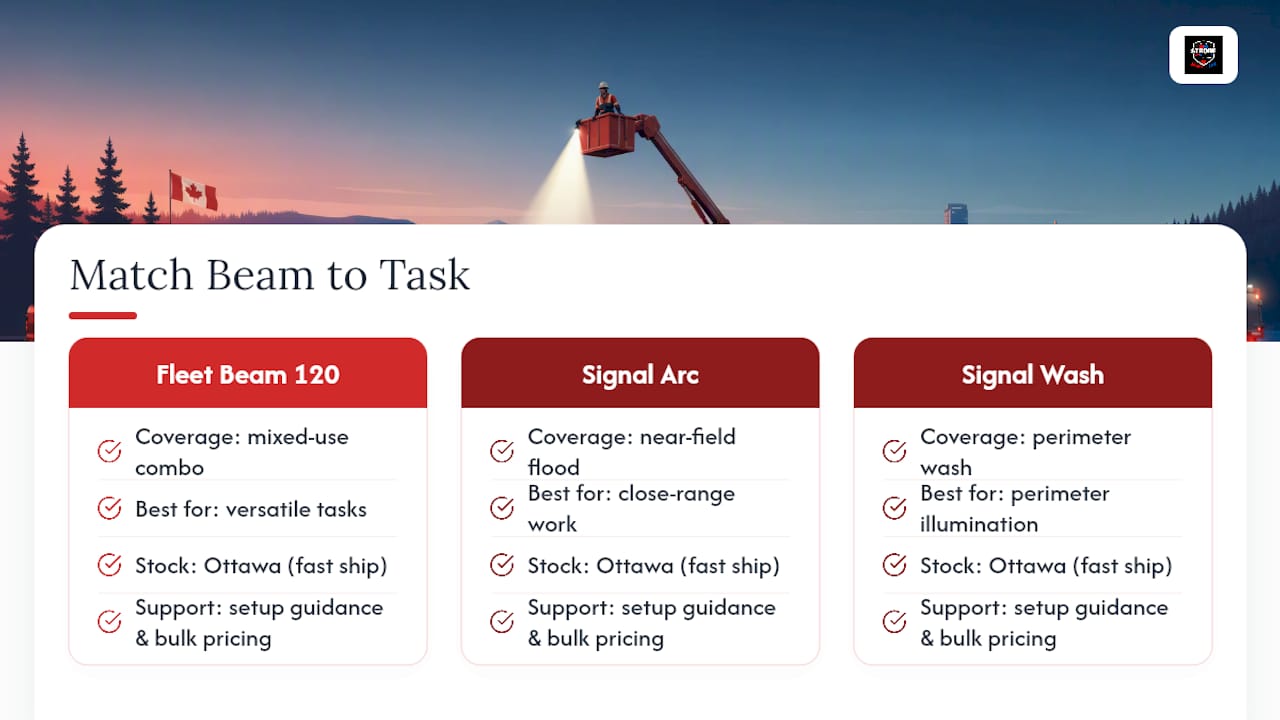
- Fleet Beam 120 is a combo-beam work light suited to the mixed work and drive-adjacent band, where crews need both close coverage and some throw.
- Signal Arc is a wide-angle work light aimed at near-field flood coverage, fitting close task lighting around the vehicle.
- Signal Wash is a flood-style work light built for worksite perimeter and close-area illumination.
None of these mappings substitute for the spec sheet itself. Check each product page for its own lux data, mounting options, and electrical requirements before you finalize a fleet order, and reach out to to Strobe My Ride directly if a spec you need isn’t listed.
Get the right output for your fleet, not just the highest number
One notable advantage for Canadian fleet buyers is access to stock in Ottawa with fast shipping, setup guidance from knowledgeable staff, and bulk pricing designed for commercial and municipal fleets buying in volume. If you’ve read this far, you already know your lumen band and beam pattern. The next step is matching that to real hardware.
Browse the Fleet Beam 120 for mixed-use combo lighting, the Signal Arc for near-field flood coverage, or the Signal Wash for perimeter work. If you’re not sure which fits your vehicle yet, Strobemyride lists the full SMR Patrol Line, SMR Fleet Line, and SMR Signal Line so you can compare specs side by side, or contact the team directly for setup help before you order.
Sources
For deeper technical context on the distinctions covered here, see Ventry Solutions on scene versus work lights, gtr lighting’s 2026 truck LED buyer’s guide, and Firehouse’s reporting on apparatus lighting decisions. Strobe My Ride’s own candela vs lumens guide and its article on vehicle scene lighting cover product-level detail this article doesn’t repeat.
- What is the difference between a scene light / site light and work light? – Ventry Solutions
- Truck LED Lights Buyer’s Guide 2026 – What the spec sheets don’t tell you - gtr lighting
- Apparatus Innovations: Lighting the decision | Firehouse
FAQ
How Many Lumens Do I Need for a Work Light?
Lower to moderate lumen flood or combo beam lights are suited for close task lighting such as hookups, hitch work, tire changes, and cab-adjacent tasks, while broader worksite or roadside scenes require higher output lights with a wide flood pattern.
What’s the Difference Between a Work Light and a Scene Light?
Work lights illuminate a small task area close to the vehicle, usually under 200 square feet, while scene lights flood much larger areas, often thousands of square feet, for multi-person or multi-vehicle situations, according to Ventry Solutions.
Do Higher Lumens Always Mean Better Illumination?
No. Beam angle and optics determine how much of a fixture’s total lumen output actually reaches the work area, so two lights with identical lumen ratings can produce very different results at the same distance.
What Should I Check on a Spec Sheet Besides the Lumen Rating?
Look for a lux figure at a stated distance, a beam pattern chart, IP rating, and voltage, since lux-at-distance data predicts usable illumination far better than a lumen number alone.
Is guidance offered on choosing the right lumen output?
Yes. Strobe My Ride stocks work and scene lights across several product lines and provides product pages with SKU-level specifications, and current pricing is available directly on Strobemyride.


