


For most Canadian construction and utility fleets, the shortlist comes down to three options from Strobe My Ride: the Signal Beacon-Lite 360 for budget-conscious procurement, the Fleet Beacon HD-Duo for heavy-duty plow and utility applications, and a DIN-ready tractor beacon for farm operations and driveway snow removal. Strobe My Ride carries some of the most inexpensive Class 1 SAE options available in Canada, ships nationwide, and provides product datasheets and warranty documentation at the point of purchase.
- Signal Beacon-Lite 360: A 360° amber beacon suited to municipal trucks, pilot cars, and light utility vehicles. Budget-leading price point with Class 1 SAE options and amber/white flash modes for added visibility in residential neighbourhoods.
- Fleet Beacon HD-Duo: A heavy-duty beacon built for snow plows, highway maintenance vehicles, and utility fleets running demanding seasonal schedules. Permanent or surface-mount options with multi-voltage wiring.
- DIN-ready tractor beacons: Designed for farm tractors and driveway snow removal equipment. DIN socket compatibility means plug-and-play installation without custom wiring, and amber/white flash combos meet visibility requirements in busy residential areas.
Strobe My Ride ships across Canada. Datasheets, photometric data where available, and warranty terms are accessible before you place an order.
Key takeaways
For Canadian construction and utility fleets, the most defensible procurement decision combines an SAE-documented beacon, a confirmed IP67 or better rating, and a supplier who provides datasheets, photometric reports, and a written Canadian warranty before the order is placed.
| Point | Details |
|---|---|
| Shortlist these products | Signal Beacon-Lite 360, Fleet Beacon HD-Duo, and DIN-ready tractor beacons cover most Canadian fleet applications. |
| Verify SAE and provincial compliance | Request SAE J845/J595 documentation and check provincial permit requirements for every jurisdiction your fleet operates in. |
| Prioritise IP and cold-temp ratings | Specify IP67 minimum and confirm the operating temperature range reaches at least -40°C for northern and prairie operations. |
| Get datasheets and warranty in writing | A supplier who cannot produce a photometric report and written warranty at the RFQ stage is a procurement risk. |
| Strobe My Ride for Canadian fleets | Strobe My Ride supplies inexpensive Class 1 SAE beacons, DIN-ready tractor options, and amber/white flash combos with fast Canadian shipping and fleet support. |
Table of Contents
- What types of construction beacons are available in Canada?
- How do you choose the right beacon for a construction or utility fleet?
- What Canadian standards and permits apply to construction beacons?
- Strobe My Ride beacons recommended for Canadian construction fleets
- Installation and upfit checklist for fleet technicians
- Keeping beacons working through Canadian winters and heavy use
- Strobe My Ride: Canadian beacon supply for professional fleets
- Sources
What types of construction beacons are available in Canada?
Matching the right beacon type to the vehicle and task is the fastest way to narrow a procurement list. The categories below cover the full range you will encounter when specifying construction warning lights for Canadian fleets.
- High-profile rotating or omni-directional beacons: Tall dome beacons that project amber light through 360° at long range. Best for highway maintenance vehicles, pilot cars, and oversize load escorts where visibility from several hundred metres is required. SAE J845 Class 1 ratings apply to the highest-output units in this category.
- Low-profile beacons and light bars: Flatter housings that suit municipal trucks, urban utility vehicles, and any application where roof clearance or aesthetics matter. Visibility is still strong at typical urban work-zone distances.
- Magnetic and portable beacons: Quick-attach units for rental equipment, maintenance vehicles, or any truck that rotates between beacon and non-beacon duty. Practical for temporary use, but speed limits, wind, and theft risk are real constraints. Magnetic mounts are not a substitute for permanent wiring on a dedicated fleet vehicle.
- Permanent surface-mount beacons: Bolted or flush-mounted units wired directly to the vehicle electrical system. The right choice for any vehicle used all season. Permanent wiring preserves IP integrity, qualifies for full warranty coverage, and eliminates the risk of a beacon separating at highway speed.
- DIN-ready and tractor-specific beacons: DIN socket compatibility is the key differentiator for farm tractors and driveway snow removal equipment. A DIN-ready beacon plugs directly into the tractor’s existing socket without custom wiring. Quebec’s regulation for farm machines and wide farm vehicles requires at least one amber beacon visible from 300 m, or two lateral flashing lamps, making a properly rated DIN beacon a practical compliance solution for agricultural operators. See the Légis Québec farm machine regulation for the specific mounting height and visibility requirements.
- Flash pattern and colour options: Amber-only is the standard for most construction and utility applications. Amber/white alternating flash patterns increase contrast and are particularly effective in busy residential neighbourhoods where drivers may be desensitised to single-colour warnings. Confirm that your province permits the white flash component for your vehicle class before specifying it.
How do you choose the right beacon for a construction or utility fleet?
Procurement for a multi-vehicle fleet is not the same as buying a single beacon. The checklist below gives you the specification criteria, vendor questions, and red flags to use at the RFQ stage.
Specification checklist
- Visibility output: Request candela ratings or photometric test reports. A beacon described only as “bright” or “high-output” without supporting data is not a compliant specification.
- SAE class and standards compliance: Identify the SAE J845 class required for your vehicle type and application. Class 1 is the highest output tier and is expected for highway maintenance and pilot car applications. Ask for the SAE J845 or J595 certification document, not just a marketing claim.
- IP rating and low-temperature performance: Canadian winters demand a minimum IP67 rating for any permanently mounted beacon. Confirm the operating temperature range covers at least down to -40°C, which is the standard for northern and prairie fleet operations.
- Voltage and wiring compatibility: Verify whether the beacon runs on 12V, 24V, or multi-voltage. Heavy trucks and some tractors run 24V systems. Mismatched voltage is the most common cause of premature LED failure.
- Mounting method: Match the mount to the vehicle. Magnetic for temporary use, surface or permanent bolt-mount for dedicated fleet vehicles, DIN socket for tractors.
- Flash modes and user controls: Confirm the number of available flash patterns and whether the controller is dash-mounted or integrated. Multiple patterns allow operators to match the flash to the work zone type.
- Warranty and datasheet availability: Require a written warranty with stated coverage terms before ordering. A supplier who cannot produce a datasheet at the RFQ stage is a procurement risk.
Questions to ask any beacon supplier
- Can you provide SAE J845 or J595 certification documentation for this specific product?
- Is there a photometric test report available, and does it cover the SAE class claimed?
- What is the stated IP rating, and has it been independently tested?
- What is the operating temperature range?
- What are the Canadian shipping lead times for bulk orders?
- What does the warranty cover, and what is the claims process?
Red flags to watch for
- Photometric claims with no supporting test data
- No SAE or CMVSS/TSD documentation available
- Warranty terms that exclude commercial or fleet use
- Products described only as “consumer-grade” with no commercial specification sheet
- No Canadian shipping or support contact
Pro Tip: Request a sample unit before committing to a fleet order. Install it on one vehicle for a full season and confirm IP integrity, flash pattern performance, and connector condition before scaling the purchase.
Beacon comparison dimensions
When evaluating options, use these columns to build your internal comparison matrix. Strobe My Ride’s LED beacons for work trucks guide covers these dimensions in detail.
| Dimension | What to specify |
|---|---|
| Best for (use case) | Plow, utility, pilot car, highway work, farm/snow removal |
| Mount type | Magnetic, permanent surface, flush, DIN socket |
| Voltage / wiring | 12V, 24V, or multi-voltage; fuse size |
| SAE class | Class 1, 2, or 3 per J845 |
| Ingress / durability | IP rating, operating temperature range, salt-spray resistance |
| Flash modes / patterns | Number of modes, amber-only vs. amber/white |
| Price / warranty / shipping | Unit cost, warranty length and scope, Canadian lead time |
What Canadian standards and permits apply to construction beacons?
This is the section most procurement teams underestimate. Beacon selection is not just a product decision. It is a compliance decision that varies by federal standard, provincial permit regime, and vehicle class.
Federal baseline: Transport Canada TSD and CMVSS
Transport Canada’s TSD for lighting (the technical standards document for CMVSS 108) sets photometric and mounting-location requirements by vehicle type. Sections S6 and S9 cover required lamps, conspicuity systems, and signal lamp construction criteria. For larger commercial vehicles, these requirements directly affect which auxiliary lamps and beacons are permissible. The Motor Vehicle Safety Regulations are the federal legislative baseline; the TSD is the technical companion document that procurement and compliance officers should read together.
Transport Canada also publishes federal lighting equipment location requirements for trucks, buses, and MPVs, which specifies where lamps and reflectors must be mounted by vehicle type. This matters when you are specifying beacon placement on a new upfit.
SAE J845 and provincial expectations
SAE J845 is the recommended practice covering optical warning devices for emergency, maintenance, and service vehicles. It defines performance classes, test procedures, and photometric requirements for omnidirectional and selective-coverage devices. Procurement teams increasingly ask for SAE J845 and J595 documentation, and some provincial jurisdictions now treat SAE certification as an expected part of a compliance package. Non-compliant equipment can create fines or insurance complications, particularly in Quebec and British Columbia.
British Columbia: flashing amber permits
BC’s CVSE administers a flashing amber permit programme. The BC CVSE flashing amber permit and device information document lists the vehicle types that will and will not be considered for permits, and specifies what a Policy of Vehicle Use must contain for applicable applications. Not every construction vehicle qualifies automatically.
The BC amber flashing lamp reference guide defines device types, including 360-degree warning devices and directional arrow boards, and sets device limits. For traffic control vehicles, the guide specifies a maximum of two devices per vehicle with a permit. These limits affect how many beacons you can legally mount, which has direct implications for fleet upfit specifications.
Pro Tip: Never apply one province’s permit rules across your entire Canadian fleet. A beacon configuration that is permitted in BC may require a different permit class or additional documentation in Alberta, Ontario, or Quebec. Verify with the provincial CVSE or Ministry of Transportation for each jurisdiction where your vehicles operate.
Quebec: numeric requirements for special permits
Quebec’s Regulation respecting special permits (C-24.2, r. 35) specifies amber beacon flash rates and minimum lens sizes and visibility distances for vehicles operating under special permits, including oversized loads and escort vehicles. These are concrete, verifiable numbers that procurement can use as a specification checklist when buying beacons for Quebec operations.
Practical compliance steps
- Identify the GVWR class of each vehicle in your fleet.
- Check the Transport Canada TSD tables for required and permissible lamps by vehicle type.
- Consult the provincial CVSE or Ministry of Transportation permit pages for each province where your vehicles operate.
- Request SAE J845/J595 documentation from your supplier at the RFQ stage.
- Contact the local permitting body or enforcement office if your vehicle class or use case is not clearly covered by published guidance.
- Classify every claim in your spec sheet as law, regulation, ministry guidance, or recommendation. Do not conflate them.
For a plain-language overview of amber warning light legality across Canadian provinces, Strobe My Ride’s compliance blog is a useful starting point before you go to primary sources.
Strobe My Ride beacons recommended for Canadian construction fleets
The two primary SKUs below cover the majority of Canadian construction and utility fleet applications. Both are available with datasheets and warranty documentation, and Strobe My Ride ships across Canada.
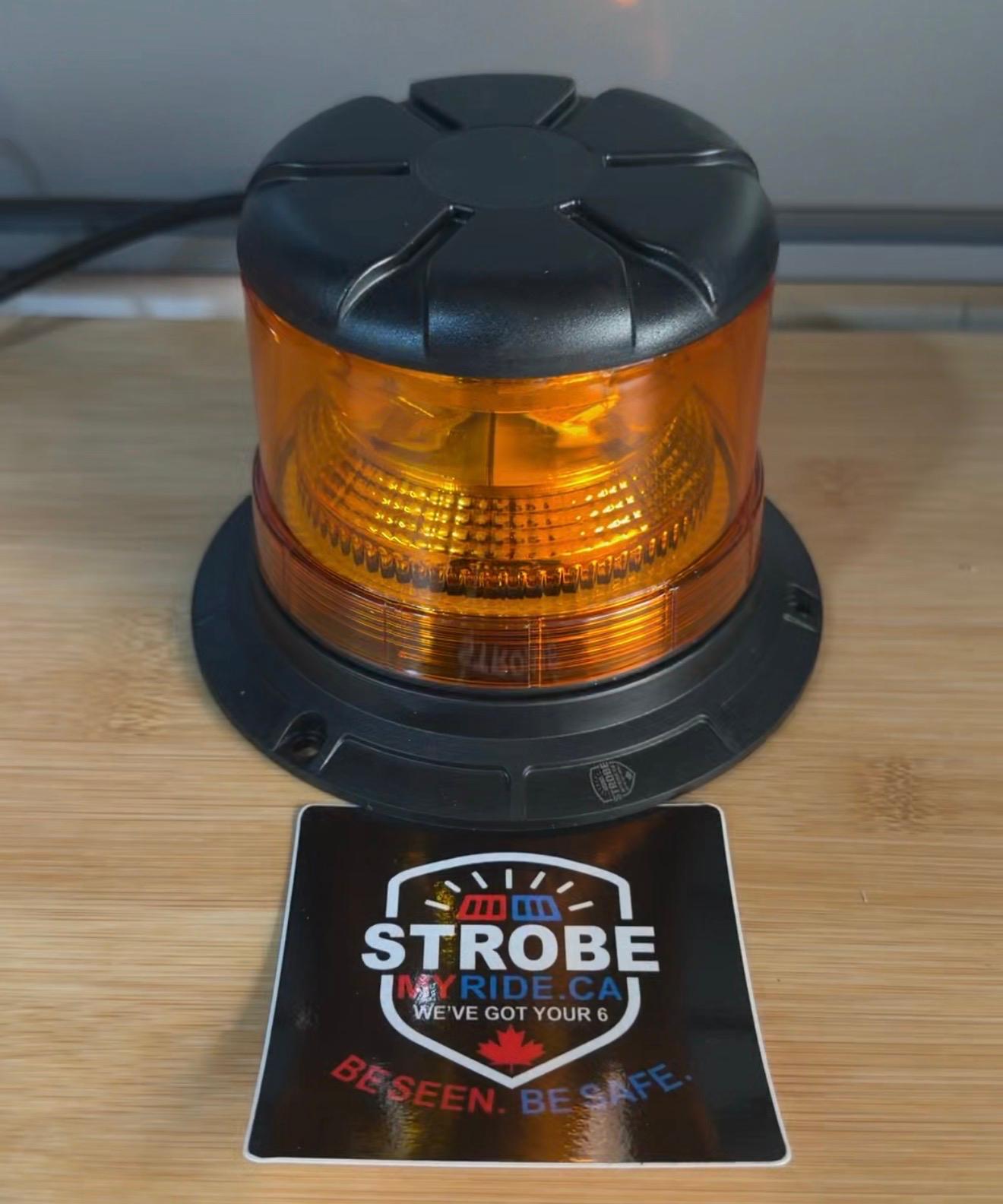
Signal Beacon-Lite 360
The Signal Beacon-Lite 360 is a 360° amber LED beacon positioned as one of the most inexpensive Class 1 SAE options in Canada. It suits pilot cars, municipal utility trucks, light construction vehicles, and any application where budget discipline matters without sacrificing compliance. The amber/white flash mode option makes it a practical choice for operations in residential neighbourhoods where contrast between flash colours improves driver response. Lightweight and compact, it works well as a first beacon on a vehicle being upfitted for the first time.
Fleet Beacon HD-Duo
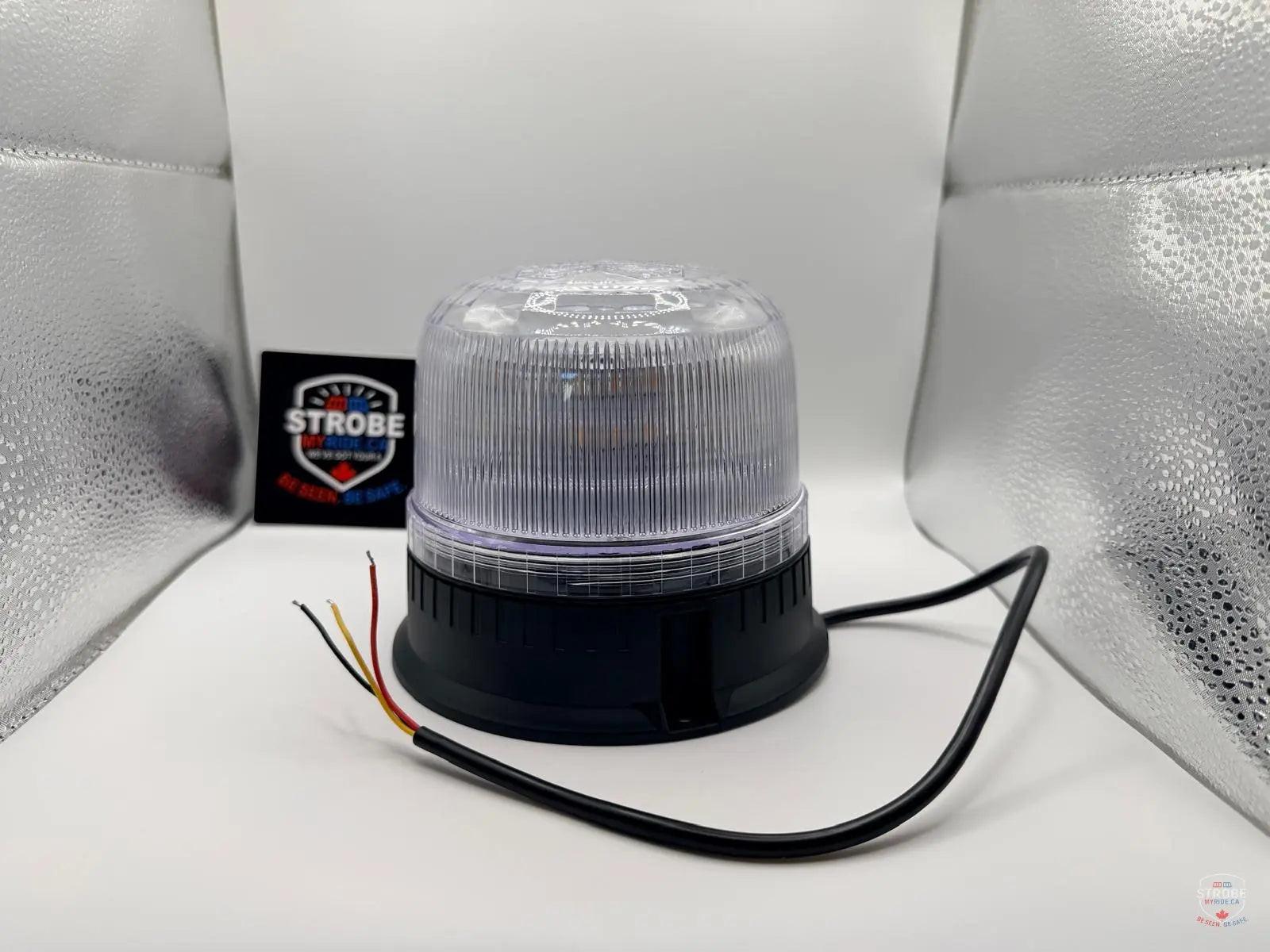
The Fleet Beacon HD-Duo is built for the demands of snow plows, highway maintenance trucks, and utility fleet vehicles that run through full Canadian winters. Heavy-duty construction, multi-voltage compatibility, and permanent surface-mount options make it the right call when the vehicle is in service all season and downtime is not acceptable. Procurement teams specifying for a plow fleet or a highway work crew should start here.
DIN-ready tractor beacons
For farm tractors and driveway snow removal equipment, DIN socket compatibility is the specification that matters most. A DIN-ready beacon from Strobe My Ride plugs directly into the tractor’s existing socket, eliminating custom wiring and reducing installation time. Amber/white flash options meet visibility requirements for residential snow removal routes. Quebec’s farm machine regulation requires a beacon visible from 300 m for wide farm vehicles, so confirm the photometric rating before specifying.
Specs comparison
| Spec dimension | Signal Beacon-Lite 360 | Fleet Beacon HD-Duo |
|---|---|---|
| Best for | Pilot car, municipal, light utility | Plow, highway maintenance, utility fleet |
| Mount type | Surface / magnetic options | Permanent surface mount |
| Voltage / wiring | 12V / multi-voltage | 12V / 24V multi-voltage |
| SAE class | Class 1 option available | Class 1 |
| IP rating / temperature | IP67, rated for Canadian winter temps | IP67, heavy-duty cold-weather rated |
| Flash modes | Amber-only and amber/white | Multiple patterns including amber/white |
| Warranty / shipping | Canadian warranty; ships across Canada | Canadian warranty; ships across Canada |
Pro Tip: At the RFQ stage, request the photometric test report alongside the datasheet for any beacon you are specifying for a highway or pilot car application. A candela figure without a test report is a marketing claim, not a compliance document.
Datasheets, warranty terms, and technical support are available directly through Strobe My Ride. For bulk orders, contact the team to confirm lead times and ask about fleet pricing. The full beacons collection lists current inventory and availability.
Installation and upfit checklist for fleet technicians
A beacon installed incorrectly loses its IP rating, voids its warranty, and can create an electrical fault. Work through this checklist before and during every installation.
Pre-installation checks
- Confirm the vehicle’s electrical system voltage (12V or 24V) and verify the beacon’s rated input matches.
- Check the OEM roof load rating and mounting point locations against Transport Canada’s federal lighting equipment location requirements for the vehicle type.
- Confirm the SAE class and photometric orientation requirements for the intended application and mount position.
- Review the provincial permit requirements for the jurisdiction where the vehicle will operate before drilling or wiring.
Installation steps
- Prepare the mounting surface: clean, degrease, and inspect for corrosion or structural weakness.
- Route cables through grommeted penetrations to protect insulation from chafing and moisture ingress.
- Size the fuse to the beacon’s rated current draw, not the circuit’s maximum capacity.
- Place the switch or controller within easy reach of the operator without obstructing sight lines.
- Ground the beacon to a clean, unpainted chassis point. A poor ground is the most common cause of intermittent flash faults.
- Apply manufacturer-recommended gaskets or sealants at all mounting penetrations to maintain the IP rating. Do not substitute with generic silicone unless the datasheet permits it.
- Verify the DIN socket wiring for tractor installations against the beacon’s wiring diagram before connecting.
- Reconnect the battery and test all flash modes before closing up the installation.
Safety and documentation
- Disconnect the battery before any wiring work. Follow your jurisdiction’s OH&S lockout/tagout procedures.
- Keep the datasheet, installation guide, and warranty documentation in the vehicle file. You will need them for any warranty claim and for permit inspections.
- Ask your supplier for torque specifications for mounting hardware and confirm the recommended flasher module for multi-pattern control before finalising the install.
Keeping beacons working through Canadian winters and heavy use
A beacon that fails in February on a highway work zone is a safety problem, not just a maintenance inconvenience. These routines keep your fleet’s warning lights reliable through salt, ice, and vibration.
Pre-season inspection routine
- Clean all lenses with a non-abrasive cleaner. Salt film and road grime reduce effective output more than most operators expect.
- Check mounting hardware for looseness. Vibration from gravel roads and plow operations works fasteners loose over a single season.
- Inspect wiring insulation at all routing points for cracking or chafing. Cold temperatures make insulation brittle, and a cracked jacket near a chassis edge will fail under vibration.
- Check all connectors for corrosion. Apply dielectric grease to exposed terminals before the season starts.
- Confirm controller and switch function across all flash modes.
Durability factors to monitor
- IP rating integrity: Any modification to the housing, cable entry, or mounting seal after installation can compromise the IP rating. Inspect seals annually and after any impact.
- Low-temperature LED performance: Confirm that the LEDs and adhesives in your beacon are rated for the lowest temperatures your fleet will encounter. Northern and prairie operations regularly see -40°C.
- Salt-spray resistance: Coastal and winter road operations expose beacons to chloride corrosion. Beacons with salt-spray resistant coatings on housing and hardware last significantly longer in these conditions.
- Vibration-rated mounts: Plow and gravel-road operations generate sustained vibration. Mounts that are not rated for this environment will crack or loosen.
Troubleshooting steps
- If the beacon stops flashing, check the fuse first, then the ground connection.
- Swap to a known-good flasher module to isolate whether the fault is in the beacon or the controller.
- Check voltage at the beacon connector under load. A voltage drop of more than 0.5V under load indicates a wiring or ground problem.
- If the fault persists after these steps, contact the manufacturer’s support line and have your purchase documentation and installation records ready. A warranty claim without installation records is difficult to process.
Register your products with Strobe My Ride after installation, retain installation photos, and keep supplier datasheets with the vehicle file. These three steps resolve the majority of warranty claim complications before they start.
Strobe My Ride: Canadian beacon supply for professional fleets
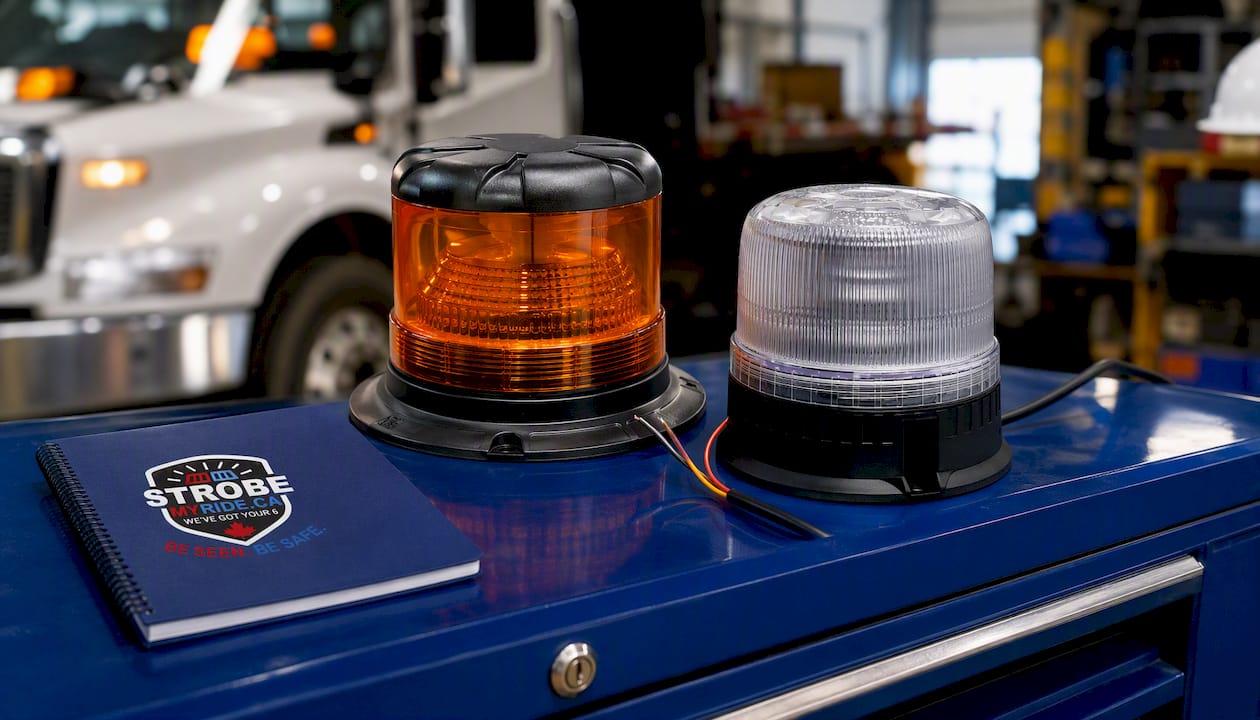
Strobe My Ride is a Canadian supplier built specifically for the fleets, contractors, and operators who need professional-grade warning lights without inflated pricing. The Signal Beacon-Lite 360 is one of the most inexpensive Class 1 SAE beacons available in Canada, and the Fleet Beacon HD-Duo is the heavy-duty answer for plow and highway maintenance fleets that cannot afford downtime. DIN-ready tractor beacons with amber/white flash capability round out the range for farm and residential snow removal operations.
Every product ships across Canada. Datasheets, photometric reports where available, and written warranty terms are accessible before you commit to an order. Fleet pricing, bulk lead times, and technical consultation are available on request. Contact Strobe My Ride directly to request a fleet quote, ask for compliance documentation, or get a recommendation matched to your specific vehicle class and provincial operating requirements.
Sources
Before finalising any beacon specification, share these primary sources with your compliance officer and verify the rules for your specific vehicle class and province.
- Flashing amber light permit and device information (BC CVSE)
- TSD — Lamps, reflective devices, and associated equipment (Transport Canada)
Provincial rules differ by vehicle class and use case. Never apply one province’s permit conditions across your entire Canadian fleet without verifying the applicable rules in each jurisdiction.
Recommended
- Warning beacon for Canadian fleets: 2026 buying guide | Strobe My Ride – Strobe My Ride
- Fleet Lighting Compliance Guide for Canada | Strobe My Ride – Strobe My Ride
- Portable traffic arrow guide for Canadian fleets | Strobe My Ride – Strobe My Ride
- Construction truck strobe lights: Canada-ready buying guide | Strobe My Ride – Strobe My Ride


