


For professional fleets and roadside operators, the Signal Flare 360 and Signal Arrow Rapid Deploy from Strobe My Ride are the strongest portable battery-powered beacons available with Canadian support, no-wires magnetic deployment, and the durability that Transport Canada and National Safety Code (NSC) compliance work demands.
- Signal Flare 360: Magnetic mount, 360° amber visibility, rechargeable Li-ion. Best for tow operators, construction crews, and roadside workers who need a self-contained beacon on any metal surface in seconds.
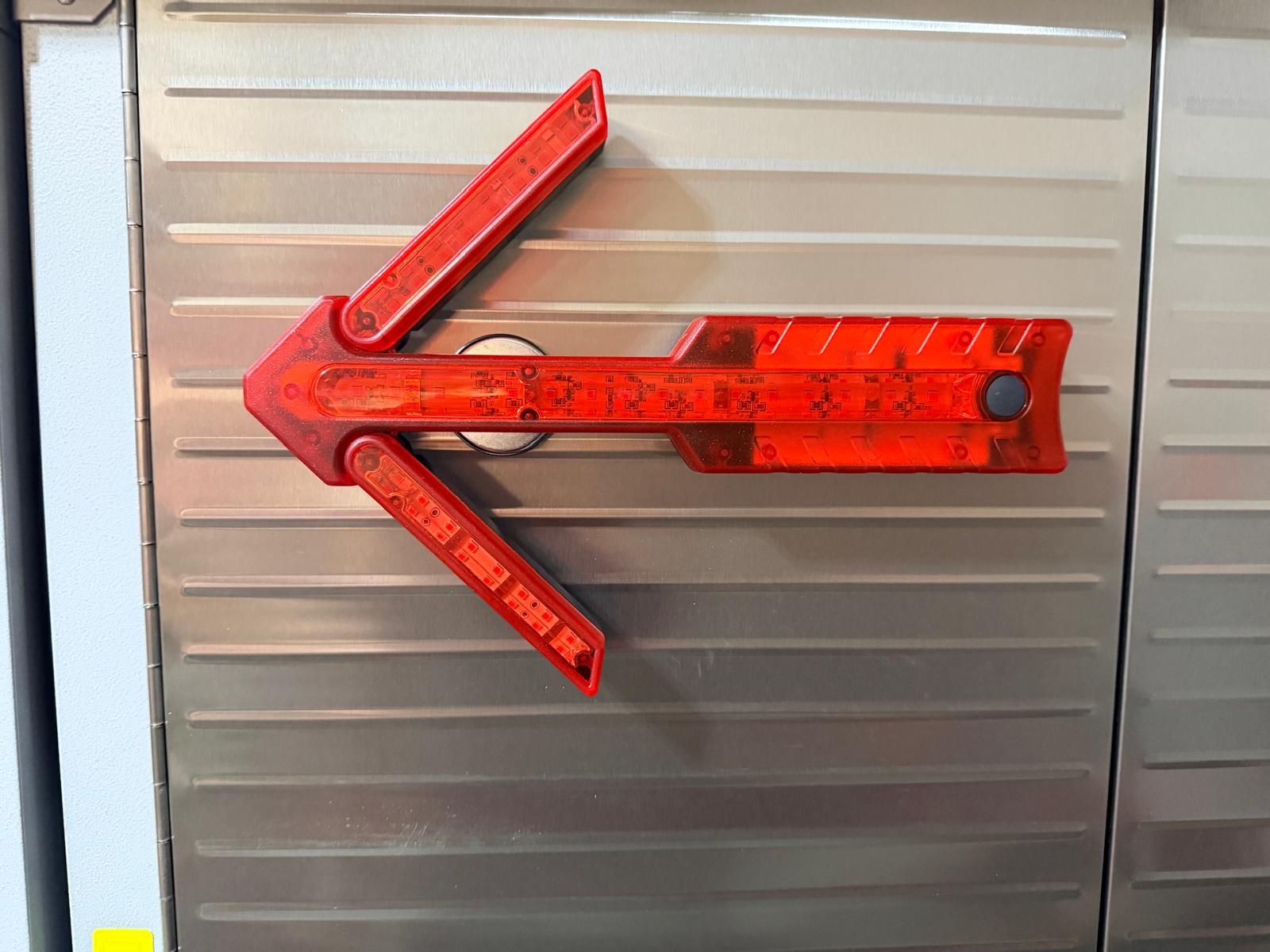
- Signal Arrow Rapid Deploy: Foldable LED directional arrow with magnetic attachment. Best for lane control, pilot cars, and any situation where you need to direct traffic around a hazard or work zone.
Both units deploy without wiring, which matters on a busy highway shoulder where every second counts.
Key takeaways
The most reliable portable battery powered beacons for professional fleets combine magnetic no-wires deployment, rechargeable Li-ion power, and provincial regulatory compliance verified before deployment.
| Point | Details |
|---|---|
| Match beacon to job | Signal Flare 360 for 360° roadside warning; Signal Arrow Rapid Deploy for directional lane control. |
| Verify provincial rules first | After-market warning lights are regulated provincially; confirm permitted colour, vehicle class, and authorisation before deploying on public roads. |
| Specify measurable criteria | Require candela rating, IP rating, magnet pull force, and SAE J845 documentation in every purchase order. |
| Manage batteries for cold climates | Use Li-ion rated for low-temperature discharge in winter; keep pre-warmed spares available for sub-zero shifts. |
| Strobe My Ride | Supplies the Signal Flare 360 and Signal Arrow Rapid Deploy with Canadian shipping, industry warranties, and technical support for fleet procurement. |
Table of Contents
- Which Strobe My Ride beacons meet professional procurement standards?
- What to check when choosing a battery powered beacon
- Which beacon type suits your job?
- Mounting, installation, and battery care for portable beacons
- What are the legal requirements for using beacons on public roads in Canada?
- What should you expect for warranty, shipping, and support in Canada?
- Strobe My Ride portable beacons: ready to order for your fleet
- Sources
Which Strobe My Ride beacons meet professional procurement standards?
The table below compares the two primary options across the dimensions fleet procurement teams use most.
| Criteria | Signal Flare 360 | Signal Arrow Rapid Deploy |
|---|---|---|
| Best for (use case) | 360° roadside warning, construction, tow trucks | Directional lane control, pilot/escort cars, work zones |
| Battery type | Rechargeable Li-ion | Rechargeable Li-ion |
| Mounting method | Magnetic (no wires) | Magnetic (no wires), foldable frame |
| IP / durability | Weatherproof construction | Weatherproof construction |
| Visibility | 360° amber, multiple flash patterns | Directional LED arrow, high-visibility amber |
| Rechargeable vs replaceable | Rechargeable | Rechargeable |
| Warranty / support | Industry warranty, Canadian shipping | Industry warranty, Canadian shipping |
Procurement notes by product:
- Signal Flare 360: The 360° coverage and magnetic base make it the default choice for any vehicle that stops on or near a travel lane. Construction workers on highway shoulders benefit most from the all-round visibility, since approaching traffic sees the beacon from every angle regardless of how the vehicle is oriented.
- Signal Arrow Rapid Deploy: The foldable arrow format solves a specific problem: telling drivers which lane to vacate. Attaching it to the rear of a tow truck or pilot car gives a clear directional cue that a standard round beacon cannot provide.
For heavy-weather or snow-plough work, the Signal Flare 360 is the recommended unit. Its sealed, weatherproof build and magnetic mount hold securely on plough decks and truck bodies in wet or icy conditions. See Strobe My Ride’s dedicated resource on snow plow beacon selection for cold-climate mounting specifics.
Rechargeable Li-ion units reduce per-unit running costs for high-frequency fleets compared to disposable alkaline cells, though cold-weather operations require a battery management protocol (covered in the maintenance section below). Canadian support and a clear warranty process are worth weighting heavily in procurement decisions: a beacon that fails on a night shift with no local support path is a liability, not a cost saving.
What to check when choosing a battery powered beacon
Procurement teams that specify measurable acceptance criteria in purchase orders avoid the most common buying mistake: accepting vendor marketing claims about “professional-grade” without test evidence. Specify these parameters in your RFQ.
Critical specifications checklist:
- Visibility distance and output: Request candela or lumen ratings. A beacon used on a 100 km/h highway needs to be visible well in advance of the hazard.
- 360° coverage: Confirm the unit provides true 360° amber output, not a wide-angle forward beam marketed as all-round.
- Flash patterns: Multiple patterns (steady, single-flash, double-flash, rotating simulation) give operators flexibility across different job types.
- SAE class: SAE J845 provides test procedures and performance requirements for single-colour, 360° warning devices. Fleets specifying professional-grade beacons should request conformance statements or test reports referencing J845 from any vendor.
- Battery chemistry: Rechargeable Li-ion suits high-use fleets. Disposable alkaline cells are a practical backup for extreme cold where Li-ion discharge rates drop.
- Runtime under realistic duty cycles: Manufacturer-stated runtime is typically measured at full brightness with continuous flash. Real-world duty cycles (intermittent use, partial charge) will differ. Ask for runtime at 50% and 100% brightness.
- Recharge time and method: USB-C or dedicated dock charging affects how quickly units cycle back into service on multi-shift operations.
- IP rating: An IP65 or higher rating confirms protection against dust ingress and water jets. Anything lower is a risk in Canadian weather.
- Cold-weather performance: Specify the minimum operating temperature. Li-ion cells lose capacity below -20°C; confirm the manufacturer’s rated low-temperature threshold.
- Magnet pull force: State a minimum pull force in kilograms or Newtons in your purchase order. A magnet that releases at highway speed is a road hazard.
- Weight and storage dimensions: Relevant for vehicles with limited storage, particularly tow trucks and pilot cars.
Questions to ask suppliers before purchase:
- Can you provide SAE J845 conformance documentation or third-party test reports?
- What is the warranty period and what does it cover (defects, battery degradation, physical damage)?
- Do you offer Canadian technical support and what is the typical response time?
- Can you provide field references from fleets operating in similar conditions?
- What is the process for warranty claims and unit replacement (RMA)?
Pro Tip: For fleet RFQs, copy the checklist above directly into your specification document and require vendors to respond line by line. Any vendor who cannot provide candela ratings, IP ratings, and magnet pull force in writing is not supplying professional-grade equipment.
The Strobe My Ride Canadian fleet beacon buying guide covers these criteria in the context of specific Canadian use cases and provincial requirements.
Which beacon type suits your job?
Matching the right portable beacon light to the job prevents both under-specification (a unit that isn’t bright or durable enough) and over-specification (paying for features a role never uses). Here is how common professional applications map to beacon features.
- Tow trucks and roadside assistance: Magnet strength and 360° visibility are the two non-negotiable specs. A tow operator working a breakdown on a highway shoulder needs a beacon that attaches instantly to any part of the truck body and stays there. Ontario’s commercial vehicle safety requirements explicitly list carrying portable warning lights for roadside work, so this is a compliance item, not just a best practice.
- Construction and work zones: Workers on highway shoulders need all-round amber visibility. The Signal Flare 360 deploys in seconds and provides the 360° coverage that approaching drivers need to see from any approach angle.
- Municipal snow ploughs: Cold-weather reliability and a mount that holds on wet, iced metal are the priorities. Rechargeable units need a battery management protocol for sub-zero shifts. Strobe My Ride’s snow plow beacon guide addresses this directly.
- Pilot and escort cars: Directional arrows are the defining feature here. The Signal Arrow Rapid Deploy attaches magnetically to the rear of the escort vehicle and gives following traffic a clear lane-change instruction that a round beacon cannot convey.
- Utility crews: Crews working at night or in low-visibility conditions benefit from multiple flash patterns. A beacon that can switch between a slow single-flash (low-speed road work) and a rapid double-flash (highway proximity) gives supervisors flexibility without carrying multiple units.
- Emergency services and scene lighting: Portable battery-operated signals supplement fixed vehicle lighting when units are deployed away from the vehicle, such as at a scene perimeter or a secondary hazard point.
When standardising a fleet, a single model reduces training time, spare-parts inventory, and charger compatibility issues. For most mixed fleets, the Signal Flare 360 covers the majority of roles, with the Signal Arrow Rapid Deploy added for any vehicle that performs lane-control or escort duties.
Pro Tip: Order one or two extra units per vehicle class as operational spares. A beacon in for charging or repair during a shift is a gap in your safety coverage. The cost of a spare unit is negligible compared to the liability of an unlit roadside stop.
Mounting, installation, and battery care for portable beacons
Proper mounting and battery maintenance are where professional-grade equipment either proves its value or fails. A beacon with excellent output ratings that falls off a truck at 90 km/h, or one that dies mid-shift because of a poor charging routine, is worse than no beacon at all.
Mounting best practices:
- Clean the mounting surface before attaching a magnetic base. Road grime, ice, and paint overspray all reduce effective pull force.
- Test magnet hold after every attachment, especially on painted or coated surfaces where pull force is lower than on bare steel.
- For vehicles where magnetic mounting is not suitable (aluminium bodies, fibreglass, or composite panels), use strap mounts or bolt-on brackets as alternatives.
- Position the beacon at the highest practical point on the vehicle to maximise visibility distance and avoid obstruction by cargo, toolboxes, or body panels.
- For the Signal Arrow Rapid Deploy, confirm the folded arrow locks securely before transport and that the deployed position is stable at road speed.
- Store units in a dedicated compartment rather than loose in a toolbox. Impact damage to the lens or housing degrades IP protection.
Battery care and total cost of ownership:
Fully depleting or leaving a unit on charge for extended periods accelerates cell degradation. For fleets operating year-round in sub-zero temperatures, specify Li-ion batteries rated for low-temperature discharge, or keep insulated storage pouches and pre-warmed spare units available for winter shifts. When Li-ion performance is unreliable in extreme cold, disposable alkaline cells in a backup unit provide a reliable alternative.
Total cost of ownership for rechargeable units is lower than for disposable-cell beacons in high-use applications. Calculate it as: purchase price plus expected battery replacement or cell cost over the unit’s service life, plus any repair costs. Rechargeable units eliminate per-shift cell costs entirely for most applications.
Pro Tip: Build a simple weekly check into your pre-trip inspection routine: confirm charge level, test one flash cycle, and inspect the lens and magnet surface. Five minutes per unit prevents the majority of field failures. For troubleshooting guidance specific to Canadian fleet conditions, Strobe My Ride’s vehicle lighting troubleshooting guide is a practical reference.
What are the legal requirements for using beacons on public roads in Canada?
The regulatory picture for portable warning lights in Canada is split between federal and provincial authority, and getting it wrong carries real enforcement risk.
Transport Canada governs factory-installed vehicle lighting through the Canadian Motor Vehicle Safety Standards (CMVSS), but there are no federal regulations covering after-market warning lights. Provinces and territories set the rules for after-market warning light use and installation. This means the legality of a portable beacon depends entirely on where you operate, what vehicle class you drive, and what colour light you use.
The National Safety Code is a set of 16 safety standards used as a template by provinces and territories for commercial vehicle regulation. Provincial inspection regimes derived from the NSC include checks on lamps and auxiliary equipment, so unauthorised after-market lights can be identified and subject to enforcement during roadside inspections.
Provincial examples:
- Ontario: Commercial vehicle safety requirements require carriers to carry portable warning lights for roadside work and list lamps and auxiliary equipment as inspection items. Tow operators and roadside assistance providers working on Ontario highways are generally required to carry and use portable warning lights, and drivers should wear high-visibility safety vests.
- Nova Scotia: The Vehicle Warning Lights Regulations under the Motor Vehicle Act permit flashing or revolving amber lights for designated vehicle classes and restrict permitted colours. Using a non-amber colour without authorisation is a regulatory violation.
- Quebec: The SAAQ requires authorisation to operate flashing or rotating lights. Unauthorised devices can be confiscated by peace officers. Fleets operating in Quebec must confirm their specific vehicle class is authorised and carry written documentation.
SAE J845 is the technical standard most commonly referenced in fleet procurement for 360° warning devices. It covers test procedures and performance requirements for single-colour warning devices on maintenance and service vehicles. Requesting J845 conformance documentation from a vendor is the most reliable way to verify that a beacon meets a defined performance threshold, but J845 conformance alone does not make a device legal to use in a given province. Legal authorisation and technical performance are separate questions.
Pro Tip: Before deploying any portable beacon on public roads, confirm three things in writing: the provincial regulation that permits its use for your vehicle class, the permitted colour in that jurisdiction, and the vendor’s test documentation. Keep copies in the vehicle for roadside inspections. For fleet compliance across multiple provinces, Strobe My Ride’s fleet lighting compliance guide is a useful starting point, but always verify against the current provincial legislation or ministry guidance for each jurisdiction.
If your fleet operates in Quebec, maintain written authorisation or a municipal permit in the vehicle at all times to reduce confiscation risk during roadside checks.
What should you expect for warranty, shipping, and support in Canada?
Buying from a Canadian supplier with direct technical support is a practical procurement advantage, not just a convenience. When a unit fails mid-contract or a fleet manager needs a specification confirmed for a provincial inspection, local support resolves the issue in hours rather than days.
Buying practicalities to confirm before ordering:
- Canadian shipping and lead times: Confirm the supplier ships from within Canada and can meet your delivery timeline. Cross-border shipping adds lead time and potential customs complications for fleet orders.
- Warranty coverage: Ask specifically what the warranty covers: manufacturing defects, battery degradation, physical damage from field use, and lens or housing failure. A warranty that excludes battery degradation is a significant gap for rechargeable units.
- Return and RMA process: Confirm the process for returning defective units and the typical turnaround time for replacements. For fleet operators, a clear RMA process with fast replacement is as important as the warranty period itself.
- Technical support availability: Confirm that technical support is available by phone or email and that the support team can answer specification and compliance questions, not just order inquiries.
- Pricing and total cost of ownership: Compare purchase price alongside expected battery replacement costs, spare-unit requirements, and repair costs over the expected service life. Rechargeable units typically offer lower total cost of ownership for high-use fleets.
- Bulk and fleet pricing: Ask whether volume pricing is available for fleet orders. Most professional suppliers offer tiered pricing for orders above a set quantity.
Strobe My Ride offers Canadian shipping, technical support, and industry warranties on its portable beacon range. Asking any supplier for field references from fleets operating in comparable conditions is a reasonable and standard procurement step. For fleet operators who also need third-party inspection or compliance auditing, DOT inspection services provide an independent verification layer alongside your internal procurement process.
Strobe My Ride portable beacons: ready to order for your fleet
Professional fleets need portable beacons that deploy without tools, hold in Canadian weather, and come with the documentation to pass a provincial inspection. Strobe My Ride’s Signal Flare 360 and Signal Arrow Rapid Deploy are built for exactly that: no-wires magnetic deployment, rechargeable Li-ion power, and Canadian support behind every order.
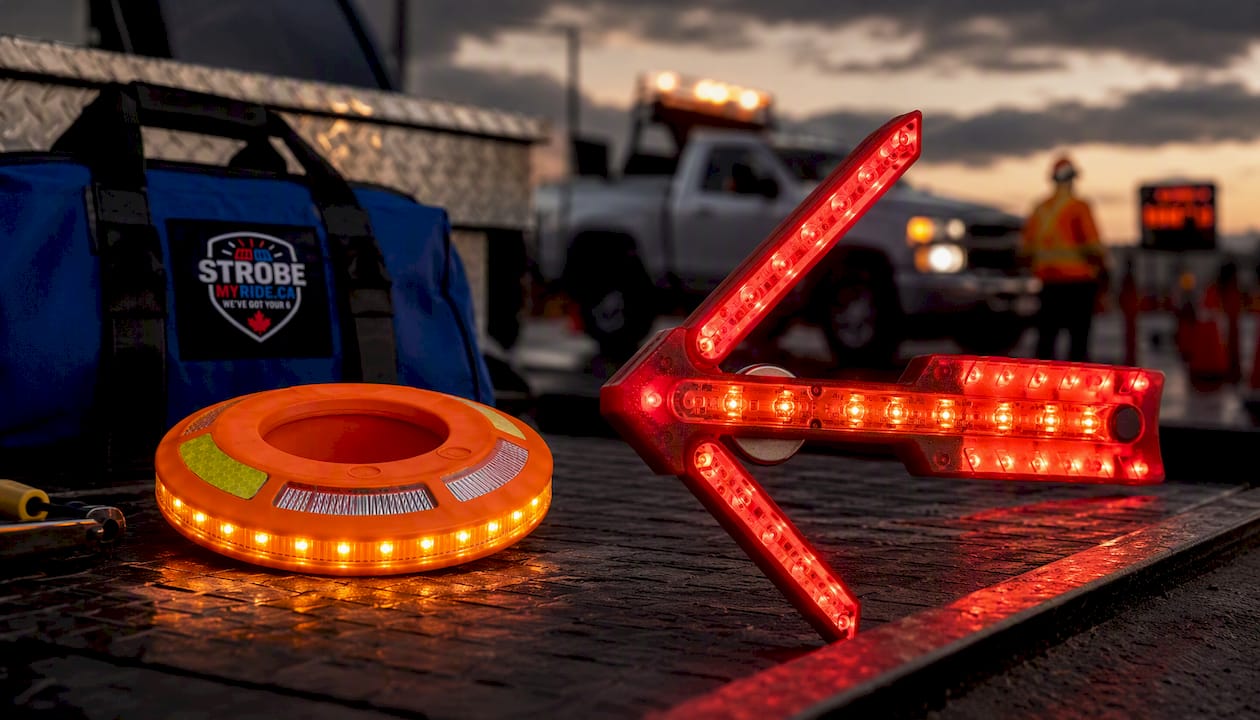
- Signal Flare 360: 360° amber visibility, magnetic mount, rechargeable. Order directly from the product page; fleet and bulk pricing available on request.
- Signal Arrow Rapid Deploy: Foldable directional arrow, magnetic mount, rechargeable. Ideal for tow trucks, pilot cars, and any lane-control application.
- Warranty and support: Industry warranty coverage, fast Canadian shipping, and a technical support team that can answer specification and compliance questions before you order.
Contact Strobe My Ride directly to request fleet pricing, specification sheets, or guidance on which unit fits your vehicle class and provincial requirements.
Sources
Before deploying any portable beacon on public roads, verify legality and technical suitability against primary sources. Keep jurisdiction names and documentation with your procurement records for audit purposes.
- Commercial vehicle safety
- Ontario
- Optical Warning Devices for Authorized Emergency, Maintenance, and Service Vehicles (SAE J845)
- Vehicle Warning Lights Regulations - Motor Vehicle Act (Nova Scotia)
- In a Vehicle With Flashing or Rotating Lights - SAAQ
Recommended
- LED Beacons for Work Trucks and Fleets | Strobe My Ride – Strobe My Ride
- Warning beacon for Canadian fleets: 2026 buying guide | Strobe My Ride – Strobe My Ride
- How to Wire Work Beacons on Fleet Vehicles | Strobe My Ride – Strobe My Ride
- Fleet Beacon Equip – Amber LED Equipment Beacon Canada | Strobe My Ride – Strobe My Ride


